
What You Are Really Choosing Between After a House Fire
A homeowner in Burbank reached out to us after a garage fire that spread into two rooms of her house. The damage estimate from the contractor her insurance company sent over was $86,000. Her insurer was moving slowly on the claim. Her mortgage payments were still due. And she had already moved into a rental because she could not live in the property. Every month she waited, she was paying rent and a mortgage at the same time with no end in sight.
The choice she actually faced was not just about the money. It was about time, certainty, and what kind of process she wanted to spend the next six months managing. That is the real decision most homeowners face after a fire. Whether to wait out the insurance payout process, use those funds to repair and then sell, or skip the whole thing and take a cash sale from a buyer who handles the project themselves.
This post walks through exactly how to think about that choice, what the insurance process actually delivers, and when a cash sale makes more financial sense than waiting.
How California Fire Insurance Payouts Actually Work
Most homeowners discover that their insurance policy covers less than they expected, or takes longer to pay out than they planned. California insurance law gives carriers specific timelines to respond and investigate, but the process is rarely quick or simple.
Under California law, there are two main types of coverage that affect how much your insurer will pay for fire damage. The first is Actual Cash Value (ACV), which means the payout equals the replacement cost of the damaged item minus depreciation based on its age and condition. If your twenty-year-old roof burned, you are not getting a brand-new roof in value. You are getting what a twenty-year-old roof in your market is worth, which is often considerably less. The second is Replacement Cost Coverage, which pays what it actually costs to repair or rebuild without subtracting for depreciation. According to California wildfire insurance guidance from Kantor and Kantor LLP, even with replacement cost coverage, initial payouts are often made at actual cash value with the remaining balance, called the holdback, released only after repairs are completed and documented.
This holdback structure is important to understand. Your insurer may cut you a check for a portion of the damage right away and hold the rest until you show receipts proving the work is done. That means you cannot simply take the insurance money and use it as a down payment on a new home or to pay off debts without completing the repairs first.
The True Cost of Repairing and Then Selling
If you decide to use your insurance payout to repair the home and then sell it on the open market, the financial picture looks better on paper than it often does in practice.
Fire repair costs in California range significantly based on the severity and type of damage. Minor cosmetic fire and smoke damage might cost $10,000 to $25,000 to address. Moderate structural damage can run $25,000 to $80,000. Extensive fire damage involving roof systems, walls, flooring, and HVAC can push $100,000 to $250,000 or more in California’s high-labor-cost market. And that is if the insurance payout fully covers the work, which it frequently does not.
Here are the real-world complications most sellers do not anticipate when choosing the repair-and-sell path:
- Gap between payout and actual repair cost. Contractors routinely find more damage once work begins. Insurance adjusters often use low estimates. The difference comes out of your pocket.
- Permit and inspection timeline. All fire repair work must be permitted in California. Getting permits approved and inspections passed can add months to the timeline.
- Carrying costs during repair. If you have a mortgage and cannot live in the home during construction, you are paying both your mortgage and temporary housing while work drags on.
- Stigma after sale. Even a fully repaired fire-damaged home often sells for 10 to 20 percent less than comparable undamaged homes because buyers worry about hidden smoke damage, structural concerns, and insurance history.
- Lender and insurance complications. Your mortgage lender has an interest in fire insurance proceeds. Checks may be made payable jointly to you and your lender. Some lenders hold funds in escrow and release them in stages as repairs are completed.
What a Cash Sale Actually Looks Like for a Fire-Damaged Property
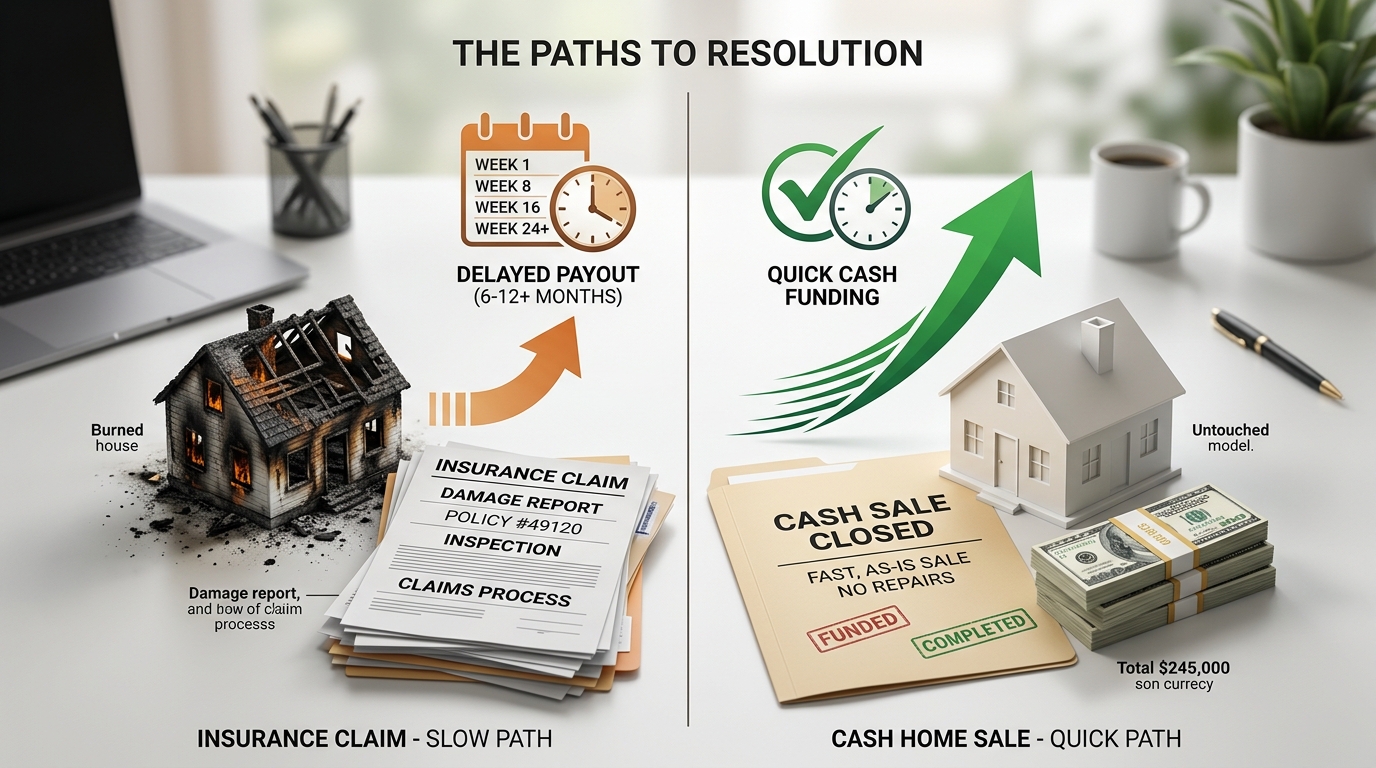
Selling to a cash buyer after a fire is a completely different experience from the repair-and-sell path. Cash buyers who specialize in distressed properties are not scared by fire damage. They walk through, assess the scope of work, factor it into their offer, and close fast.
How Cash Buyers Price Fire-Damaged Homes
An experienced cash buyer evaluates a fire-damaged property by starting with the after-repair value, meaning what the home would sell for once fully restored, and then subtracting their estimated repair cost, holding costs during renovation, and their profit margin. The offer reflects all of that math.
If a home would be worth $700,000 fully restored and repairs are estimated at $120,000, a cash buyer might offer somewhere in the range of $500,000 to $560,000 depending on their cost of capital, the local market, and how certain the repair estimate is. That is a real discount from full market value, but you receive it in days rather than months and you do not have to manage the renovation project yourself.
One important point that many sellers do not know: in many situations, you can still keep your insurance payout and also sell to a cash buyer. According to guidance from United Policyholders, a consumer advocacy organization for insurance claimants, your insurance claim is not automatically terminated if you sell before completing repairs. Whether you retain the payout or assign the claim to the buyer depends on your policy terms, your mortgage situation, and how the sale is structured. This is worth discussing with your insurance professional and real estate attorney before you sign anything.
Can You Sell While the Insurance Claim Is Still Open
Yes, and this happens more often than most people realize. You do not have to wait for your claim to fully settle before selling. Many cash buyers are comfortable purchasing a property with an open insurance claim, especially if the situation is clearly documented. The key is transparency. Tell the buyer exactly what the claim status is, what documentation you have, and what you expect the eventual payout to be.
California law requires you to disclose all known material facts about the property on the Transfer Disclosure Statement, which includes the fire damage, the extent of that damage, and the status of any insurance claim. Hiding it is not just unethical, it exposes you to serious post-sale legal liability. Be upfront, document everything, and let the buyer factor the full picture into their offer.
If you are also dealing with mortgage issues alongside fire damage, our post on selling a house with a Notice of Default filed in LA County covers the overlapping complications that often arise when a property has both fire damage and financial distress at the same time.
Side-by-Side Comparison of Both Paths
Here is how the two main options compare across the factors that matter most to fire-damaged property sellers.
| Factor | Use Insurance Payout to Repair and Sell | Sell As-Is to a Cash Buyer |
|---|---|---|
| Timeline to Close | 6 to 18 months or more | 7 to 21 days |
| Sale Price | Closer to market value (minus stigma discount) | Discounted but immediate and certain |
| Insurance Payout | Used for repairs (holdback released after work) | Possibly retainable depending on policy and structure |
| Carrying Costs During Process | High (dual housing, ongoing mortgage) | None after close |
| Risk of Cost Overrun | High (hidden damage found during work) | None, buyer assumes that risk |
| Stress Level | Very high (contractors, permits, insurer) | Very low |
Neither path is automatically wrong. If your home has minor fire damage, your insurance is cooperating, and you have the time and resources to manage a renovation, the repair-and-sell route can recover more value. But if the damage is significant, the insurance process is dragging, or you simply do not want to spend the next year managing contractors and paperwork, a cash sale is a legitimate and financially sensible alternative.
Our team buys fire-damaged properties throughout Los Angeles and Southern California. If you want to understand what a direct offer would look like for your specific situation, reach out through our Contact Us page for a no-obligation cash offer.
Key Steps No Matter Which Path You Choose
Regardless of whether you decide to repair or sell as-is, there are steps every fire-damaged property owner should take before making any major decisions.
Document Everything Immediately
Take photos and videos of all damage before any cleanup or temporary repairs begin. Keep every receipt for any emergency board-up or tarping work. Get a copy of the official fire department report, which confirms the cause, date, and severity of the fire. Request a copy of your insurance adjuster’s inspection report once it is completed. This documentation protects you whether you are pursuing an insurance claim, selling to a cash buyer, or doing both.
According to the California Department of Insurance wildfire resources page, documenting your losses thoroughly from the start is one of the most important steps a homeowner can take after a fire to protect their claim and their legal rights during the sale process.
Get an Independent Contractor Assessment
Your insurance company will send their own adjuster, but their estimate is not always in your favor. Getting two or three independent contractor quotes for full fire restoration gives you a realistic picture of what repair actually costs and gives you leverage when negotiating with the insurer or when evaluating offers from buyers. Without these numbers, you are guessing.
If you are also thinking through related property issues like title or ownership complications that sometimes arise from fire situations, our guide on how to remove a cloud on your title before selling your LA home covers steps that may apply alongside the fire damage process.
And to see which cities and areas we buy fire-damaged and distressed properties in, visit our Locations page for a full coverage map across Southern California.
Conclusion
Selling a fire-damaged property is one of the most complicated real estate decisions a homeowner can face. The insurance process is slow, the repair path is expensive and uncertain, and the market for damaged homes is narrower than most sellers expect.
The right answer depends on your personal situation. If you have full replacement cost coverage, a cooperative insurer, time to manage the process, and a property in a strong market, repairing first can recover more value. If your timeline is tight, your insurance is underpaying, or you simply want out, a cash sale offers certainty and speed at a known cost.
Know your options before you commit to either path, and talk to an insurance professional and a real estate attorney before you sign anything or make any irreversible decisions about your claim.
Frequently Asked Questions
Can I keep my insurance payout if I sell the fire-damaged house as-is?
In many cases, yes, though it depends on your specific policy and your mortgage situation. If you have a mortgage, your lender is typically named on insurance checks and may require their interest to be addressed in any claim settlement. If there is no mortgage, you may have more flexibility. Whether you retain the payout or assign it to the buyer depends on how the sale and claim are structured. Always work with your insurance professional, real estate attorney, and lender before making this decision to make sure the arrangement is documented properly and compliant with your policy terms.
Does California law require me to disclose fire damage when selling a house?
Yes. California requires sellers to disclose all known material facts that could affect the value or desirability of the property on the Transfer Disclosure Statement under Civil Code Section 1102. Fire damage, smoke damage, structural issues caused by fire, and the status of any open insurance claim all qualify as material facts. Selling as-is does not exempt you from disclosure. Failing to disclose known fire damage can result in post-sale legal claims from the buyer.
How much below market value will I typically get for a fire-damaged home in California?
This varies based on the severity of damage, local market conditions, and the buyer type. Cash investors and real estate buyers typically offer between 20 and 50 percent below the property’s fully restored market value, with the discount reflecting estimated repair costs plus their holding costs and profit margin. Properties with moderate damage in high-value markets tend to see smaller discounts than severely damaged properties in slower markets. Getting two or three offers and having independent contractor repair estimates gives you the best basis for evaluating any offer you receive.
What is the difference between Actual Cash Value and Replacement Cost Coverage for fire damage?
Actual Cash Value (ACV) pays you the replacement cost of the damaged property minus depreciation based on its age and condition. This can result in significantly less money than what repairs actually cost, especially for older homes. Replacement Cost Coverage pays the actual cost to repair or rebuild to the same or equivalent condition without subtracting for depreciation. Most policies with replacement cost coverage still issue an initial payment at actual cash value and hold the difference, called the holdback, until repairs are completed and documented. Review your specific policy carefully to understand which type of coverage you have.
Can I sell a fire-damaged house before the insurance claim settles?
Yes. You do not have to wait for the insurance claim to fully settle before selling your property. Many sellers choose to sell while a claim is still open, especially when a cash buyer is involved. The important steps are to notify your insurance carrier about the planned sale, document everything, and be fully transparent with any potential buyer about the claim status. How the insurance proceeds are ultimately paid, and to whom, depends on your policy terms, any mortgage on the property, and how the sale is structured. An insurance professional and real estate attorney can help ensure the arrangement is done correctly.