
Most Los Angeles sellers never think about their title until they are already in escrow. Then the preliminary title report comes back with something unexpected on it and the transaction suddenly stalls. A cloud on title is one of the most common reasons a sale gets delayed or derailed, and it is also one of the most preventable problems if sellers know what to look for and how to address it before the property ever goes under contract. This post explains what a cloud on title actually is, what causes them, and how to get yours cleared so your sale can move forward without surprises.
What a Cloud on Title Actually Means
The Definition and Why It Blocks a Sale
A cloud on title is any outstanding claim, encumbrance, or defect in the recorded history of a property that casts doubt on the seller’s ability to convey clear, marketable ownership to a buyer. The California Department of Real Estate defines it as any outstanding encumbrance or claim that, if valid, affects or impairs the property owner’s title and prevents them from selling or transferring marketable title to others.
The reason a cloud on title is such a problem for sellers is straightforward. Title insurance companies will not insure a transaction when there is an active cloud. Lenders will not fund a buyer’s mortgage if the title cannot be insured. And most buyers, financed or otherwise, are unwilling to take ownership of a property when there is unresolved doubt about who actually has the legal right to sell it. The cloud does not disappear after the sale closes, either. It stays attached to the property and passes to the new owner, which is exactly why buyers walk away from clouded titles rather than inherit them.
When a Cloud Shows Up and How It Gets Discovered
Clouds on title are discovered during a title search, which typically happens shortly after a purchase agreement is signed and escrow is opened. The title company searches county land records, court filings, and the grantor-grantee index going back through the entire chain of ownership. Anything that was ever recorded against the property, whether it was addressed or not, will surface in that search. Many sellers are genuinely surprised by what shows up, especially on properties that have been owned for decades or that passed through an estate.
Our post on why we request a title report immediately and why it protects you explains why ordering the title report at the very start of the transaction, rather than waiting, is one of the most important things a cash buyer can do to protect both parties. The sooner a cloud is identified, the more time there is to resolve it before the closing date.
The Most Common Causes of a Cloud on Title in Los Angeles
Liens That Were Never Properly Released
The most common cloud on title in California is an unpaid or unreleased lien. This includes mortgages that were paid off years ago but where no deed of reconveyance was ever recorded, mechanic’s liens from contractors who were paid but never filed a release, property tax liens from missed payments, HOA liens for unpaid dues, and judgment liens from old lawsuits where a creditor recorded an abstract of judgment against the owner. The debt may have been paid in full years ago, but if the release or satisfaction was never recorded with the county, the lien still appears on title as if it were active.
Resolving an unreleased lien requires locating the original lienholder, obtaining a recorded release or satisfaction document, and filing it with the county recorder’s office. In cases where the lienholder is no longer in business or cannot be located, a quiet title action through the court may be necessary. Our post on how we handle liens and judgments during a sale covers the full process of how liens are identified and resolved through escrow.
A Lis Pendens Filed in Connection With a Lawsuit
A lis pendens is a recorded notice that a lawsuit is pending that may affect title to or possession of a property. Once a lis pendens is recorded with the county recorder, it creates a cloud that makes the property virtually impossible to finance, refinance, or sell until the underlying lawsuit is resolved. Any prospective buyer who discovers a lis pendens during a title search is on legal notice that they could acquire a property whose ownership or rights are actively being disputed in court.
Removing a lis pendens requires either resolving the underlying lawsuit or successfully petitioning the court to expunge it. In California, a party can move to expunge a lis pendens by showing the court that the claimant cannot establish the probable validity of the real property claim. Until the lis pendens is removed or expunged, the cloud remains and no title company will insure the transaction.
Errors in the Chain of Ownership or Deed Defects
Some clouds are not the result of unpaid debt or litigation. They arise from technical errors in how ownership was transferred at some point in the property’s history. Examples include a deed that was never recorded after a sale, a deed signed by only one spouse when both were required, an heir who failed to sign when a property was transferred through an estate, a misspelled name that creates ambiguity about whether the current owner is the same person as the recorded grantee, and boundary description errors that leave it unclear exactly what land was transferred.
These defects can be from the current owner’s transaction or from any prior transaction in the chain going back decades. Deed errors that are caught early can often be corrected through a corrective deed signed by the relevant parties. Errors involving missing signatures from heirs, former spouses, or co-owners who cannot be located may require a quiet title action to resolve.
How Each Type of Cloud Gets Resolved
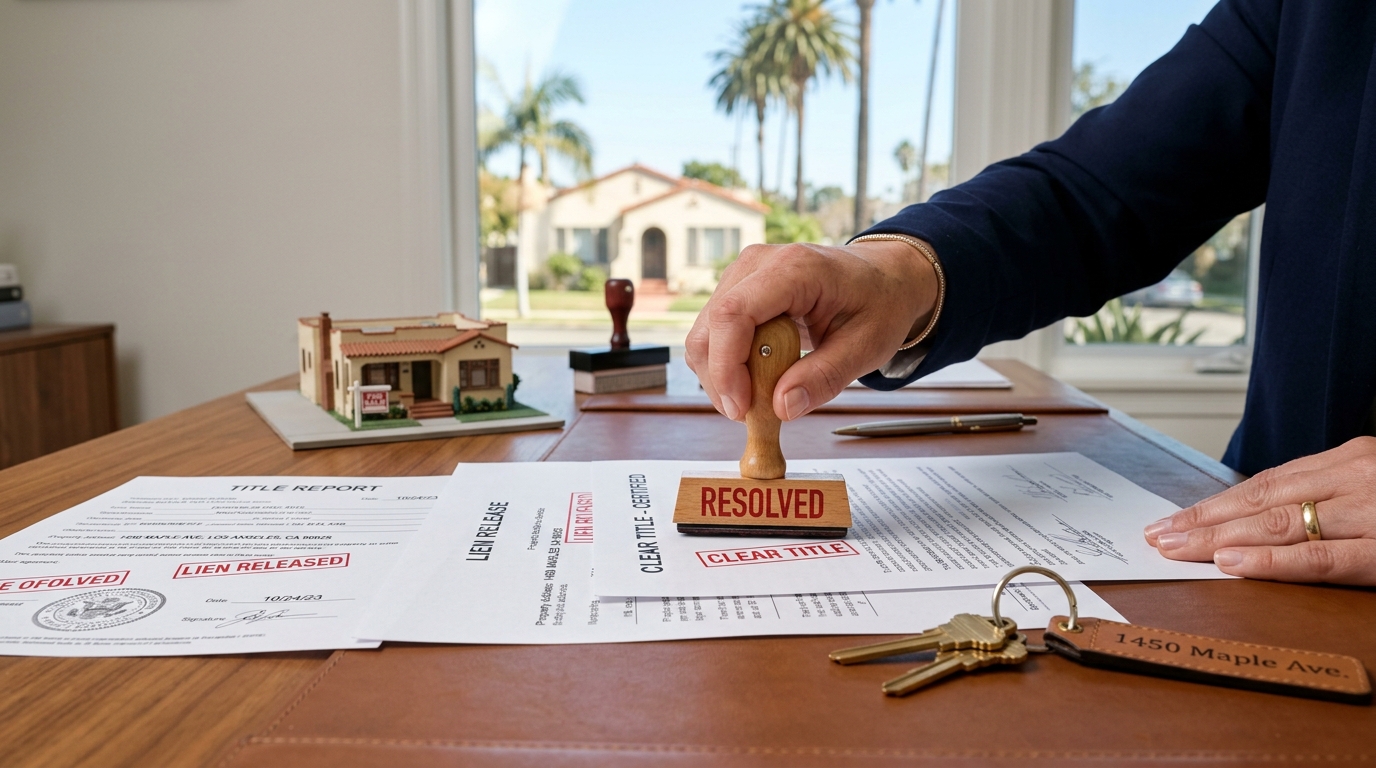
The Main Tools for Clearing Title in California
Here is a straightforward breakdown of the most common cloud types and how they are typically cleared:
| Type of Cloud | How It Is Typically Removed | Who Handles It |
|---|---|---|
| Paid-off lien with no recorded release | Obtain and record a deed of reconveyance, satisfaction of judgment, or lien release | Lienholder files release; escrow coordinates |
| Active unpaid lien | Pay off through escrow proceeds at closing | Escrow officer disburses proceeds to lienholder |
| Lis pendens from active lawsuit | Resolve the underlying lawsuit or petition court to expunge | Attorney handles court proceedings |
| Missing heir or co-owner signature | Locate the party and obtain a quitclaim deed, or file quiet title action | Real estate attorney |
| Deed error or incorrect description | Record a corrective deed signed by original grantor | Real estate attorney drafts; parties sign |
| Forged deed in the chain | Quiet title action through the court | Real estate litigation attorney |
| Open permit never closed | Complete and finalize the permit with the city or county | Owner or contractor coordinates with building department |
What a Quiet Title Action Is and When You Need One
A quiet title action is a lawsuit filed in California Superior Court in which a property owner asks the court to declare their ownership rights and clear any competing claims or defects from the title record. California uses the quiet title process to resolve the full range of competing interests in real property, including disputed ownership, easements, liens that cannot be resolved outside of court, and defects in the chain of title going back multiple prior owners.
A quiet title action is not required for most clouds. Many common issues, such as an unreleased lien where the lienholder is known and cooperative, or a simple deed error, can be resolved without going to court. But when the party who needs to sign a release or corrective deed cannot be located, refuses to cooperate, or no longer exists as a legal entity, a quiet title action may be the only path available. These cases require a real estate attorney and can take several months to conclude.
Steps Los Angeles Sellers Should Take Before Listing
How to Get Ahead of Title Problems Before They Stall Your Sale
The best time to discover and resolve a cloud on title is before you accept an offer, not after. Sellers who identify title issues in advance can address them on their own schedule rather than scrambling to clear them while a buyer waits and a closing deadline approaches. Here is what Los Angeles sellers can do proactively:
- Order a preliminary title report before listing the property. A title company can run a search and produce a report showing everything recorded against the property, giving you time to address any issues before going under contract
- Review your original purchase documents to confirm that a deed of reconveyance or lien release was recorded when you paid off any prior mortgage
- Check county records online or through the county recorder’s office to confirm that no old judgments, tax liens, or HOA liens are still showing as active against the property
- If the property was inherited or transferred through an estate, confirm that all required signatures and recordings were completed properly at the time of transfer
- If you have had any contractor disputes, unpermitted work, or open permits on the property, verify the current status with the relevant city or county building department
- Consult a real estate attorney if anything in your property’s ownership history is unclear or if you suspect a prior deed was not properly executed
Our sell your property page explains how we approach the title process as a cash buyer and why ordering the title report immediately after opening escrow is a standard part of how we protect sellers through closing. And if you have a specific title question or want to talk through whether a cloud on your property can be resolved before listing, reach out to our team and we will give you a direct, honest answer.
Conclusion
A cloud on title does not have to end a sale, but it almost always delays one if it is discovered mid-transaction. Understanding what creates a cloud, knowing how to identify one before you list, and acting early to resolve whatever shows up puts you in a far better position than most sellers who only find out there is a problem after a buyer is already waiting. For Los Angeles homeowners who want to avoid that scenario entirely, getting a preliminary title report before anything else is one of the simplest and most valuable steps you can take.
Frequently Asked Questions
What is the most common type of cloud on title in California?
The most common cloud is an unreleased lien, typically a mortgage that was paid off but where no deed of reconveyance was recorded, or a judgment lien from an old lawsuit. These appear on title as active obligations even if the underlying debt was resolved years ago. The fix usually involves locating the original lienholder and recording a release or satisfaction document with the county recorder.
Can I sell my home with a cloud on the title?
It is very difficult to sell through traditional channels with an active cloud because title insurance companies will not insure the transaction and lenders will not fund a buyer’s mortgage. Some cash buyers are willing to purchase properties with certain clouds if the issue can be resolved through escrow as part of the closing process, but the specifics depend on the nature and severity of the cloud. The best approach is to identify and resolve title issues before listing whenever possible.
How long does it take to clear a cloud on title in California?
Simple issues like an unreleased lien with a cooperative lienholder can be resolved in days to weeks. More complex issues, such as a missing heir who needs to sign a quitclaim deed or a lis pendens tied to active litigation, can take months. Quiet title actions, which require court proceedings, typically take three to six months or longer depending on how contested the matter is.
What is a quiet title action and do I need one?
A quiet title action is a lawsuit filed in California Superior Court to legally establish clear ownership and remove competing claims from the title record. You need one when a cloud cannot be resolved by simply obtaining a release or corrective deed, such as when the lienholder cannot be located, refuses to cooperate, or when ownership of the property is genuinely in dispute. Most common clouds do not require a quiet title action and can be resolved through paperwork and recordings.
Will a cash buyer purchase a home that has a cloud on the title?
It depends on the type of cloud. Many liens and judgment clouds can be resolved through the escrow process, with the title company coordinating payoffs and releases before closing. A cash buyer who is experienced with these situations can often work through clouds that would stop a financed buyer cold. Clouds that involve active litigation, disputed ownership, or a quiet title action in progress are more difficult and require legal resolution before any buyer can close. If you have a cloud on your title and want to understand whether a cash sale is still an option, reaching out directly is the fastest way to get a real answer.