
If you have decided to sell your home for cash, you still have one big decision ahead of you. Do you go with a local buyer who knows your neighborhood, or do you call up one of those big national firms you see advertised everywhere? It sounds like a small choice, but it can change your entire experience and the amount of money you actually walk away with. Let me break this down in plain terms so you can make the right call for your situation.
What Is a National Cash Buyer or iBuyer
A national cash buyer, also called an iBuyer, is a large company that buys homes in many cities across the country using a tech-driven process. You go to their website, you type in your address, and within minutes or hours you get a preliminary offer generated by an algorithm. Companies like Opendoor and Offerpad operate this way.
According to the National Association of Realtors, these companies are often backed by venture capital or Wall Street funds, and they buy homes to either rent them out or flip them on the open market after light renovation. The process is designed to be fast and digital from start to finish.
The appeal is real. You do not have to stage your home or deal with showings. You just get an offer online. But what sounds easy upfront does not always work out the way sellers expect once the details come through.
What Is a Local Cash Buyer
A local cash buyer is usually a small real estate company or individual investor who operates in a specific market. They know the neighborhoods, they know the streets, and they have often bought homes in your zip code before. They do not rely on a national algorithm to figure out what your house is worth. They look at it with their own eyes and make an offer based on what they actually know about your area.
Working with a local buyer feels very different from working with a national platform. There is a real person involved. You can call them directly. They have a track record in your community. And because they are not juggling thousands of transactions across 25 states, they can give your sale real attention.
If you want to see what that kind of experience looks like, you can visit Buy Your Properties and get a feel for how a local LA cash buyer actually works with homeowners.
The Real Differences Between Local and National Buyers
How Offers Are Generated
This is where the gap starts. A national firm uses data models to price your home. These models pull from recent sales data, square footage, school ratings, and other inputs. The problem is that these models are built for averages. They do not know that your block gets more sun than the next one. They do not factor in the neighbor who renovated their yard and lifted the whole street’s feel. They do not know your home the way someone who has actually walked it does.
I have seen homeowners in Los Angeles get an iBuyer offer that felt surprisingly low, and when they asked why, the company pointed to comparable sales from a nearby zip code that was nothing like their actual neighborhood. That kind of mistake does not happen with a local buyer who has spent years working in that specific area.
A local buyer will walk your home. They will look at the condition, the location, the lot, and the upgrades you made. Their offer reflects reality rather than a model built to work across dozens of different markets at the same time.
Fees and What You Actually Keep
National iBuyers often advertise a quick, easy process. What they sometimes do not mention upfront is the fee structure. According to Bankrate, major iBuyers like Opendoor charge a service fee of up to 5% of the home’s sale price, on top of repair costs and other deductions that come after the walkthrough. Offerpad can charge between 5% and 8% in service fees alone. These are fees that eat directly into your net proceeds.
A local cash buyer typically charges no service fees. They make their money by buying the home at a price that works for them and reselling later. There are no hidden deductions after the walkthrough in most cases. What you see in the offer is very close to what you get at closing. That transparency matters a lot, especially when you are counting on a specific number to fund your next move.
We have written a helpful piece about why a high Zillow price can leave you with less money at closing, which covers some of the same surprises sellers face when the numbers do not add up the way they expected.
Side by Side Comparison of Local vs National Cash Buyers
The Key Differences at a Glance
Here is a straightforward comparison to help you see where each type of buyer stands:
| Factor | Local Cash Buyer | National iBuyer or Wall Street Firm |
|---|---|---|
| Offer Method | In-person walkthrough, local market knowledge | Algorithm-based, often online only |
| Service Fees | Usually none | 5% to 8% plus repair costs |
| Offer Accuracy | High, based on real local data | Can miss neighborhood-specific factors |
| Post-Walkthrough Changes | Rare, offer is usually firm | Common, offer often drops after inspection |
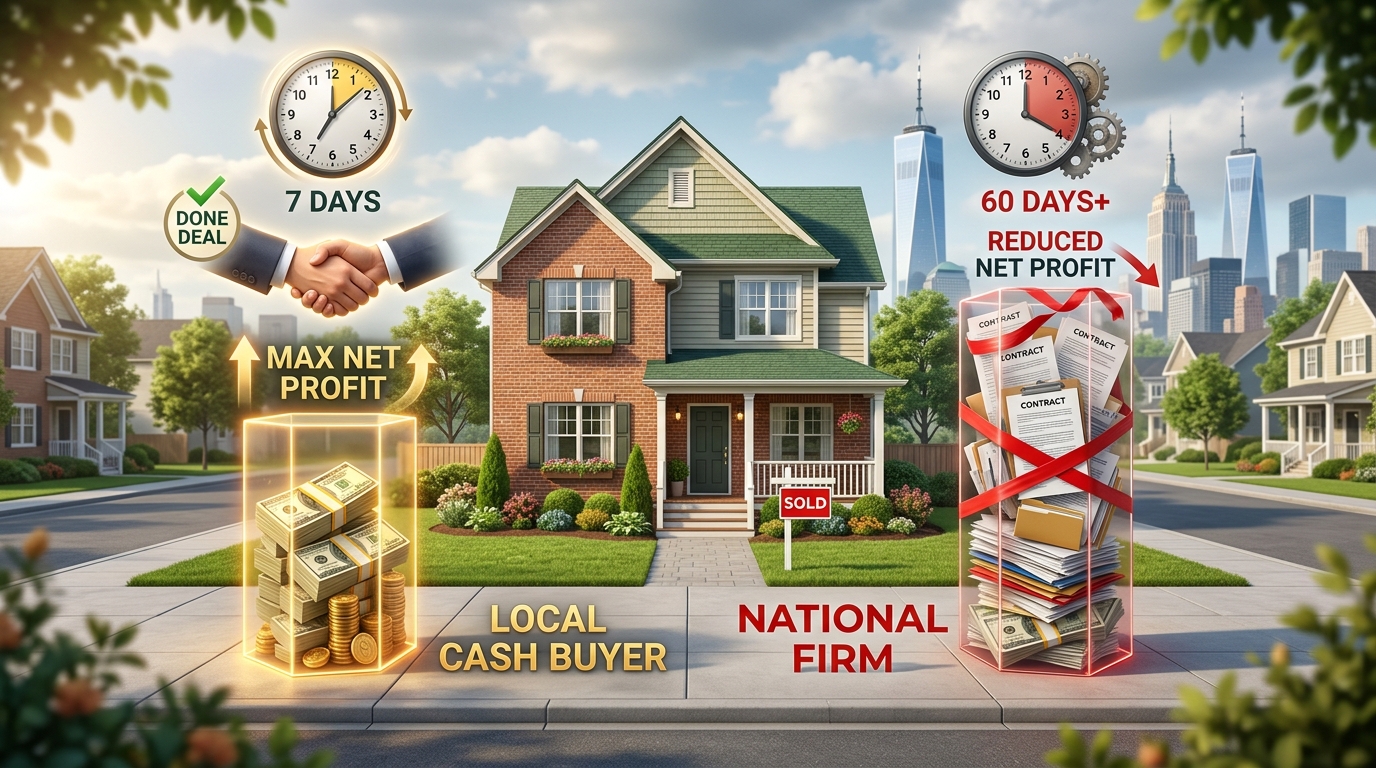
| Closing Timeline | 7 to 14 days, flexible | 8 to 90 days depending on company |
| Personal Communication | Direct, real person available | Often handled through apps or call centers |
| Local Market Expertise | Strong, neighborhood-specific | General, based on city-level data |
What Happens After the Walkthrough
One thing a lot of sellers do not realize until it is too late is that the number a national firm gives you upfront is almost never the final number. After the walkthrough, many iBuyers come back with repair deductions that reduce the original offer by thousands of dollars. Sellers have reported cases where the offer dropped by $20,000 or more after the initial number looked promising.
A local buyer is typically more straightforward about this. If they say they will buy your home for a certain price, that number tends to hold. They have already factored in the condition of the property before making the offer. There is no bait-and-switch process where the number shrinks after you have already said yes and started making plans.
When a National Firm Might Actually Work for You
Specific Situations Where iBuyers Have an Edge
Honestly, national firms can work well in certain situations. If your home is newer, in great condition, and in a city where the iBuyer has a strong presence, their offer can be competitive. Their digital process is very convenient if you are out of state or simply do not want anyone walking through your home multiple times.
Here are a few situations where a national buyer might be worth considering:
- Your home is in move-in ready condition and does not need any repairs that would trigger large deductions after the inspection.
- You are comfortable with a fully digital process and do not need personal communication throughout the sale.
- The iBuyer has strong coverage in your specific market and their pricing data is accurate for your neighborhood.
- You want a longer, flexible closing window and the national company can accommodate your specific move-out timeline.
- You want to compare multiple offers side by side from different sources before making a decision.
That said, in a market like Los Angeles, where neighborhood conditions can change dramatically block by block, many sellers find that a local buyer ends up being a better fit. The personalized approach and absence of service fees often makes the local option the smarter financial decision even if the headline number looks slightly lower.
Why Local Knowledge Wins in Markets Like LA
Los Angeles is not one housing market. It is hundreds of small markets layered on top of each other. A home in Silver Lake and a home in Reseda are both in LA, but they are completely different in terms of demand, pricing, and what buyers will pay. A national algorithm trained on city-wide data will average these out. A local buyer will treat them completely differently.
According to a 2025 market update from Norada Real Estate Investments, the Los Angeles housing market is made up of highly distinct micro-markets where inventory, pricing, and buyer competition vary significantly by neighborhood. A pricing model that works well in one part of the city can produce a wildly inaccurate number just a few miles away.
This is why sellers in LA who have worked with both types of buyers often say that the local buyer felt more trustworthy and more connected to what their home was actually worth.
How to Decide Which Option Is Right for You
Questions to Ask Before Choosing
Before you pick a buyer, it helps to think through your own priorities. What matters most to you in this sale? Is it speed, net proceeds, simplicity, or flexibility? The answers will point you in a clear direction.
If you care most about net proceeds and want someone who knows your neighborhood inside and out, a local cash buyer is almost always the better call. If convenience and a fully digital process matter most to you and your home fits the iBuyer criteria, a national firm may be worth getting a quote from as a comparison point.
Either way, do not accept the first offer you get without doing some homework. Get more than one quote. Read the fine print. Ask what happens after the walkthrough. And make sure you understand every fee that will come out of your final number before you sign anything.
You might also find it helpful to read about how a cash sale compares to an insurance payout when selling a fire-damaged property, which shows another real-world scenario where the type of buyer makes a significant difference.
Why Sellers in LA Keep Choosing Local
Time and again, homeowners in Los Angeles come back to local buyers for one simple reason. They want to talk to a real person who understands their street, their neighborhood, and their specific situation. They do not want to feel like a transaction being processed by a call center somewhere across the country.
A local buyer like Buy Your Properties is here in Los Angeles. We buy homes as-is, we make firm offers, and we close on a timeline that works for you. No service fees, no algorithm surprises, and no lowball offers after a walkthrough. If you are ready to find out what your home could bring with a local cash offer, reach out to us here and we will get back to you quickly with no pressure and no obligation.
Conclusion
Choosing between a local cash buyer and a national firm comes down to what you value most. National iBuyers offer a slick digital process, but they come with fees that reduce your take-home pay and offers that can change after the walkthrough. Local buyers bring real neighborhood knowledge, transparent pricing, and a personal experience that most sellers find far less stressful. In a market as unique as Los Angeles, that local expertise is not just a nice bonus. It is a real advantage that shows up in the final number you walk away with.
Frequently Asked Questions
What is the main difference between a local cash buyer and a national iBuyer?
A local cash buyer knows your neighborhood personally and makes offers based on real on-the-ground knowledge. A national iBuyer uses an automated system to price homes across many cities at once. Local buyers usually charge no service fees, while national firms often deduct 5% to 8% or more from the final offer.
Will a national iBuyer offer change after the walkthrough?
Yes, in many cases it does. National iBuyers often lower their initial offer after their team inspects the property and identifies repair costs. These post-walkthrough deductions can reduce the final number by thousands of dollars compared to what the seller originally expected.
Is a local cash buyer safer than a national firm?
In most cases, yes. A local buyer has a reputation to protect in your community. You can verify their track record by checking local reviews, asking for proof of past closings, and talking directly to someone who works there. National firms can be less transparent about how their offers are structured and what deductions will apply.
How long does it take to close with a local cash buyer vs a national firm?
A local cash buyer can typically close in 7 to 14 days once you accept the offer. National firms vary widely, with some offering closings in as little as 8 days and others offering windows up to 90 days. The key difference is that a local buyer will often work around your preferred timeline rather than fitting you into their schedule.
Should I get multiple offers before choosing a cash buyer?
Yes, always. Whether you are leaning toward a local buyer or a national firm, getting more than one offer gives you leverage and helps you understand what your home is actually worth on the current market. Comparing offers side by side also makes it easier to spot hidden fees or terms that are not in your favor before you commit.