
Selling a home in the traditional way sounds manageable until you are actually in the middle of it. Then the questions start piling up. Which agent do I hire? What price do I list at? Do I make repairs before listing? How do I handle the showings? What if the offer is too low? Should I counter? Every single one of these feels huge in the moment, and the decisions never stop. That steady draining of your mental energy has a name: decision fatigue. And it is quietly responsible for a huge portion of the frustration and mistakes that happen during a traditional home sale.
What Decision Fatigue Actually Is
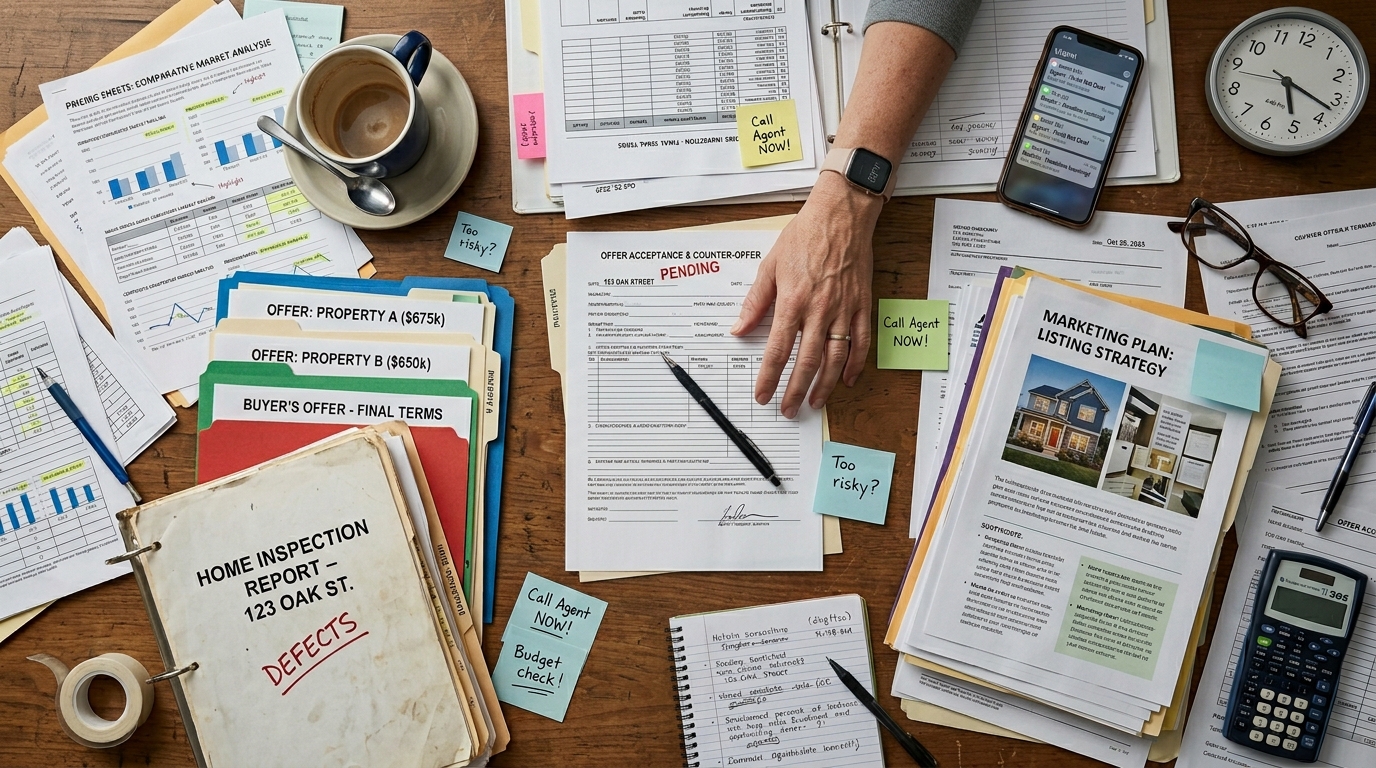
Your Brain Has a Daily Budget for Decisions
Your brain can only make a certain number of good decisions in a day before the quality of those decisions starts to drop. This is not a personal weakness. It is how the brain works. The more decisions you make, the more depleted your mental energy becomes. By the end of a long decision-heavy day, your brain looks for shortcuts. It either goes with whatever is easiest, or it delays the decision entirely and does nothing.
Real estate is one of the most decision-heavy processes a person can go through. Every day brings new questions. Every new question requires research, judgment, and trade-offs. Real estate professionals recognize this as decision paralysis, where sellers or buyers freeze up, become unable to commit, or make poor choices out of frustration. The classic sign is when someone accepts a significantly lower offer just because they are tired of waiting, or when they delay making any decision at all and the market moves past them.
The Traditional Home Sale Multiplies Every Decision
A traditional home sale is not just one or two big decisions. It is dozens of smaller ones that keep stacking up from the moment you decide to sell to the day you hand over the keys. And each one arrives before you have fully processed the last.
Think about what sellers face in a typical listing process. You choose an agent from multiple interviews. You decide on a listing price after reviewing comparable sales that may not feel all that comparable. You decide what repairs to make or skip. You decide how to respond to showing feedback. You decide how to respond to a lowball offer. You decide whether to accept a contingency. You decide on a closing date. And at every single stage, the stakes feel enormous because this is your home, your financial future, and often your ability to move into your next chapter.
How Decision Fatigue Costs Sellers Real Money
Tired Sellers Accept Worse Deals
There is a direct connection between how mentally exhausted a seller is and how good the deal they ultimately accept turns out to be. According to real estate analysis from Manausa Real Estate on seller fatigue, when sellers are tired and stressed, it becomes easier to overlook important aspects of the sale process. Vince Lombardi’s quote gets used a lot in this context: fatigue makes cowards of us all. In a real estate transaction, a fatigued seller is more likely to accept a lower offer out of frustration, miss a detail in the contract that costs them later, or stop negotiating when one more counter-offer might have gotten them significantly more money.
The longer your home sits on the market, the worse this gets. Extended days on market do not just affect the price perception among buyers. They wear down the seller. Every week that passes with no acceptable offer is another week of carrying costs, showing disruptions, and mounting stress. By the time a workable offer finally arrives, many sellers are so worn down that they grab it without fully evaluating whether it is actually the best they can do.
The Paradox of Too Many Choices
There is a well-documented psychological concept called the paradox of choice. Researchers have found that having more options does not always lead to better decisions. In fact, having too many choices often leads to worse ones, or to no decision at all. In real estate, this plays out in predictable ways.
When multiple offers come in at once, many sellers freeze instead of acting. When there are too many competing priorities, whether to price high and wait, or price to move fast, sellers often split the difference and end up with neither benefit. The abundance of information and choices that a traditional sale brings is one of its biggest hidden costs, not because the information is wrong, but because too much of it at once overwhelms the brain’s ability to process it effectively.
| Stage of Traditional Sale | Decision Required | Fatigue Risk |
|---|---|---|
| Pre-listing | Agent selection, pricing, repair decisions | Moderate. Many choices before anything starts |
| Active listing | Showing schedules, feedback responses, price adjustments | High. Continuous small decisions with no clear endpoint |
| Offer review | Which offer, which terms, whether to counter | Very high. High stakes with time pressure |
| Under contract | Inspection responses, appraisal gap, closing timeline | High. New problems arise unexpectedly |
What a Simplified Sale Process Does Differently
Fewer Choices, Faster Clarity
The antidote to decision fatigue in real estate is not making better decisions. It is making fewer of them. When the sale process is simpler, with a clear offer, a straightforward timeline, and fewer moving parts, sellers can focus their mental energy on the things that actually matter. There is no guessing about whether to reduce the price after week three. There is no agonizing over whether to accept a buyer’s contingency that might fall through. You get an offer, you evaluate it clearly, and you decide.
According to research on how the real estate decision burden affects sellers, one of the most consistently cited benefits of working with professionals who handle the process end to end is the relief of not having to manage every micro-decision yourself. When someone you trust is handling the showing coordination, the buyer communications, and the paperwork flow, you are freed up to make the big decisions well without being exhausted by the small ones first.
How to Protect Your Decision Quality During a Sale
Even if you are going through a traditional sale, there are things you can do to reduce the decision fatigue that comes with it. Some of these are practical. Some are just about being honest with yourself about when you need to step back and recharge before making a call.
- Define your non-negotiables before you list. Know your minimum acceptable price, your preferred closing timeline, and which contingencies you will and will not accept. Doing this work upfront removes a lot of in-the-moment decisions.
- Limit how often you check listing activity. Refreshing the listing every hour and reading every piece of feedback obsessively does not help. It just adds noise.
- Make important decisions in the morning when your mental energy is highest, not at night after a full day of work and life.
- Delegate decisions you do not need to own personally. Your agent should be handling the logistics, communication, and scheduling. If you are managing all of it yourself, the process is much harder than it needs to be.
- Give yourself a set time window for each decision. Unlimited deliberation time often leads to worse outcomes than a clear deadline.
According to Hawaii Life’s real estate guide on decision fatigue, it is better to have a few really good options than a ton of mediocre or poor options. That principle applies directly to how you approach a home sale. The goal is not to consider every possible path. The goal is to identify the best path given your situation and take it.
If you are already feeling the weight of a drawn-out traditional process and wondering whether there is a simpler path, our post on why a high listing price often leads to lower net proceeds can help you rethink whether the traditional approach is actually delivering what you hoped for. And our guide on how to sell your house and rent it back while you find a new home shows how flexible sale structures can remove one of the biggest stressors from the equation. When you are ready to talk through a simpler path, contact us here.
Conclusion
Decision fatigue is not talked about enough in the home-selling conversation. But it is real, it is measurable, and it costs sellers money and peace of mind every single day that a traditional sale drags on. The solution is not to push through and make more decisions. It is to reduce the number of decisions you have to make by simplifying the process, delegating what you can, and knowing your limits before they know you. A good sale is a clear one. And clarity comes easiest when the path in front of you is not filled with a hundred things to figure out before you can take the next step.
Frequently Asked Questions
What is decision fatigue in a home sale?
Decision fatigue is the mental exhaustion that comes from making too many choices over too long a period. In a traditional home sale, sellers face dozens of decisions across weeks or months. The quality of those decisions degrades as fatigue sets in, often leading to poor offers being accepted or important details being missed.
How does decision fatigue cost sellers money?
Fatigued sellers are more likely to accept below-market offers to end the stress, skip important negotiation steps because they are too tired to push back, and miss contract details that cost them later. Research from real estate professionals confirms that seller fatigue directly correlates with lower final sale prices.
What is the paradox of choice in real estate?
The paradox of choice is the psychological phenomenon where having too many options leads to worse decisions, not better ones. In real estate, an overload of competing priorities, offers with different terms, and endless feedback from showings can freeze sellers into inaction or push them toward choices they would not make with clearer heads.
What can sellers do to reduce decision fatigue during a sale?
Define your non-negotiables before listing so most decisions are already made. Delegate logistics to your agent. Make important decisions in the morning when mental energy is highest. Set time limits for each decision to avoid endless deliberation. And consider whether a simpler sale structure might remove many of the recurring decisions entirely.
Does a cash or direct sale really reduce decision fatigue?
Yes, significantly. A direct sale eliminates the staging decisions, showing disruptions, offer comparison complexity, and extended negotiation cycles that define a traditional listing. The process is much shorter and involves far fewer moving parts, which means far fewer decisions and a much lower fatigue burden for the seller.