
If you owe more on your home than it is worth, the idea of a deficiency judgment can feel like a punch to the gut. You already lost the house, and now the bank might come after your paycheck or bank account. That is a real fear, and it is one that keeps a lot of California homeowners up at night. The good news is that a direct sale can stop that from happening.
What Is a Mortgage Deficiency Judgment
When your home sells for less than what you owe on the mortgage, that gap is called a deficiency. For example, if your home sells at a foreclosure sale for $300,000 but you owe $360,000, the remaining $60,000 is the deficiency.
A deficiency judgment is a court order that makes you personally responsible for that remaining balance. The lender can then use that judgment to garnish your wages, freeze your bank accounts, or put a lien on other property you own. According to Nolo’s legal encyclopedia, a lender must file for a deficiency judgment within three months of the foreclosure sale in California.
### How California Law Protects You
California has strong anti-deficiency laws, and honestly, they are better than most states. Under California Code of Civil Procedure Section 580d, lenders cannot seek a deficiency judgment after a non-judicial foreclosure. Since the vast majority of California foreclosures are non-judicial, most homeowners here already have some built-in protection.
Under Section 580b, lenders also cannot pursue a deficiency on purchase money loans, meaning the original loan used to buy the home. This protection covers both first and second mortgages that were part of the original purchase price.
But here is where people get caught off guard. If you refinanced your mortgage after buying, that new loan is not a purchase money loan anymore. If you took out a HELOC or home equity loan that was not part of the original purchase, those are also potentially at risk. That is where a direct sale becomes so important.
When You Are Still at Risk for a Deficiency
Not every homeowner in California is fully protected. You may still face a deficiency claim in these situations.
- You refinanced your original purchase money mortgage and the new loan is larger
- You have a second mortgage or HELOC that was not used to buy the home
- Your lender chose judicial foreclosure instead of the more common non-judicial route
- You signed a deed in lieu of foreclosure without language clearly stating the debt is fully satisfied
- Your property is a commercial or investment property, not your primary residence
I have talked with homeowners who assumed they were safe because they lived in California, only to find out their refinance loan opened them up to liability. One couple I know refinanced twice during the housing boom, pulled cash out both times, and ended up exposed to a significant deficiency when things went south. A direct sale before the foreclosure auction would have protected them.
### The One-Action Rule and What It Means for You
California also has what is called the one-action rule under California Code of Civil Procedure Section 726. This means a lender can only take one form of action to collect on a mortgage debt. They cannot sue you personally on the note and also foreclose at the same time.
This rule protects borrowers, but it does not eliminate the risk entirely. If a lender chooses judicial foreclosure, the one-action rule still allows them to seek a deficiency if you are not protected by the anti-deficiency statutes. This is one more reason why getting ahead of the situation with a direct cash sale is so powerful.
How a Direct Sale Helps You Avoid a Deficiency Judgment
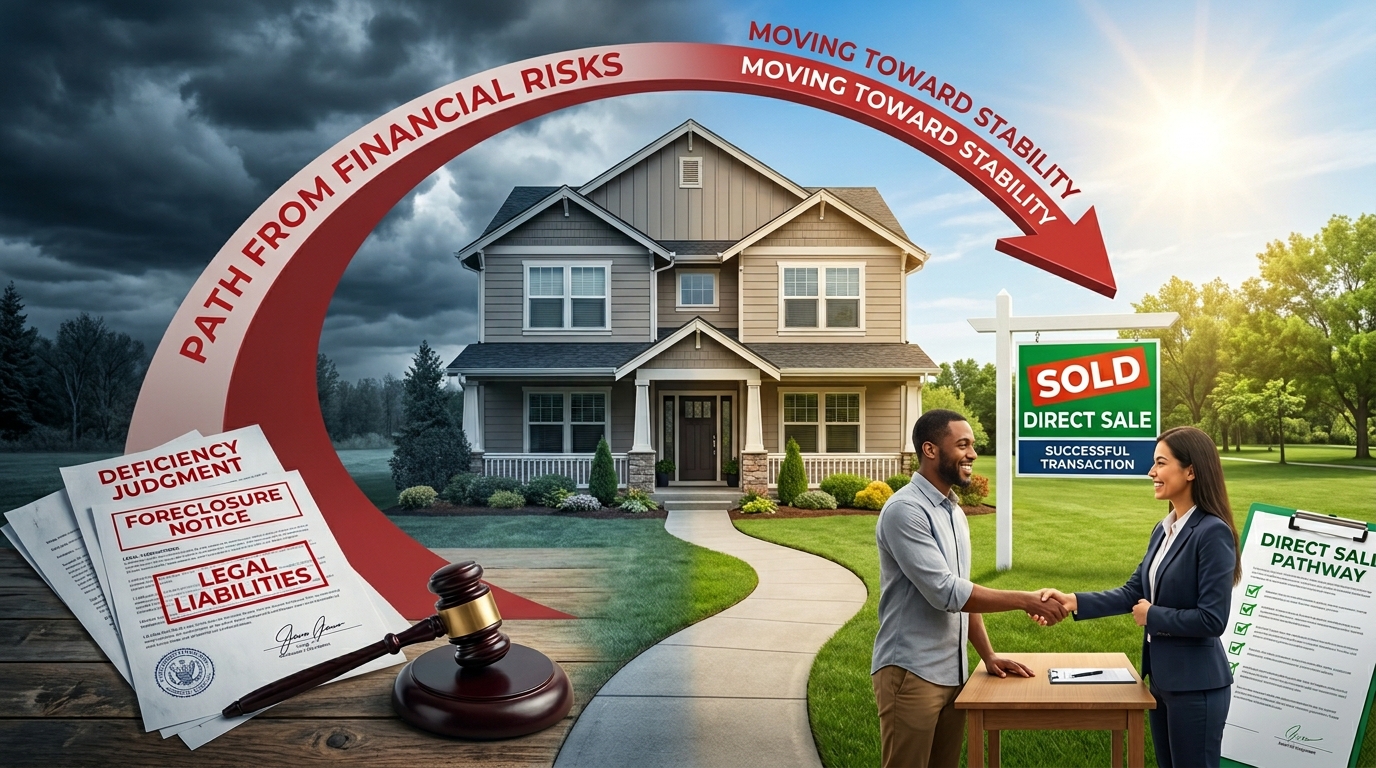
A direct sale, sometimes called a cash sale to a professional home buyer, works differently from a traditional listing. You are not waiting months for a buyer to get financing approved. You are not going through a short sale where the lender still might come after you. You sell the home fast, for a real price, and you close on your terms.
Here is how a direct sale can protect you from a deficiency judgment.
| Scenario | Risk of Deficiency Judgment | How a Direct Sale Helps |
|---|---|---|
| Foreclosure auction | High (if refinanced or judicial) | Sale happens before auction, stopping foreclosure |
| Short sale | Medium (lender may not waive) | Direct sale often pays off full balance, no deficiency |
| Deed in lieu | Medium (depends on agreement) | Direct sale avoids this process entirely |
| Direct cash sale | Low to none | Full payoff clears the lien at closing |
When you sell directly, the title company handles the payoff of all liens at closing. If the sale price covers what you owe, the deficiency issue goes away completely. Even if the price is slightly under what you owe, a professional buyer can sometimes negotiate directly with the lender to settle the shortfall, which is far cleaner than going through foreclosure.
### Timing Matters More Than Most People Think
The sooner you sell, the better your options are. Once a Notice of Default is filed in California, you typically have about 90 days before a Notice of Trustee Sale can be recorded. After that, you have 21 more days before the auction. That is not a lot of time if you are trying to list with a traditional agent, find a buyer, get financing approved, and close.
A direct sale to a cash buyer can close in as little as 7 to 14 days in many cases. That speed alone can be the difference between losing your home at auction with a potential deficiency hanging over you, and walking away clean with the debt paid off.
If you are facing this kind of situation right now, take a look at what happened in a related case covered in our post on selling a house with a Notice of Default filed in LA County. It breaks down exactly what your options look like once that clock starts ticking.
What About a Short Sale Instead
A lot of homeowners ask about short sales as an alternative. A short sale happens when the lender agrees to let you sell the home for less than you owe. Under California law, lenders generally cannot pursue a deficiency judgment after a short sale of a residential property with four units or fewer.
That sounds good, but there is a catch. Short sales take a long time. They can take three to six months or even longer while the lender reviews the offer. You need the lender’s approval for everything. If the lender counters or rejects the offer, you start over. And during all that time, the foreclosure process is still moving forward in the background.
A direct sale to a cash buyer sidesteps all of that. You negotiate directly with the buyer, not the bank. You close on your timeline. You are not at the mercy of a lengthy bank approval process. For more about how the selling process can look in difficult situations, our guide on selling real estate during bankruptcy shows how a clean exit strategy works even when finances are complicated.
Steps to Take Right Now If You Are Worried About a Deficiency
If you are behind on payments or already in the foreclosure process, here is a simple plan of action.
- Find out what type of loan you have and whether it qualifies as a purchase money loan
- Check whether you refinanced at any point and how that changed your exposure
- Get a realistic value of your home from a professional buyer or local agent
- Contact a professional home buyer to get a cash offer with no fees or commissions
- Review the offer with a real estate attorney to understand what you will net at closing
- Act before the Notice of Trustee Sale is recorded so you have more flexibility
You can also learn about the full range of options available to homeowners facing title and lien issues in our article on how to remove a cloud on your title before selling your LA home. Clearing any title issues before closing will help ensure the transaction goes smoothly and the lender is fully satisfied.
According to Bankrate, California is one of only a handful of states that broadly restricts deficiency judgments. But broad protection is not total protection. The safest move is to sell before the situation gets to the point where the question even comes up.
If you are ready to talk about your options, we are here to help. Visit our Contact Us page and tell us about your situation. We will walk through everything with you at no cost and no pressure.
Conclusion
A deficiency judgment can follow you long after you lose your home. It can affect your credit, your wages, and your financial future for years. But California law gives homeowners real tools to fight back, and a direct sale is often the cleanest and fastest way to put the whole thing behind you. The key is to move early and work with people who know how this process works. You deserve a clear exit, not a long legal battle after the fact.
Frequently Asked Questions
Can a lender come after me for a deficiency after a non-judicial foreclosure in California?
No. Under California Code of Civil Procedure Section 580d, lenders are not allowed to pursue a deficiency judgment after a non-judicial foreclosure. Since most California residential foreclosures are non-judicial, most homeowners are protected. However, if you refinanced or have a HELOC, there may be exceptions.
What is a purchase money loan and why does it matter?
A purchase money loan is the original mortgage you used to buy your home. California law generally protects these loans from deficiency judgments. If you refinanced after buying, the new loan may not qualify for the same protection, which is why refinancing can increase your risk.
How does a direct sale prevent a deficiency judgment?
A direct sale to a cash buyer closes quickly and allows the title company to pay off all liens at closing. If the sale price covers the full mortgage balance, the deficiency never exists in the first place. Even if there is a small gap, the lender is more likely to settle cleanly outside of a foreclosure court process.
Is a short sale safer than a direct sale when it comes to deficiency risk?
Not always. A short sale still requires lender approval and can take months. California law does restrict deficiency judgments after short sales on residential properties, but the process is slow and uncertain. A direct cash sale can close faster and often removes the deficiency issue entirely by paying off the full balance at closing.
How long do I have to sell before a foreclosure auction in California?
After a Notice of Default is recorded, you have about 90 days before a Notice of Trustee Sale can be filed. After that, the auction can be scheduled 21 days later. Acting quickly and contacting a cash buyer as soon as possible gives you the best chance to sell before the auction takes place.