
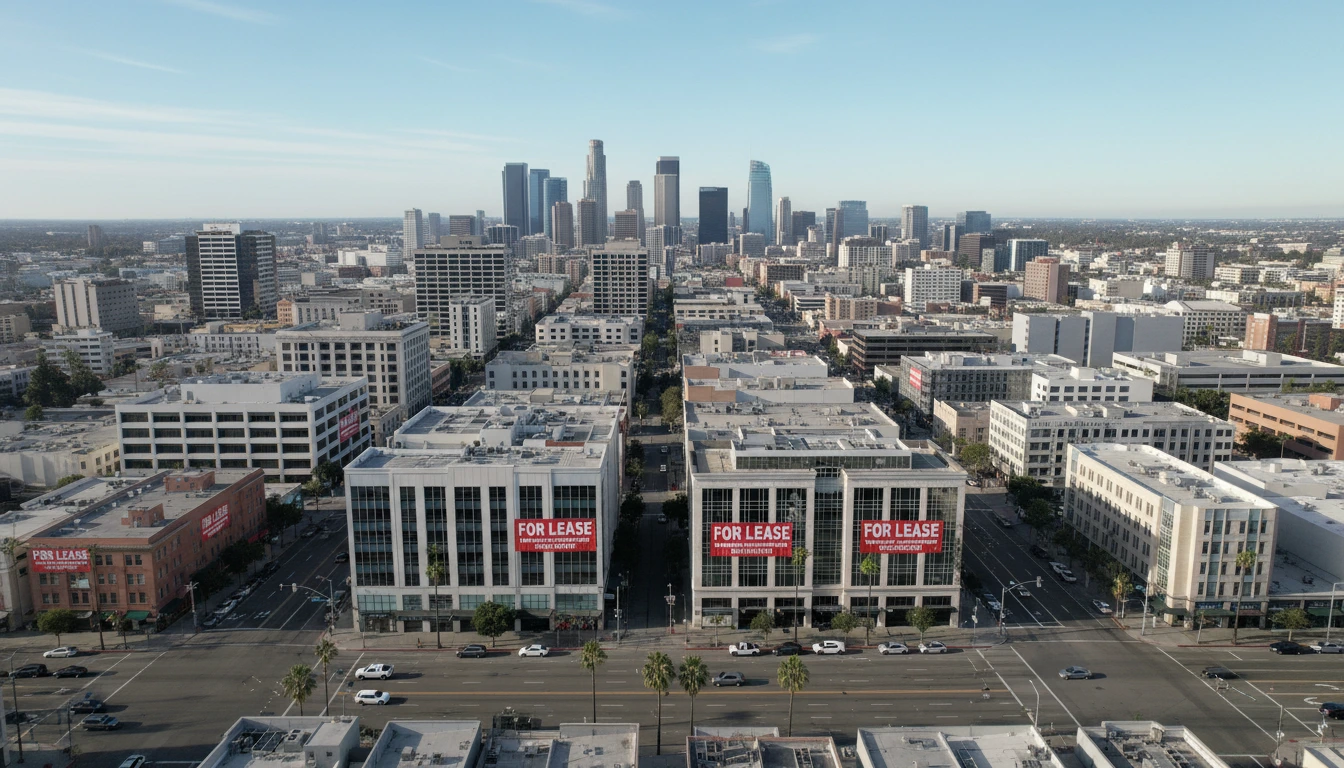
Walk down any major street in Downtown Los Angeles, and you’ll notice something strange: beautiful office buildings, storefronts, and commercial spaces just sitting empty. No signs of life. No workers. No customers. Just locked doors and dark windows. It makes you wonder: what’s going on? Why are so many commercial properties sitting vacant in one of the biggest cities in the world?
The Current State of Commercial Vacancy in LA
Los Angeles is going through a tough time in its commercial real estate market. And the numbers don’t lie.
As of early 2025, the office vacancy rate in Los Angeles has reached alarming levels, around 22% to 24.5% depending on the area. That means nearly one in every four office buildings has empty space. Downtown LA alone saw its office vacancy rate rise from 15.3% in 2020 to 22% by mid-2025, according to a report by Avison Young.
The retail sector is struggling too. In the second quarter of 2024, over 859,000 square feet of retail space was left empty across LA County, more than double the empty space from the same period in 2023. Even the industrial market, which was doing great for years, now has a vacancy rate of around 4.2% to 4.6%, the highest it’s been in a decade.
This is not a small problem. It’s a big shift happening in real time.
How Bad Is the Office Market Really?
Honestly, the office market in LA is in rough shape right now.
The direct vacancy rate reached 16.0%, while total availability climbed to 20.1%, up 3.45% year-over-year. Total lease transactions fell to 2.6 million square feet, down 44.6% year-over-year. That’s a massive drop in leasing activity.
I remember reading about 1000 Wilshire, a once-prized office building in LA. Its value dropped by 69% to just $60.5 million after a major tenant left and the landlord couldn’t keep up with loan payments. That one story tells you everything about where things stand right now.
Los Angeles office market experts expect many spaces to remain vacant, with no clear catalyst for a broad rebound in leasing activity. Without a resurgence in entertainment and tech, the city is likely to maintain an oversupply of office space.
Remote Work Changed Everything
This is probably the biggest reason commercial spaces are sitting empty.
When the COVID-19 pandemic hit in 2020, companies sent their workers home. Many of them never fully came back. Businesses realized they could save money by using less office space or going fully remote. Workers realized they liked working from home.
A continued lack of positive net absorption across the market underscores the persistence of remote and hybrid work models. As a result, many companies are signing smaller leases, reflecting reduced space requirements.
What’s more, according to return-to-office tracker Kastle Systems, return-to-office attendance in LA peaked in 2023 at 47.1% and then dropped to 46.1% in 2024, and the national rate for the same period was about 60%. That means LA workers are going back to offices at a much slower rate than most other cities.
The result? Companies are giving back office space they no longer need. This is called sublease space, where a business rents out its unused office to someone else. Vacant sublease space has accumulated, reaching 7.6 million square feet, surpassing levels not seen since the Dot-Com Bust.
High Interest Rates Made Things Worse
Remote work started the problem. But high interest rates poured fuel on the fire.
The Federal Reserve raised interest rates aggressively starting in 2022 to fight inflation. By 2024, interest rates were at a 23-year high. This made borrowing money much more expensive for businesses and property investors.
High interest rates are dampening demand by increasing the cost of borrowing for businesses and consumers, a measure designed to tame inflation by slowing spending across the economy.
For commercial property owners, this meant fewer buyers, fewer tenants, and harder times refinancing loans. Many buildings that were worth a lot in 2020 are now worth much less, and owners are stuck holding empty spaces they can’t afford to upgrade or sell.
What Are the Key Numbers? (Vacancy Snapshot)
Here’s a quick look at commercial vacancy rates across different property types in Los Angeles County as of 2024–2025:
| Property Type | Vacancy Rate (2024–2025) | Key Trend |
| Office (Downtown LA) | ~22–24.5% | Rising every quarter since Q2 2020 |
| Office (LA County overall) | ~16–20.1% | At multi-decade highs |
| Retail | ~5.5–5.7% | Slight increase, store closures rising |
| Industrial | ~4.2–4.6% | Highest level in a decade |
| Multifamily/Apartments | ~4.8–5.4% | Relatively stable, best-performing sector |
The office sector has clearly hit the hardest. And it’s not bouncing back anytime soon.
California Regulations and Taxes Add Pressure
Running a business in California, and especially Los Angeles, comes with a lot of rules. Those rules can make it harder to fill empty spaces.
One big example is Measure ULA, sometimes called the “Mansion Tax.” This is a special property transfer tax in the City of Los Angeles that started in April 2023. It puts a 4% tax on real estate sales over $5 million and a 5.5% tax on sales over $10 million.
According to NAI Capital Commercial, this led to a 39.8% year-over-year drop in sales, or $1.9 billion below last year’s total in the City of Los Angeles.
California also raised the minimum wage for fast-food workers to $20 per hour in 2024, a 25% increase. This hit retail landlords hard because fast-food tenants had to cut hours or close locations to stay profitable. When restaurants close, retail strips become emptier.
Add in strict zoning laws, slow permitting, and complex building codes, and you’ve got a city where it’s hard to change how a building is used, even when the current use isn’t working anymore.
Why Can’t Owners Just Lower Rents and Fill the Spaces?
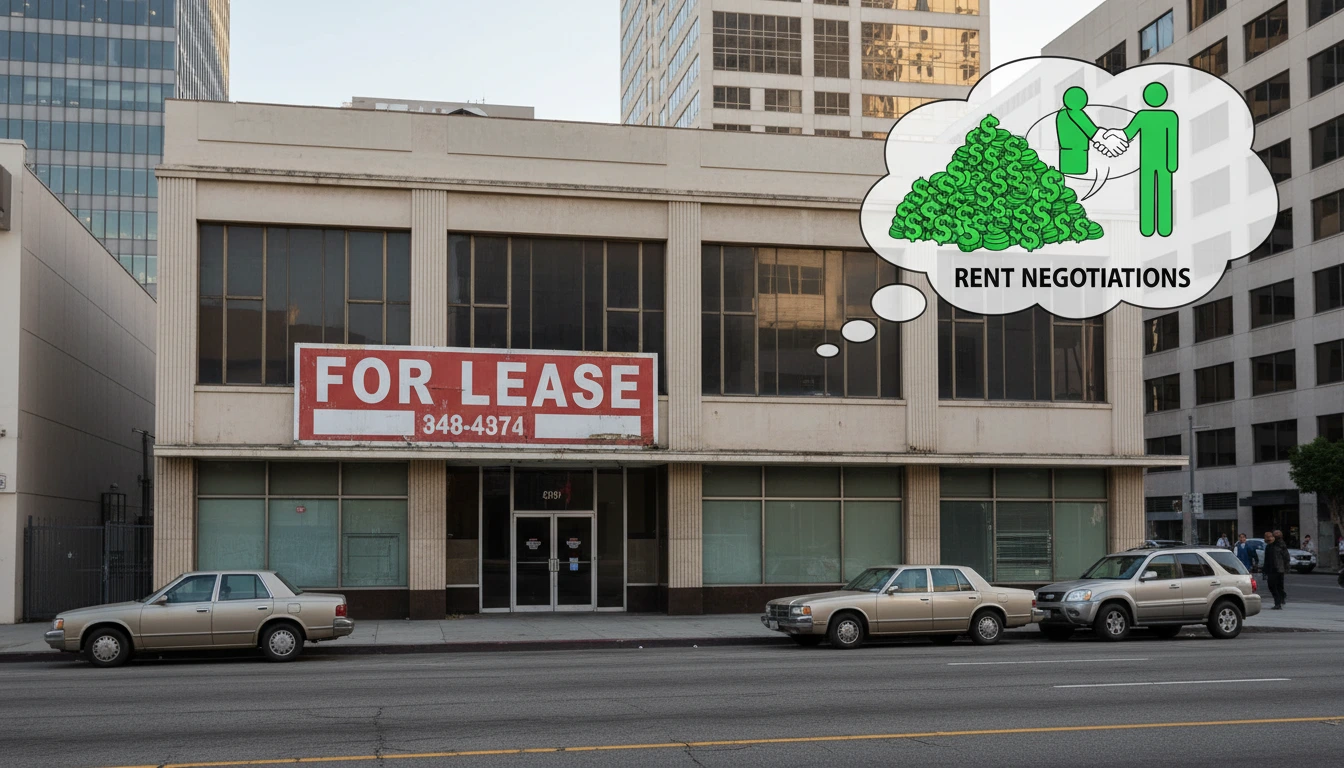
Great question. You’d think landlords would just drop their prices and find new tenants. But it’s not that simple.
Many landlords are locked into loan agreements that require them to keep rents above a certain level. Others don’t want to set a lower “market price” that could hurt the value of the entire building.
Landlords, wary of adjusting asking rents despite elevated vacancy rates, face challenges in spurring occupancy.
There’s also the issue of asking rents staying flat while the market softens. Average asking rent for office space in LA is around $3.47–$3.48 per square foot, and landlords are holding onto that number even as vacancy climbs. Some are offering concessions (like free months of rent or build-out allowances) instead of officially lowering prices.
The funny part is, this stubborn approach often backfires. Tenants who can afford to wait do exactly that, and the space stays empty longer.
The Rise of Sublease Space and What It Means
Here’s something worth paying attention to: sublease space has exploded in LA.
When a business has extra office space it’s not using, it can put that space back on the market for other companies to rent. This is sublease space. The problem is, this sublease space competes directly with landlords trying to rent out their own empty buildings.
Available sublease space has ballooned 103% since Q2 2020 from the pandemic shutdown. And because companies offering sublease space often charge less than the building owner, they’re pulling tenants away from direct leases.
This creates a cycle: more sublease space → lower effective rents → landlords struggle to compete → more vacancy.
What’s Happening with Retail Spaces Specifically?
Retail vacancy is a slightly different story, but still a painful one.
E-commerce changed how people shop. More people buy online now, so fewer people visit physical stores. This pushed many retailers to close locations, especially underperforming ones.
The retail sector witnessed a setback in its pivot back to brick-and-mortar establishments as retailers continued to shutter underperforming locations, resulting in a rise in the vacancy rate to 5.7%.
LA saw the largest retail space loss nationally, with roughly 3.1 million square feet vacated. That’s a lot of empty storefronts. Even though some prime retail locations are still doing well, the weaker spots in the city are really struggling.
Can Empty Office Buildings Be Turned Into Homes?
This is one of the most talked-about solutions, and it makes a lot of sense on paper.
LA has a huge housing shortage and a huge office surplus at the same time. Why not convert empty offices into apartments? Some people are trying to do exactly that.
The city adopted a Citywide Adaptive Reuse Ordinance in 2024, aiming to encourage conversions across Los Angeles by reducing regulatory barriers.
A study found that converting just 10 empty office buildings in Downtown LA could create approximately 3,859 homes and add $12 billion in property value. That’s a huge opportunity.
But it’s not easy. Converting office buildings to homes is expensive and complicated. Old buildings may not have the right plumbing, lighting, or layouts for apartments. Permits take a long time. And state building codes make the process slow.
Still, more property owners are at least thinking about it. About 25% of California property owners plan to pursue adaptive reuse projects in the coming years, according to the Allen Matkins/UCLA Anderson Forecast survey.
What the Future Looks Like
Here’s a look at what experts think will happen next:
- Office market: No big recovery expected before 2026. Some buildings may get converted or repurposed. Others will sit empty.
- Retail: Showing signs of stabilizing. Prime locations are doing fine. Weaker spots will keep struggling.
- Industrial: Still strong long-term, thanks to the Port of Los Angeles and e-commerce growth. Short-term pain, but the fundamentals are good.
- Multifamily (apartments): The strongest sector. Rents reached $2,652 per month in mid-2025. Strong demand, especially in working-class neighborhoods.
Key things to watch: interest rate cuts from the Federal Reserve, new zoning rules, and whether LA’s big employers (entertainment, tech, healthcare) start hiring again at scale.
Why Some Properties Stay Vacant on Purpose
Here’s something most people don’t think about: some owners actually choose to leave properties vacant.
Why? Because they’re waiting. Waiting for the market to improve. Waiting for a big tenant to show interest. Waiting to sell at a higher price. Or sometimes, they’re dealing with legal or financial disputes that prevent them from leasing the space.
Some landlords also hold out for a specific type of tenant, like a luxury brand or a well-known restaurant, because they believe the right name can raise the value of the whole building.
It’s a gamble. And in today’s LA market, it’s a risky one.
Need to buy or sell a property in Los Angeles? Buy Your Properties helps homeowners and commercial owners explore fast, hassle-free selling options with no pressure.
👉 Contact us today to discuss your situation and see what your property may be worth.
Conclusion
Why commercial properties sit vacant in Los Angeles comes down to a mix of big changes happening all at once. Remote work emptied out offices. High interest rates slowed down investment. Rising costs, tough regulations like Measure ULA, and the boom in e-commerce all made things harder for landlords and businesses alike.
The good news? The market is slowly finding its footing. Solutions like office-to-residential conversions, interest rate cuts, and smarter zoning laws are being explored. LA is resilient, it’s been through tough times before.
If you’re an investor, a business owner, or just curious about the market, keeping an eye on vacancy rates, sublease trends, and city policy changes will tell you a lot about what’s coming next.
Frequently Asked Questions
Why is the office vacancy rate so high in Los Angeles?
The main reason is remote and hybrid work. After the pandemic, many companies stopped needing as much office space. They gave back space or put it up for sublease. At the same time, new office buildings were built, but not enough tenants moved in. This pushed the office vacancy rate in LA to historic highs, reaching around 22% in Downtown LA as of 2025.
What is sublease space, and why does it matter?
Sublease space is office or commercial space that a current tenant rents out to another business. It matters because there is now more sublease space in LA than ever before, over 12.1 million square feet as of mid-2024. This floods the market with cheap space and makes it harder for building owners to find tenants at normal prices.
How does Measure ULA affect commercial real estate in Los Angeles?
Measure ULA is a property transfer tax in the City of Los Angeles. It charges a 4% tax on property sales above $5 million and 5.5% on sales above $10 million. This made buying and selling commercial properties more expensive and contributed to a significant drop in sales volume in the city, down nearly 40% year-over-year in some reports.
Can vacant commercial buildings be converted into apartments?
Yes, and it’s being done in Los Angeles right now. The city passed a Citywide Adaptive Reuse Ordinance in 2024 to make this easier. Converting offices to homes can help both the housing shortage and the commercial vacancy problem at the same time. However, the process is still expensive and slow because of building codes and permitting delays.
Will the Los Angeles commercial real estate market recover?
Most experts say a full recovery will take time, likely 2026 or beyond for the office sector. The retail and industrial markets are showing earlier signs of stabilizing. A lot depends on whether the Federal Reserve cuts interest rates, whether major employers start expanding again, and whether the city makes it easier to repurpose vacant buildings. The outlook is cautiously hopeful, but not certain.