
You found out your garage conversion, extra bedroom, or backyard ADU was never permitted. Now you want to sell. Honestly, this situation is way more common in LA than most people realize — and it doesn’t have to stop your sale. But you do need to understand your options clearly before you list.
Why Unpermitted Additions Are So Common in Los Angeles
LA has a long history of homeowners skipping the permit process. Some did it to save money. Others did it to avoid higher property tax assessments under California’s Proposition 13. Under Prop 13, adding permitted square footage can trigger a reassessment — which could push taxes up significantly.
So instead of pulling permits, many owners just built quietly. A sunroom here. An extra bathroom there. A full garage conversion. Over time, the gap between what’s on file with the Los Angeles Department of Building and Safety (LADBS) and what’s actually in the house can get pretty wide.
According to the LA Department of Building and Safety (LADBS), the most commonly unpermitted work in the city includes room additions, garage conversions, electrical upgrades, and accessory dwelling units (ADUs). If any of those sound familiar, you’re not alone.
What Counts as Unpermitted Work?
Unpermitted work is any construction or renovation done without getting approval from the local building department. In LA, that means anything that changes the structure, plumbing, electrical systems, or square footage of a property — without the sign-off from LADBS.
Common examples include:
- Garage conversions to living space
- Room additions or extensions
- Basement or attic build-outs
- Unpermitted ADUs (accessory dwelling units)
- Bathroom or kitchen remodels with new plumbing
- Electrical panel upgrades done without a permit
If you’re not sure what’s permitted on your property, you can do a free permit lookup on the LADBS permit records portal. Just enter your address and see what’s on file.
How Unpermitted Work Hurts Your Sale
Here’s where things get real. When you go to sell a home with unpermitted work in Los Angeles, several things can go wrong:
- Lenders won’t finance: Most mortgage lenders base their loan amount on the square footage listed in county records. If your home has an extra 800 square feet that’s not on record, the lender may only lend based on the smaller official size. That sharply limits your buyer pool.
- Buyers ask for big price cuts: Once unpermitted work is discovered, buyers typically want either a significant price reduction or the seller to legalize the work before closing.
- Title companies flag it: During escrow, title companies may flag outstanding code violations, which can delay or derail your closing.
- Insurance issues: Home insurance in California may not cover damage related to unpermitted construction.
California Law: You Must Disclose Unpermitted Work
This is not optional. Under California law, sellers are required to disclose any known unpermitted work on the Transfer Disclosure Statement (TDS) — even if the work was done by a previous owner. If you know about it and don’t say anything, you’re opening yourself up to a lawsuit.
Real estate attorneys have won cases on behalf of buyers who discovered unpermitted work after closing — even when the seller claimed the work was done before they owned the property. California’s disclosure rules are broad. If you knew, you had to tell.
Bottom line: disclose everything you know. It protects you legally and builds trust with buyers.
What Happens If You Don’t Disclose?
The consequences can be serious. LADBS can issue a Notice to Comply, giving you 30 days to fix the violation. If you ignore it, fines escalate under Los Angeles Municipal Code Section 91.106.4.8 — sometimes running $150 to $1,000 per day.
And if a buyer discovers undisclosed unpermitted work after the sale, they can sue for fraud or misrepresentation. Courts in California have reversed sales and ordered sellers to pay significant damages. It’s simply not worth the risk.
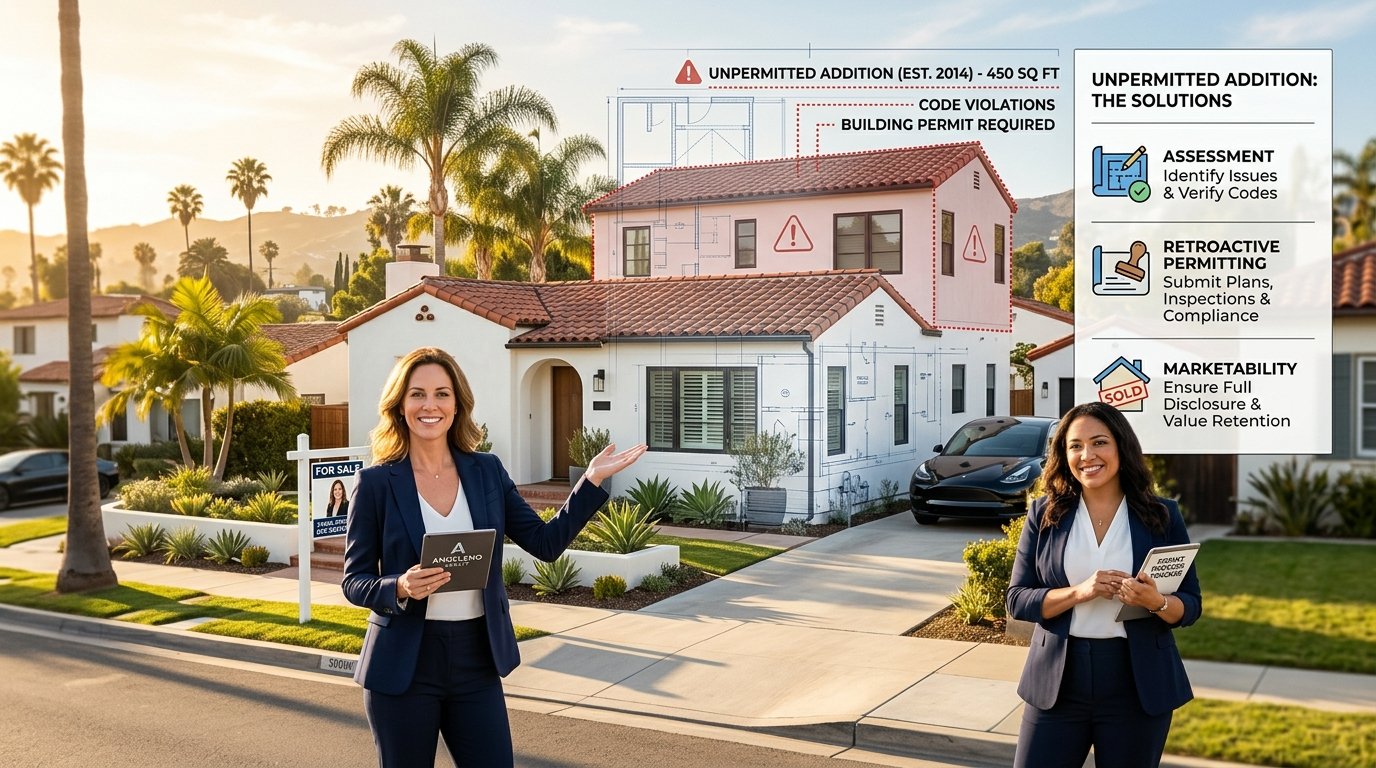
Your Options for Selling with Unpermitted Work in LA
Here’s the good news: you have choices. Each one has different costs, timelines, and trade-offs.
| Option | Timeline | Estimated Cost | Best For |
|---|---|---|---|
| Retroactive Permit (Permit After the Fact) | 3–6 months | $2,000–$15,000+ | Sellers who want full market value |
| Disclose and Sell As-Is | 30–90 days | Minimal | Sellers who want speed over price |
| Sell to a Cash Buyer | 7–21 days | $0 | Sellers who need to close fast |
| Demolish the Unpermitted Work | Varies | $5,000–20,000+ | Work that can’t be legalized |
Getting a Retroactive Permit in Los Angeles
A retroactive permit (sometimes called a permit after the fact) lets you legally approve work that was already done. It’s not fast or cheap, but it can be worth it if the work was done well and your goal is to get full market value.
Here’s how the process generally works:
- Contact LADBS to discuss the unpermitted work and understand what’s required
- Hire a licensed architect or engineer to draw up compliant plans
- Submit the plans and pay permit fees (typically $2,000–$5,000 for a room addition)
- Pass inspections — which may require opening walls or making code corrections
- Budget $2,000–$10,000 extra for any required fixes found during inspection
- Receive a Certificate of Occupancy once everything passes
The whole process usually takes three to six months. If the work was done poorly or doesn’t meet current codes, you may need to make expensive changes — or even tear parts of it down.
Selling As-Is with Full Disclosure
If you don’t have the time or budget to legalize the work, you can sell as-is — but you still have to disclose everything. Many buyers, especially investors and cash buyers, are happy to take on properties with unpermitted work. They price it in and deal with it themselves.
Traditional buyers using a mortgage may struggle, though. Lenders often won’t approve loans on homes with known unpermitted square footage. That means your buyer pool shrinks significantly if you go this route with an on-market listing.
That’s why many LA homeowners with unpermitted work find the best path is selling directly to a cash buyer.
Selling to a Cash Buyer: The Fastest Path Forward
When a home has complicated issues — unpermitted work, code violations, structural problems — cash buyers are often the cleanest solution. They buy the property as-is, handle the permitting themselves after closing, and don’t need lender approval.
You skip the months-long permit process, avoid the back-and-forth with buyers, and close in a matter of days.
At Buy Your Properties, we buy homes in any condition — unpermitted additions, code violations, and all. See how we calculate our cash offers in the LA market so you know exactly what to expect. We’re transparent about our numbers from the start.
You might also find it helpful to read about selling your house without a sign in the yard — a quiet, private sale is often exactly what homeowners with unpermitted work want to avoid public attention.
How Unpermitted ADUs Are Treated in Los Angeles
ADUs are a special case in LA. The city has been pushing hard to encourage ADU construction to address the housing shortage. Under California state laws AB 68 and SB 13, some previously unpermitted ADUs may qualify for retroactive legalization through a simplified process.
But it’s not guaranteed. Unpermitted ADUs that don’t meet current safety codes may need significant upgrades — costing $15,000–$40,000 in some cases. And if you’re renting out an unpermitted ADU without a legal permit, you can’t do so legally, which cuts into your income and complicates the sale.
If your property has an unpermitted ADU, talk to a real estate attorney before listing. And if you just want to move on quickly, a cash buyer who specializes in complex LA properties may be your smartest option.
Tips to Make the Sale Smoother
- Pull your permit history from LADBS before listing so you know exactly what you’re disclosing
- Get a pre-listing inspection so you understand the scope of the issue before buyers discover it themselves
- Work with an agent who has experience in properties with code violations or unpermitted work in LA
- Price realistically — buyers will factor in the cost of legalization, so price it in from the start
- Gather all documentation you have about when and how the work was done
According to the California Department of Housing and Community Development, homeowners are strongly encouraged to legalize unpermitted work before selling, especially as California pushes for more housing transparency across the state.
If you want to talk through your situation, our team can help. Just reach out via our Contact Us page and we’ll walk you through your options with zero pressure.
For more on how to handle the financial side of selling in Los Angeles, check out our article on the hidden costs of selling a home with a realtor in Los Angeles — unpermitted work often creates surprise costs that sellers don’t see coming.
Conclusion
Selling a property with unpermitted additions in Los Angeles is challenging — but far from impossible. You can pull a retroactive permit to boost value, disclose and sell as-is to a willing buyer, or go straight to a cash sale if you need speed. Whatever you choose, California law requires you to be upfront about what you know. Hiding unpermitted work is never worth the legal risk. Be honest, price it right, and pick the path that fits your goals.
Frequently Asked Questions
Do I have to disclose unpermitted work when selling in Los Angeles?
Yes. California law requires sellers to disclose all known unpermitted work on the Transfer Disclosure Statement. This includes work done by previous owners if you’re aware of it. Failure to disclose can result in lawsuits after the sale.
Can I get a retroactive permit for any type of unpermitted work in LA?
In most cases, yes — as long as the work can be brought up to current building codes without major demolition. LADBS will inspect the work and let you know what corrections are needed. Some types of work, however, may require partial teardown if they don’t meet safety standards.
Will a buyer’s lender approve a loan on a home with unpermitted additions?
Often not. Lenders typically base loan amounts on the county’s official square footage records. If your home has unpermitted additions, the buyer may only qualify for a loan based on the smaller official size. This often limits your buyer pool to cash buyers or investors.
How long does it take to get a retroactive permit in Los Angeles?
Typically three to six months from start to finish. This includes hiring an architect, submitting plans, waiting for review, passing inspections, and receiving your Certificate of Occupancy. Complex cases or properties needing major code corrections can take longer.
What is the fastest way to sell a house with unpermitted additions in LA?
The fastest option is to sell to a cash buyer. Cash buyers purchase properties as-is, regardless of permit status, and can close in as little as 7 to 21 days. You don’t need to fix or legalize anything — just disclose what you know and let them handle it from there.