
How We Calculate Our Cash Offers: Transparency in the LA Market
If you’ve ever gotten a cash offer on your home and thought, “How did they come up with that number?” — you’re not alone. I hear this question all the time. Most sellers just want to know the math is fair. So let me break it all down clearly, the way I wish someone had explained it to me early on.
Why Cash Offers Are Lower Than Market Value
This is the first thing most sellers want to know. You look at Zillow, you see your home estimated at $750,000, and then a cash buyer offers $530,000. That feels like a lowball. But here’s the thing — it’s not always about greed. There’s real math behind it.
Cash buyers are taking on risk. They’re buying your home as-is, paying for repairs themselves, holding the property for weeks or months, and then selling it again. Each of those steps has real costs. Those costs have to come from somewhere, and that’s why the offer is below market value.
According to a Clever Real Estate survey of over 700 investors, the typical cash offer ranges from 60% to 80% of the home’s after-repair value, with a median offer of 67.5% of ARV. That number surprises a lot of people, but once you understand the formula, it makes complete sense.
The Real Costs a Cash Buyer Carries That You Don’t
When a cash buyer purchases your home, they immediately take on a long list of expenses. Here’s what’s actually built into that gap between the cash offer and your home’s market value:
- Repair and renovation costs — roofing, HVAC, electrical, plumbing, cosmetic upgrades
- Holding costs — property taxes, insurance, utilities, and sometimes loan interest during renovation
- Resale commissions — 5% to 6% when they sell the finished home
- Closing costs on resale — another 2% to 3% of the resale price
- Profit margin — typically 10% to 20% to justify the risk and time invested
None of that is padding. It’s the real cost of doing business. And once you subtract all of it, the offer you receive reflects what’s left after the buyer covers their end.
What You Gain in Return
Honestly, the tradeoff is real. You give up some equity, and in return you get certainty, speed, and zero hassle. No repairs, no showings, no inspections dragging on for weeks, no deal falling through at the last minute. For a lot of sellers in LA, that trade makes total sense — especially if time or stress is a factor.
If you’ve ever dealt with a traditional sale going sideways, you know the feeling. I worked with a seller who had two deals collapse back-to-back — once from a failed inspection, once from the buyer’s financing falling through. By the time she called us, she just wanted it done. The cash offer she accepted was lower than her list price, but she closed in 11 days and had zero more sleepless nights about it.
The Formula We Use: The 70% Rule Explained
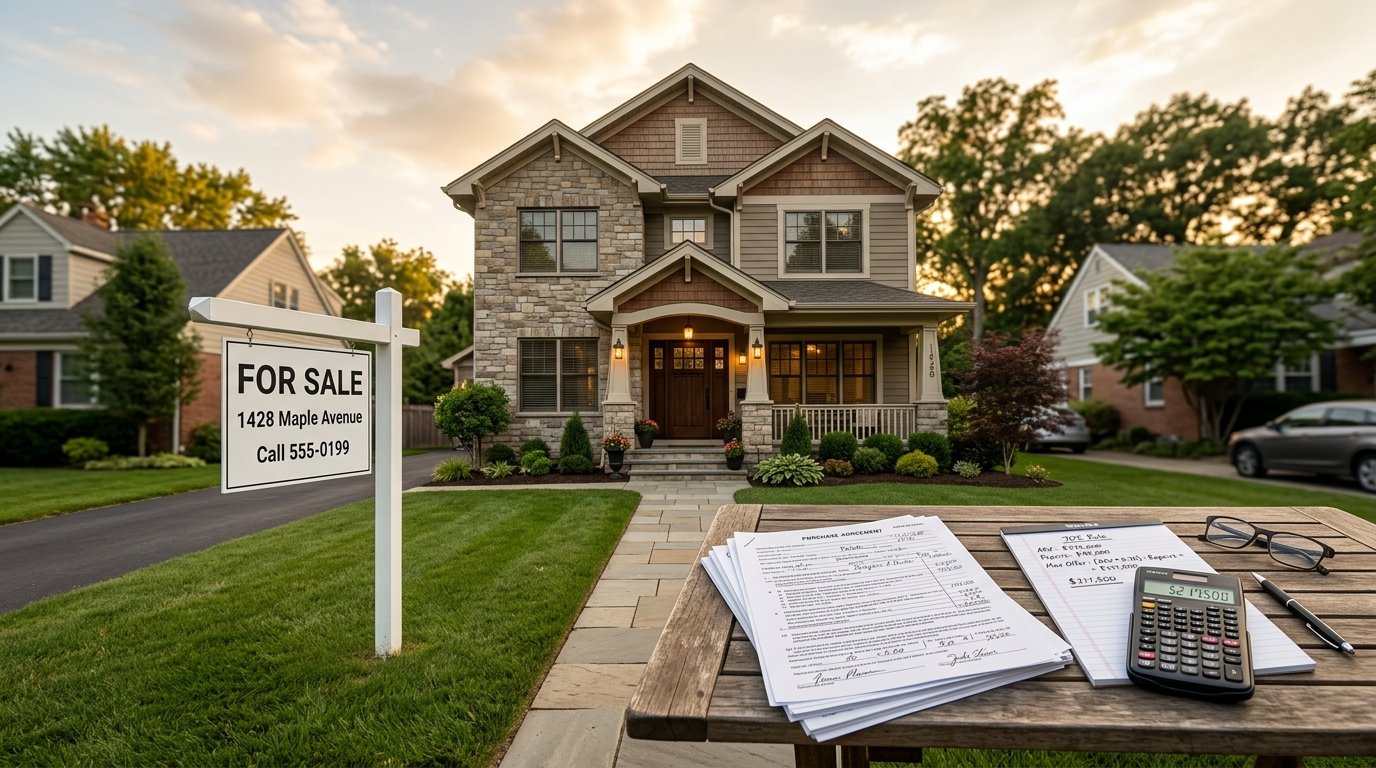
Most cash buyers — including us — base their offers on something called the After Repair Value, or ARV. This is what your home would be worth once it’s fully updated and ready to sell on the open market. From there, we apply the 70% rule.
The formula looks like this:
Cash Offer = (ARV × 70%) − Estimated Repair Costs
So if your home’s ARV is $600,000 and it needs $40,000 in repairs, the math works out to: ($600,000 × 0.70) − $40,000 = $380,000. That’s the maximum offer price using this formula.
According to Paranova Property Buyers’ explanation of the offer formula, the 30% buffer in the 70% rule isn’t profit — it covers agent commissions on resale, closing costs, holding expenses, and risk. On a $200,000 resale, that 30% can easily be consumed by $10,000–$12,000 in commissions, $4,000–$6,000 in closing costs, and months of holding costs on top.
How We Determine Your Home’s ARV
ARV isn’t a guess. We look at real data — specifically, comparable sales, also called “comps.” These are homes similar to yours in size, age, layout, and condition that have sold in your neighborhood recently, usually within the past 3 to 6 months.
We look at the sale prices of those updated homes and use that data to estimate what your home could sell for after renovations. Location matters a lot in LA. A home in Silver Lake gets a different ARV than a similar-sized home in Compton, even if the floor plan is the same.
We also use tools like MLS data, public records, and local market trend reports to make sure the number is grounded in reality, not guesswork.
How We Estimate Repair Costs
This is where a lot of sellers feel skeptical, and I get it. The repair estimate directly affects the offer, so you want to know it’s fair.
When we walk through your home, we’re looking at each major system and surface area. We note what needs to be replaced versus what just needs cosmetic work. We use current contractor pricing in LA — because labor and materials here cost more than in other markets — to build a realistic budget.
What We Look at During the Walkthrough
| Item Inspected | What We Check | Typical LA Cost Range |
|---|---|---|
| Roof | Age, condition, missing shingles, leaks | $8,000 – $20,000 |
| HVAC System | Age, function, filters, ductwork | $5,000 – $12,000 |
| Electrical | Panel age, wiring type, safety issues | $3,000 – $10,000 |
| Plumbing | Pipe age, leaks, water pressure | $2,000 – $8,000 |
| Foundation | Cracks, settling, drainage | $5,000 – $25,000+ |
| Kitchen & Baths | Fixtures, cabinets, countertops, tiles | $8,000 – $30,000 |
| Flooring | Condition, type, coverage needed | $3,000 – $10,000 |
| Exterior / Paint | Condition, damage, curb appeal | $2,000 – $6,000 |
We walk through every room and document what we see. Then we apply current labor and material costs to each item. It’s not a wild guess — it’s a budget built from real contractor quotes and LA market data.
Why We Share the Repair Breakdown with You
We believe transparency builds trust. When we make you an offer, we’ll walk you through the repair estimate line by line if you want to see it. You should know exactly why the number is what it is. No mystery, no pressure, no fine print games.
If you think our repair estimate is off, tell us. We’re open to that conversation. We’d rather get to a number both sides feel good about than rush you into something that doesn’t sit right.
What Makes Our Offers Different in the LA Market
The LA market is expensive, competitive, and unique. A $600,000 home here might be a 1970s bungalow that needs a full kitchen and bath overhaul. The same home in a less expensive market might be worth half that — and command a completely different buyer pool after renovation.
We work exclusively in the LA area, so we know the neighborhoods, we know the comps, and we know what buyers in each part of the city are willing to pay for a finished product. That local knowledge means our ARV estimates are more accurate than a national buyer punching your address into an algorithm.
How Our Offer Compares After You Do the Real Math
This is the part most sellers don’t think about until it’s too late. A traditional sale might net you a higher gross price — but after agent commissions (5.67% in LA on average), closing costs, repairs, staging, and months of holding costs, the difference between a traditional sale and a cash offer gets much smaller than it looks on paper.
According to data reported by Redfin’s 2024 all-cash sales analysis, just under one-third of all U.S. home purchases were made in cash in 2024. That’s a massive share of the market — and a sign that more and more sellers are choosing this path not out of desperation, but because the numbers make sense when you run them honestly.
Want to see what a real cash offer looks like for your property? Contact us today for a no-obligation offer — we’ll show you the full breakdown so you can compare it fairly with any other option.
When a Cash Offer Makes the Most Financial Sense
Not every seller is in the same situation. But for many, a cash offer wins when you factor everything in. It makes the most sense if your home needs significant work, if you need to close quickly, if you want to avoid months of uncertainty, or if you’ve already gone through a painful failed sale and just want a done deal.
For help figuring out what repairs are worth doing before any sale — cash or traditional — take a look at our guide on high-ROI home improvements before selling. And if you want to understand how the negotiation process works once you have an offer, our post on how to negotiate with cash home buyers covers it step by step.
Conclusion
Cash offers aren’t magic — they’re math. The formula is simple: we start with what your home could be worth after repairs, subtract what those repairs will actually cost, and leave enough room to cover holding costs, resale expenses, and a fair profit margin. What’s left is your offer. We show our work because we believe you deserve to understand exactly how we got to that number. In the LA market, where every dollar counts, transparency isn’t just a nice touch — it’s the right way to do business.
Frequently Asked Questions
How exactly do cash buyers come up with their offer price?
Most cash buyers use the ARV (After Repair Value) formula: they estimate what the home would sell for after full renovation, then multiply by roughly 70%, and subtract the estimated repair costs. The result is the maximum offer price. This leaves room for holding costs, resale fees, and profit margin.
Is the 70% rule the only method used to calculate cash offers?
Not always. The 70% rule is the most common formula for fix-and-flip investors. But some buyers — especially those who plan to rent the property — may offer slightly more because they’re evaluating long-term cash flow rather than a quick flip profit.
Can I negotiate a cash offer if I think the repair estimate is too high?
Yes, absolutely. A reputable cash buyer will be transparent about their repair estimates and open to discussion. If you have receipts for recent work or believe certain items are in better condition than assessed, share that information. It can move the offer.
Why is the LA cash offer market different from other cities?
LA has higher property values, higher labor costs, and more specific neighborhood-by-neighborhood demand. This means ARV calculations in LA require very local knowledge of which areas command premium resale prices and which don’t. A national buyer using generic algorithms may be less accurate than a local buyer who knows the market deeply.
How quickly can I get a cash offer after reaching out?
Most reputable cash buyers in LA can provide an initial offer within 24 to 48 hours of receiving your property information. After a walkthrough to confirm condition, the final offer is usually confirmed the same day or the next morning. From there, closing can happen in as little as 7 to 14 days.