
Getting a red tag on your home after an earthquake is one of the scariest things a California homeowner can face. It means an inspector determined the structure is not safe to occupy. Your home is essentially off-limits, you may have nowhere to live in the short term, and now you are trying to figure out what to do with a property that is legally uninhabitable. Selling feels impossible. But it is not.
What a Red Tag Actually Means for Your California Home
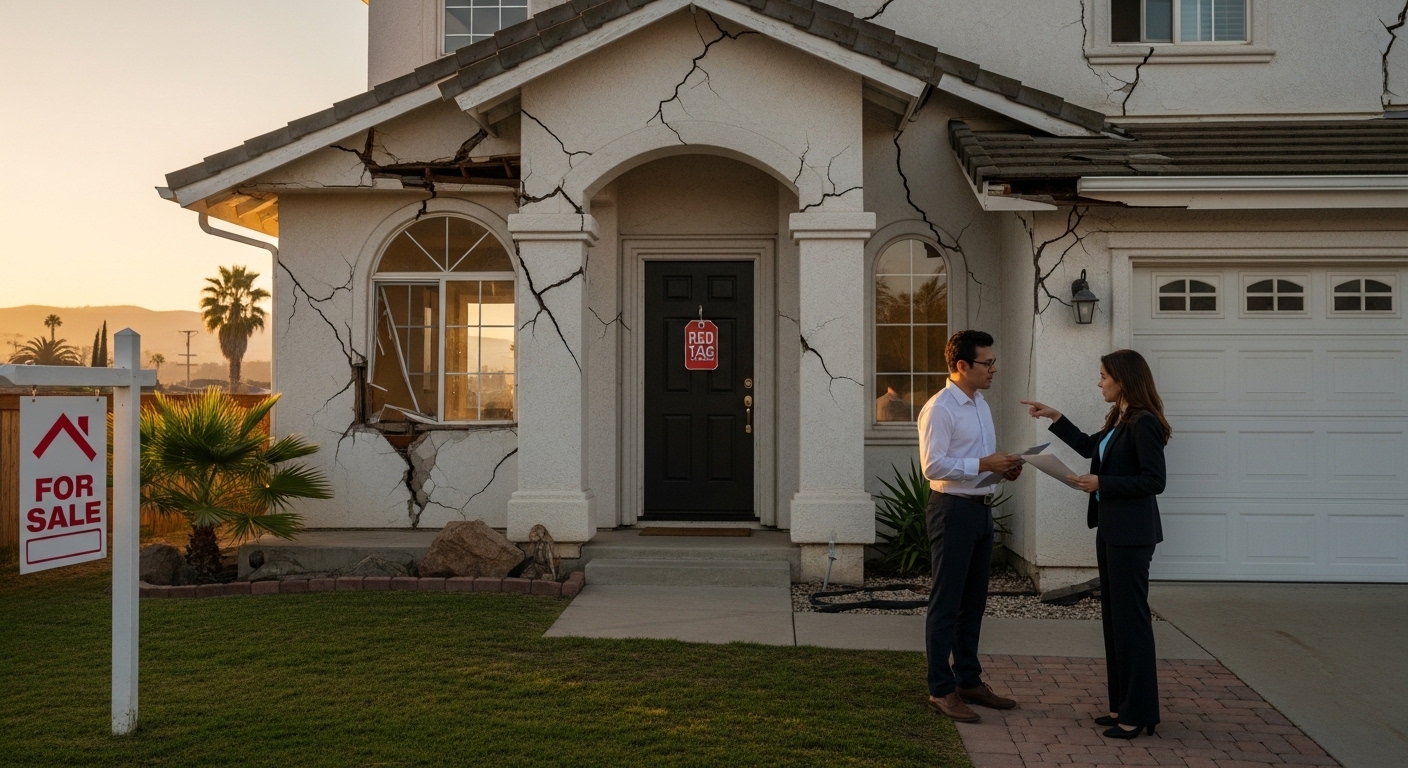
A red tag, officially called an Unsafe placard in California, is issued by a building inspector after a major event like an earthquake when the structure is found to be in a condition that poses an immediate danger to occupants. A red-tagged building cannot legally be entered or occupied until the tag is lifted, which requires repairs that bring the structure back to a condition that passes re-inspection.
In California, the red tag system is coordinated by local building departments following guidelines from the Applied Technology Council’s ATC-20 post-disaster safety evaluation program. After a significant earthquake, inspectors conduct rapid evaluations of affected structures and post placard notices indicating the safety status of each building.
The Difference Between a Red Tag and a Yellow Tag After Earthquake Damage
California uses a three-color placard system after disasters. A green tag means the building is inspected and has no apparent structural concerns. A yellow tag means the building has restricted entry and some areas may not be occupied, but full uninhabitability has not been determined. A red tag is the most severe designation and means the structure is unsafe for any occupancy until repaired and re-inspected.
Sellers dealing with red-tagged homes face the strictest set of constraints. The home cannot be shown to buyers as a residential dwelling. No one can live in it. And any financing that requires the property to be in habitable condition, which is essentially all standard residential mortgage products, is unavailable until the red tag is lifted.
How Earthquake Damage Gets Red Tagged in Los Angeles and Southern California
After major seismic events in Southern California, city and county building inspectors work through affected neighborhoods conducting rapid safety evaluations. The evaluations are visual and structural, looking for cracking in load-bearing elements, failure of soft-story ground floors, chimney collapse, foundation damage, and other signs of compromised structural integrity.
According to California Governor’s Office of Emergency Services, post-earthquake damage assessment is a coordinated process involving state, county, and municipal building departments and uses standardized inspection protocols to ensure consistent evaluation across all affected properties. A red tag is never issued lightly, and it reflects a genuine and documented safety concern with the structure.
Can You Sell a Red-Tagged House in California?
Yes. You can sell a red-tagged home in California. The red tag restricts occupancy, but it does not prevent the transfer of ownership. You can enter into a purchase agreement, open escrow, and complete a sale on a red-tagged property just as you would on any other property. The difference is in who will buy it and on what terms.
Traditional buyers using residential mortgage financing are effectively eliminated from the buyer pool for a red-tagged home. Their lenders will not approve a loan on a property that cannot legally be occupied. Owner-occupant buyers who need to live in the home are also not realistic options since they cannot move in. That leaves a very specific category of buyer: cash investors and developers who are buying the property for its land value or its post-repair potential rather than its current livable condition.
What Cash Buyers Look at When Evaluating a Red-Tagged Home
A cash buyer evaluating a red-tagged earthquake-damaged home in California is making a different calculation than a traditional buyer. They are looking at what the property will be worth once the structural issues are repaired and the red tag is lifted, then deducting the cost of those repairs plus their required return on the investment and risk they are taking on.
The key unknowns that affect the offer price are the scope of the structural damage, the cost to repair it to a standard that passes re-inspection, and how long that process will take. A buyer who can get clear answers to those questions from a structural engineer can make a confident offer. A buyer who cannot get answers because the damage has not been assessed will factor in additional uncertainty as a buffer in their offer.
| Buyer Type | Can Buy Red-Tagged Home? | Primary Motivation |
|---|---|---|
| Traditional buyer with mortgage | No, lender will not approve | Owner-occupancy, not relevant here |
| FHA or VA buyer | No, habitability required | Owner-occupancy, not relevant here |
| Cash investor or flipper | Yes | Post-repair value minus repair cost |
| Developer or demolish-rebuild buyer | Yes | Land value minus demolition cost |
| Experienced distressed property buyer | Yes | Discounted acquisition for rehab or hold |
What Documents Help Sell a Red-Tagged Home Faster
The more information you have about the damage and the estimated repair cost, the faster an experienced buyer can evaluate your property and make an offer. Here is what to gather if you have it available:
- A copy of the red tag placard itself, showing the date of issuance and the specific concerns noted
- Any structural engineering assessment that was conducted after the earthquake
- Repair estimates from licensed contractors if any have been obtained
- Insurance claim documentation and any settlement offers you have received
- A copy of the building permit history showing the original construction and any prior structural work
- Photos of the visible damage from the event
Selling a Red-Tagged Earthquake-Damaged Home Without Making the Repairs First
Many owners of red-tagged homes in California do not have the financial resources, the insurance proceeds, or the personal bandwidth to manage a major structural repair project before selling. Fixing a red-tagged earthquake-damaged home can cost hundreds of thousands of dollars depending on the scope of the damage, and it can take months or years to complete permitting, engineering, construction, and re-inspection.
Selling the home as-is to a cash buyer allows you to transfer the repair burden to someone who is equipped and willing to take it on. You receive the proceeds of the sale immediately and close a chapter that has likely been consuming your time, money, and energy since the earthquake happened. For many sellers in this situation, the speed and certainty of a cash sale more than compensates for the difference in price compared to what the home might be worth once repaired.
How to Get a Realistic Offer on Your Red-Tagged California Home
Our guide on selling a house in an LA High Fire Hazard Severity Zone covers how cash buyers evaluate homes with major challenges tied to California natural hazard designations. And our post on selling a house as-is in East Los Angeles walks through the practical as-is sale process from start to finish.
Our team at Buy Your Properties purchases red-tagged and earthquake-damaged homes throughout Los Angeles and Southern California. Reach out through our contact page and we will evaluate your property and get back to you with a realistic offer within 24 to 48 hours.
According to FEMA’s Disaster Recovery resources, homeowners with earthquake-damaged properties have access to federal assistance programs that may provide funds for temporary housing and basic repairs, which can help sellers understand the full picture of resources available to them before deciding whether to repair or sell as-is.
According to the National Association of Realtors, post-disaster property sales in major markets like Southern California have shown consistent activity from cash buyers and investors who specialize in acquiring damaged properties and restoring them to habitable condition, providing a necessary market function in disaster-affected neighborhoods.
Conclusion
A red-tagged home after earthquake damage in California feels like the end of the road for many sellers. But it is not. The home can be sold, the process can move quickly with the right buyer, and you do not need to manage a massive repair project before you can exit. Cash buyers who specialize in distressed properties understand red-tagged homes and know how to evaluate them accurately.
Get your documentation in order, reach out to buyers who are experienced in post-earthquake property purchases, and make your decision based on real offers rather than assumptions about what is possible. A fast, fair cash sale may be closer than you think.
Frequently Asked Questions
Can I legally sell a red-tagged house in California?
Yes. A red tag restricts occupancy but does not prevent the sale of the property. You can legally enter into a purchase agreement and transfer ownership of a red-tagged home. California requires you to disclose the red tag status and all known earthquake damage to any potential buyer before closing. Cash buyers who specialize in distressed properties are fully aware of this process and purchase red-tagged homes regularly.
What causes a home to receive a red tag after an earthquake in California?
A red tag is issued when a building inspector, following the ATC-20 post-disaster evaluation protocol, determines that the structure poses an immediate danger to occupants due to earthquake damage. Common causes include failure of load-bearing walls, soft-story collapse or partial collapse, foundation damage, chimney failure affecting the structural system, and other damage that compromises the building’s ability to safely support its occupants.
How much does it typically cost to repair a red-tagged earthquake-damaged home in LA?
The cost varies enormously depending on the type and scope of the structural damage. Minor soft-story issues on a smaller building might cost in the range of $50,000 to $150,000. Major foundation damage, significant frame damage, or partial collapse requiring engineering and full reconstruction can run into the hundreds of thousands of dollars or more. Getting a structural engineering assessment is the only accurate way to understand the true repair cost for your specific home.
Will my homeowner’s insurance cover the cost of repairing earthquake damage that caused a red tag?
Standard homeowner’s insurance policies in California do not cover earthquake damage. Earthquake damage is covered only by a separate earthquake insurance policy through a private carrier or through the California Earthquake Authority. If you do not have earthquake insurance, you will likely need to fund repairs out of pocket, apply for FEMA disaster assistance if available, or sell the property as-is to a cash buyer who takes on the repair burden after purchase.
How quickly can a cash buyer close on a red-tagged earthquake-damaged home in California?
An experienced cash buyer can typically make an offer within 24 to 48 hours of receiving basic property information and any available structural assessment documents. Most red-tagged home cash sales close within 14 to 21 days once the offer is accepted. This timeline is dramatically shorter than the months or years it might take to repair the home to a habitable condition, list it traditionally, and wait for a financed buyer to complete the purchase.