
Pasadena is one of Southern California’s most architecturally celebrated cities — a place where Craftsman bungalows, Spanish Revival estates, and Greene & Greene masterpieces line the same tree-shaded streets they’ve occupied for over a century. Owning a historic home here carries real prestige. It also carries real complexity when it comes time to sell.
If your historic property needs work — deferred maintenance, dated systems, or original features that don’t meet modern buyer expectations — you may be facing a choice: invest significant money in restoration before listing, or find a path to sell as-is. This guide explains why the restoration requirement looms large in traditional sales, and how a direct cash sale can help you avoid that burden entirely.
The Pasadena Historic Home Market in 2025–2026
Pasadena remains one of the most desirable residential markets in the San Gabriel Valley, anchored by its architecture, schools, and proximity to downtown Los Angeles. But the market has cooled meaningfully from its 2022 peak.
Key Market Data
- Median sale price (Redfin, Jan 2026): $1.2M, down 3.9% year over year
- Zillow home value index: $1.08M, down 1.6% year over year
- Average days on market (Jan 2026): 66 days, up from 48 days a year prior
- Market condition: “Somewhat competitive” with cooling momentum
- Historic neighborhoods (Bungalow Heaven, Madison Heights): Command a 10–15% premium over standard properties due to architectural character
Pasadena’s historic neighborhoods — particularly Bungalow Heaven, Madison Heights, and the Arroyo Seco corridor — consistently attract buyers willing to pay premiums for architectural authenticity. But those same buyers typically expect the home to be in good condition. That’s the catch for owners whose historic properties need substantial work.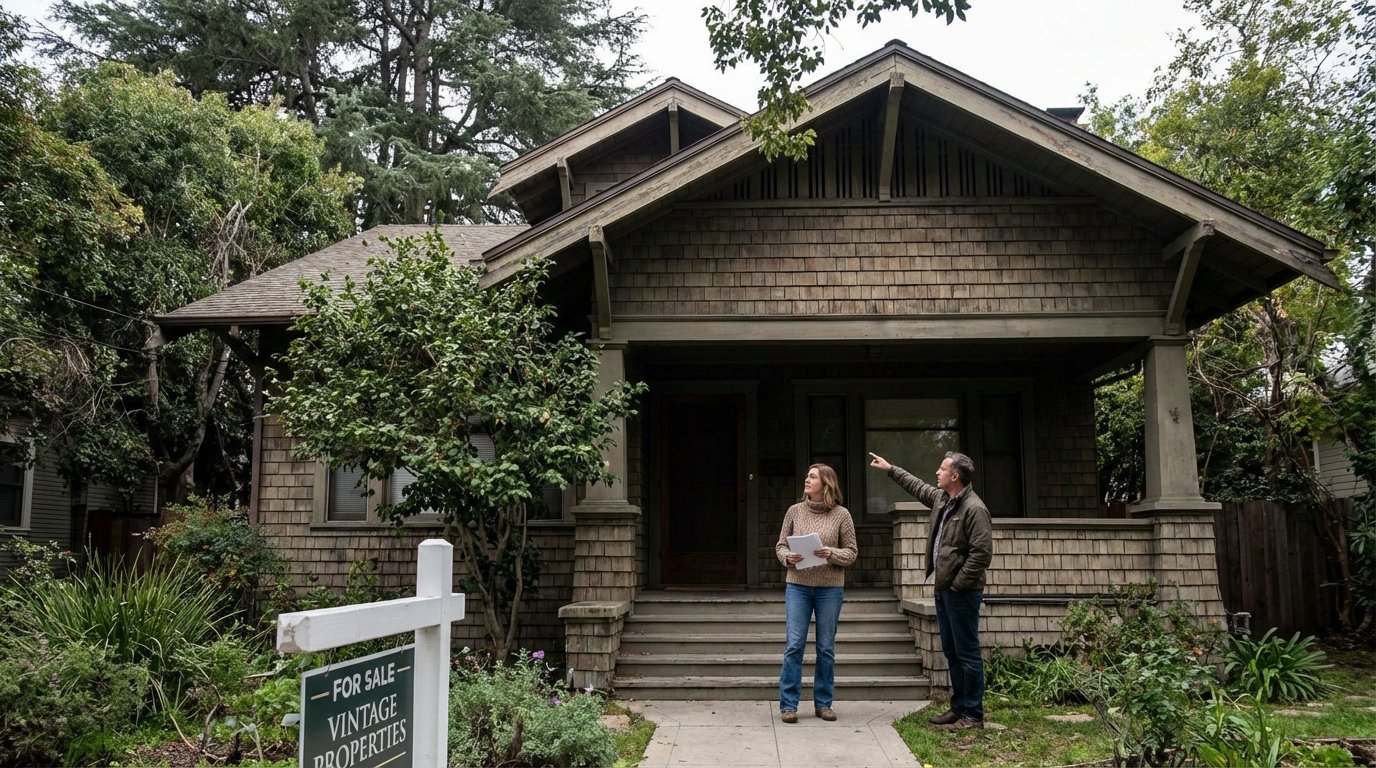
Why Historic Homes in Pasadena Are Hard to Sell Traditionally
The Restoration Expectation Problem
Buyers of historic homes in Pasadena are drawn to the architecture — original hardwood floors, built-in cabinetry, period tile work, clinker brick, and craftsman detailing. But they often expect those features to be in excellent condition, or they price in steep discounts for the work required. In a market where median days on market have stretched to 66 days, a historic home with deferred maintenance can sit even longer as buyers discount for restoration costs, request large inspection credits, and struggle to get lender approval.
Mills Act Contracts: A Benefit That Complicates Sales
Many Pasadena historic properties carry a Mills Act contract — a city program established in 2002 under California state law that offers substantial property tax reductions in exchange for a commitment to preserve and maintain the property according to the Secretary of Interior Standards.
Mills Act contracts run for ten-year terms and self-renew annually. They transfer to new owners at the time of sale. For buyers, this can be a significant financial benefit. But it also comes with obligations: the new owner inherits the maintenance and preservation schedule, and must continue meeting the standards agreed to with the City.
For sellers, this creates several complications in traditional sales:
- Disclosure requirements: The contract and its obligations must be fully disclosed to prospective buyers, which narrows the buyer pool to those who understand and accept the preservation requirements
- Financed buyer hesitation: Some lenders are unfamiliar with Mills Act properties and may require additional due diligence or raise underwriting flags, adding time and uncertainty to the escrow process
- Maintenance compliance questions: If the property has fallen behind on required maintenance under the contract, a traditional buyer’s agent or lender may raise questions about compliance history that can stall or kill a deal
- Condition vs. contract tension: If the home needs restoration work, buyers must weigh accepting a contract that mandates preservation standards against the cost of bringing the property into compliance
Historic District and Landmark Restrictions
Properties in designated Pasadena landmark districts are subject to Certificate of Appropriateness review for exterior alterations visible from the street. While this does not restrict paint colors, interior work, or most landscaping, it does add time and process to any significant exterior repair or renovation. Buyers who want to make changes — even to bring the property up to condition — face a review process that can take weeks or months.
For sellers, this means the pool of buyers who can realistically purchase, finance, and improve a historic Pasadena home in need of work is significantly narrower than for a standard property. Retail buyers often conclude the friction isn’t worth it.
Lender-Mandated Repairs on Financed Sales
When a buyer uses conventional financing or an FHA/VA loan, the lender’s appraiser will flag deferred maintenance items as required repairs before the loan can fund. In a historic Pasadena home, those items might include original knob-and-tube wiring, galvanized plumbing, aging roofing materials, or single-pane windows. These are not cosmetic issues — they’re items a lender will require to be addressed. This puts the seller in the position of either completing the repairs before closing (at significant cost) or watching financed deals fall through repeatedly.
Appraisal Complexity in a Softening Market
Historic homes are inherently difficult to appraise because comparable sales are limited. Pasadena Craftsman bungalows don’t have standard comps the way a tract home does. In a market where prices have declined 3.9% year over year, appraisers are under pressure to be conservative, and an appraisal that comes in below the agreed purchase price will either kill the deal or require the seller to reduce the price. Cash buyers eliminate this entirely — no appraisal, no gap, no renegotiation.
The Cost of Restoring Before You List
Many sellers assume they have no choice but to restore before selling. That assumption deserves scrutiny. Here’s what restoration work commonly costs on Pasadena historic homes:
| Restoration Item | Typical Cost Range |
|---|---|
| Electrical upgrade (knob-and-tube replacement) | $8,000–$20,000 |
| Plumbing (galvanized to copper) | $10,000–$30,000 |
| Roof replacement (period-appropriate materials) | $15,000–$40,000 |
| Foundation repairs | $10,000–$50,000+ |
| Window restoration or replacement | $5,000–$25,000 |
| Historic wood siding repair / repaint | $8,000–$20,000 |
| Kitchen / bath modernization | $25,000–$75,000 |
| Staging and pre-listing prep | $3,000–$10,000 |
Even a modest restoration package easily reaches $50,000–$100,000 before a single offer is received. And in today’s cooling market, there’s no guarantee you recoup every dollar spent. Cash buyers make that entire calculation irrelevant.
How a Cash Sale Works for Historic Pasadena Properties
A direct cash buyer purchases the property as-is, understanding the home’s condition, historic designation, and any Mills Act obligations. Here’s how the two paths compare:
| Traditional Listing | Cash Buyer | |
|---|---|---|
| Timeline | 60–90+ days on market | 2–4 weeks to close |
| Restoration required | Yes — to meet lender/buyer standards | No — as-is purchase |
| Lender-mandated repairs | Often required before close | None |
| Appraisal | Required, risk of gap | Not required |
| Mills Act disclosure complexity | Can deter financed buyers | Handled by experienced investor |
| Historic district review delays | Affect buyer renovation plans | Not a factor for buyer |
| Agent commission | 5–6% | None |
| Carrying costs during listing | $15,000–$25,000+ at $1.2M median | Minimal |
Get a no-obligation cash offer on your Pasadena historic home in 24 hours.
Who Benefits Most from a Cash Sale in Pasadena
Estates and Inherited Historic Properties
Inherited historic homes are among the most common cash sale candidates. Heirs typically don’t want to invest in a property they don’t live in, manage contractor access for restoration work, or navigate the Mills Act compliance questions with the City. A cash buyer handles all of that after closing. We also purchase properties with liens or complex title situations.
Long-Term Owners with Deferred Maintenance
Owners who have lived in their Pasadena home for 20 or 30 years have often deferred major systems work — not out of neglect, but because the home was livable and the cost wasn’t worth addressing while they were staying. When they’re ready to sell, the scope of work can feel overwhelming. A cash sale eliminates the need to tackle any of it.
Sellers Who Need to Close on a Specific Timeline
A job relocation, a move to assisted living, or a divorce settlement doesn’t wait for a 90-day listing. Cash buyers can close in two to four weeks on your schedule, without the uncertainty of a financed deal that may or may not survive the appraisal and lender process.
Sellers Who Don’t Want to Stage, Show, or Manage Contractors
Preparing a historic home for market is disruptive and time-consuming. Staging, cleaning, managing open houses, scheduling inspections, and responding to buyer requests for credits or repairs — all of that goes away with a direct cash sale. One walkthrough, one offer, one closing. See the full breakdown of what traditional listing costs add up to.
Frequently Asked Questions
Does my Pasadena home need to be a designated historic property for you to buy it?
No. We purchase all property types throughout Pasadena regardless of historic designation. Historic designation can add value, and we understand the Pasadena market deeply — including the premium that architecturally significant homes command even when they need work.
My home has a Mills Act contract. Does that complicate a cash sale?
Not for a cash buyer who knows the Pasadena market. The contract transfers to the buyer at closing. A knowledgeable cash buyer will price the property with the Mills Act contract’s benefits and obligations in mind, and won’t require you to resolve compliance questions before closing. Learn how we factor these details into our offer calculations.
The property needs significant work — roof, electrical, plumbing. Will that kill the offer?
No. We factor renovation scope into our pricing, but we do not require you to complete any repairs before closing. Our offer reflects the property’s as-is value. You avoid the contractor management, carrying costs, and risk of renovation overruns entirely. See why skipping the inspection process saves weeks of stress.
Will I get a fair price if I sell as-is?
The net proceeds comparison is often closer than sellers expect. When you subtract the cost of restoration work ($50,000–$100,000+), agent commissions (5–6% on $1.2M = $60,000–$72,000), carrying costs during a 60–90 day listing, and the risk of appraisal gaps or financing fallout, a cash offer at a moderate discount can yield comparable or better net proceeds. Run the numbers on the hidden costs of a traditional listing.
Do you buy historic homes in specific Pasadena neighborhoods?
We purchase properties throughout Pasadena, including Bungalow Heaven, Madison Heights, Prospect Park, Linda Vista, Old Town, the Arroyo Seco corridor, and surrounding neighborhoods. We also buy in South Pasadena, Altadena, and the broader San Gabriel Valley. Contact us to discuss your specific property and location.
The Bottom Line
Selling a historic Pasadena home doesn’t have to mean months of restoration work, a complicated listing process, and the uncertainty of financed buyers who may struggle with appraisals or lender requirements. A direct cash sale lets you capture the value of your property — architectural significance, neighborhood desirability, and all — without investing in repairs you’ll never personally benefit from.
Contact us today for a free, no-obligation cash offer on your Pasadena historic property. We know this market, we understand historic homes, and we close on your schedule.