
What It Really Costs You to Hold Your Mortgage for 60 Days Instead of 7
Most sellers focus all their attention on getting the highest offer. That is understandable. But there is another number most people completely ignore, and it quietly eats away at their profit every single day. That number is the daily cost of holding your mortgage while you wait for a slow deal to close.
Whether your sale takes 7 days or 60 days to close is not just a scheduling difference. It is a financial difference, and the gap can be bigger than most sellers realize until they actually run the math.
Why the Closing Timeline Matters More Than You Think
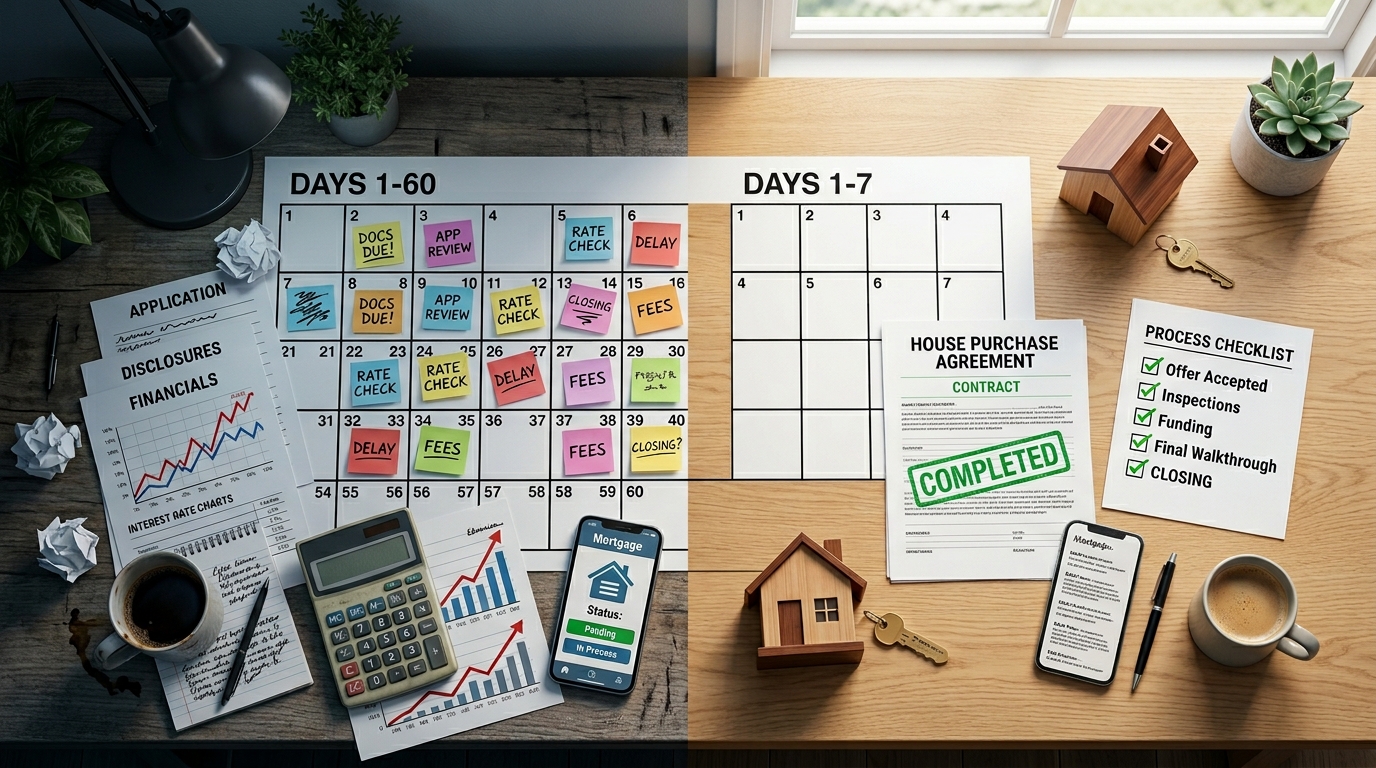
Here is something I did not fully appreciate the first time I helped someone sell a home. The mortgage does not stop while you wait for a buyer’s lender to get their paperwork done. Your insurance keeps running. Your property taxes keep accruing. Your utilities keep adding up. Every single day the deal is not closed, those costs are real money out of your pocket.
A traditional financed sale takes an average of 41 to 60 days to close from the time an offer is accepted. According to Zillow’s 2024 Buyer Trends Report, a 2024 study found that closing on a home after an offer is accepted takes an average of 44 days when a mortgage is involved. A cash sale, on the other hand, can close in as few as 7 days.
That is a difference of up to 53 days. And those 53 days have a price.
Breaking Down What Each Extra Day Actually Costs You
Let me walk through a real example. Say you have a $350,000 home with a $250,000 remaining mortgage balance at a 6.75% interest rate.
At 6.75%, the annual interest on $250,000 is $16,875. Divide that by 365 days and you get about $46 in mortgage interest every single day. That is just the interest. Now add the other holding costs that keep piling up.
Here is a realistic look at what you are paying every month you hold the home while waiting to close.
- Mortgage interest at 6.75% on a $250,000 balance is roughly $1,406 per month
- Property taxes averaging $300 to $500 per month depending on location
- Homeowner’s insurance running roughly $100 to $200 per month
- Utilities if the home is vacant, easily $150 to $300 per month
- HOA fees if applicable, ranging from $50 to $400 or more per month
- Any ongoing maintenance costs that come up while you wait
Add those up and the conservative estimate is $2,000 to $2,800 per month in total holding costs. Now divide by 30 days and you get roughly $67 to $93 every single day. Every day you wait to close costs you that much, whether the deal closes or falls apart.
The Real Dollar Difference Between Closing in 7 Days vs 60 Days
Let me put it into a clear table so you can see the actual impact side by side.
| Factor | Closing in 7 Days | Closing in 60 Days |
|---|---|---|
| Days Holding After Offer | 7 days | 60 days |
| Mortgage Interest (at $46/day) | $322 | $2,760 |
| Property Taxes ($13/day) | $91 | $780 |
| Insurance ($5/day) | $35 | $300 |
| Utilities ($7/day) | $49 | $420 |
| Total Holding Costs (Estimated) | Around $497 | Around $4,260 |
| Extra Cost From Waiting | Not applicable | About $3,763 more than closing in 7 days |
That is nearly $3,800 in extra costs just from waiting 53 more days. And this example uses a relatively modest mortgage balance. If your balance is higher, the numbers go up proportionally.
What Happens When a Financed Deal Falls Through
Here is where things get even worse. You waited 45 days on a financed buyer, paid nearly $3,000 in holding costs, and then the deal fell apart because the buyer’s loan was denied. Now you relist, wait another few weeks for offers, and start the clock all over again.
According to Bankrate, financing issues are one of the most common reasons a real estate deal falls through before closing. When that happens, all the holding costs you paid during that time are gone. You did not just lose time. You lost real money.
I have seen sellers go through two or even three failed financed deals before finally closing. The holding cost total in those situations can reach $8,000 to $12,000 or more on a mid-priced home. And most of those sellers never thought about it because they were just focused on the sale price.
Why a Lower Cash Offer Sometimes Nets You More Money
This is the part that surprises people the most. A cash offer that is $5,000 lower than a financed offer might actually put more money in your pocket when you subtract the holding costs from the financed deal.
If the cash deal closes in 7 days and costs you roughly $500 in holding costs, but the financed deal closes in 60 days and costs you $4,000 in holding costs, the financed deal has to be $3,500 higher just to break even. And that calculation does not even account for the risk that the financed deal might not close at all.
For sellers weighing their options, our post on why a fair cash offer beats a high contingent offer walks through the full picture in more detail. And if you are thinking about timing your sale around the interest rate environment, our breakdown of selling now vs waiting for interest rates to drop shows you the actual math on that decision too.
What Sellers Often Miss When Comparing Offers
Most sellers compare offers on two numbers: the purchase price and the closing date. But there is a third number that should always be part of the comparison, and that is the total cost of getting from accepted offer to actual closing.
The Other Costs Nobody Talks About
Beyond the daily holding costs, a longer closing can also mean other expenses that add up. If the buyer’s lender orders an appraisal and it comes in low, you either lower your price or lose the buyer. If the inspection reveals something that needs fixing, you might end up paying for repairs you did not budget for. If the buyer’s financing falls through, you lose all the time and money you spent during that deal.
A cash buyer removes almost all of those variables. No lender means no appraisal requirement. No mortgage underwriting means no last-minute loan denial. No lengthy inspection negotiation means the deal moves forward cleanly.
According to data from the Federal Reserve Bank of St. Louis, the median home sale price in the U.S. was $410,800 in Q2 2025. On a home at that price with a typical mortgage balance, closing costs and holding costs for a 60-day sale can easily run $5,000 to $8,000. That is real money that most sellers never account for when they compare offers.
How to Calculate Your Own Holding Cost Number
You do not need a complicated spreadsheet. Take your current monthly mortgage payment and add your property taxes, insurance, and utilities. Divide that total by 30. That is your daily holding cost number.
Now multiply that by how many days you expect a financed deal to take to close. Compare that to the same math on a 7-day cash deal. The difference is what closing fast is actually worth to you in real dollars.
If you want to find out what a fair cash offer on your home could look like, reach out through our Contact Us page or visit our residential property page to learn how we work and what a direct sale could put in your pocket.
Conclusion
The closing timeline is not just a calendar detail. It is a financial decision. Every extra day your mortgage, taxes, insurance, and utilities keep running while you wait for a deal to close is real money coming out of your final number. A fast cash close in 7 days can save you thousands of dollars in holding costs compared to a 60-day financed deal, and it eliminates the risk of starting over if the deal falls through. The best offer is not always the highest number on paper. It is the one that actually closes fast and leaves the most money in your pocket.
Frequently Asked Questions
What are holding costs when selling a house?
Holding costs are the ongoing expenses you pay while waiting for a sale to close. They include mortgage interest, property taxes, homeowner’s insurance, utilities, and any HOA fees. These costs add up every day from the time you accept an offer until the deal actually closes and you get paid.
How much does it cost per day to hold a house while waiting to close?
It depends on your mortgage balance and local expenses, but on a home with a $250,000 mortgage at 6.75%, mortgage interest alone runs about $46 per day. When you add property taxes, insurance, and utilities, total daily holding costs typically range from $67 to $100 or more.
Can a cash sale really close in 7 days?
Yes. Without a lender involved, there is no loan approval, no underwriting, and no appraisal required by a mortgage company. A cash sale can close in 7 to 14 days in most cases, which dramatically reduces the holding costs compared to a financed deal that takes 45 to 60 days.
Is a lower cash offer ever better than a higher financed offer?
Yes, once you factor in the holding costs of a longer financed closing. A cash offer $5,000 lower than a financed offer can actually net you more money if the financed deal runs $4,000 to $5,000 in holding costs before it closes. The risk of the financed deal falling through makes the math even more favorable for cash.
What happens to my holding costs if a financed deal falls through?
You lose all the holding costs you paid during that deal with nothing to show for it. If a financed deal takes 45 days and then falls through, those costs are gone. You then have to relist, find a new buyer, and pay those costs again during the next deal. It is one of the biggest hidden risks of accepting a contingent offer.