
If someone asks you for your Certificate of Occupancy and you have no idea where to start looking, you are not alone. Most LA homeowners have never needed this document until the moment they really do. Whether you are selling your home, pulling a permit, or dealing with a buyer who wants proof that the property was legally approved for occupancy, knowing where to find it in the city’s records can save you a lot of time and stress. Here is exactly where to look and what to do if it is not there.
What a Certificate of Occupancy Actually Is
A Certificate of Occupancy, often called a CO, is an official document issued by the city after a building inspection confirms that a structure is safe and meets all local building codes. It is basically the city’s way of saying the building is legal to live in or use for its intended purpose.
In Los Angeles, these certificates are issued by the Los Angeles Department of Building and Safety, also known as LADBS. Every new construction and most major renovations require one before anyone can legally move in or use the space. Older homes built before the city started keeping digital records may have a CO on file in paper form or may not have one documented at all.
Why You Might Need It When Selling Your Home
Honestly, a lot of sellers only find out about the Certificate of Occupancy requirement when a buyer or title company asks for it. It tends to come up when an addition was made to the home, a garage was converted to living space, or a major renovation was done at some point in the property’s history.
If the work was done with permits and inspections, the CO should be on file. If the work was done without permits, that is where things get complicated. A missing CO for an addition or conversion can slow down or even stop a sale, so it is worth locating yours before you get deep into the selling process.
Getting ahead of paperwork like this is part of a smart pre-sale strategy. Our post on the 3 documents you should have ready before calling a cash buyer covers the other key records you will want to pull together at the same time.
Where LA City Building Records Are Stored
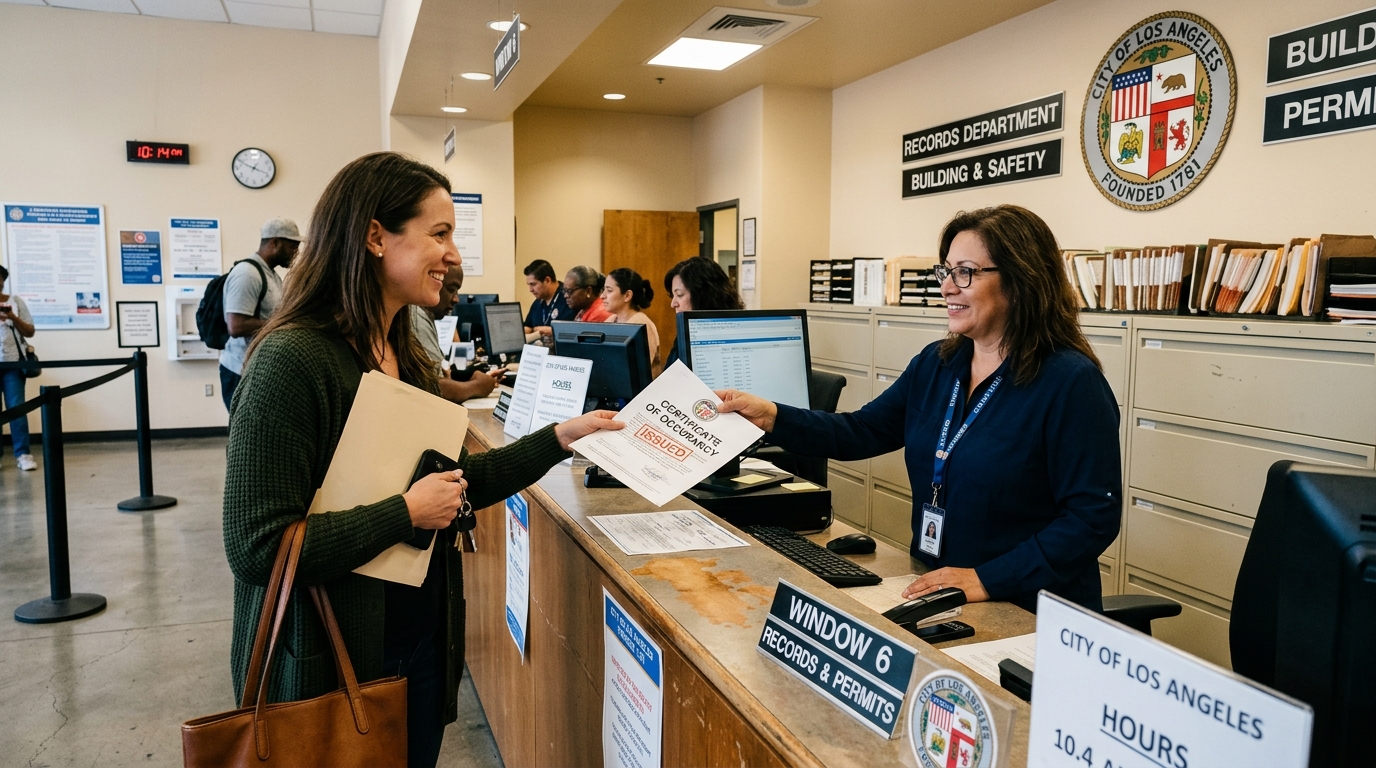
In Los Angeles, building permits and Certificates of Occupancy are managed by the Los Angeles Department of Building and Safety. They maintain records going back decades, and many of those records are now searchable online through their official records portal.
The primary place to start is the LADBS official website, which gives homeowners access to property inspection history, permit records, and in many cases, digital copies of Certificates of Occupancy. All you need is your property address to run a search.
For properties in the unincorporated parts of Los Angeles County rather than the City of LA, records are managed by the LA County Department of Regional Planning and the County Building and Safety office, which is a separate system from LADBS. Make sure you know whether your property falls within the City of Los Angeles boundaries or the County before you start searching.
How to Search for Your Certificate of Occupancy Online
The LADBS online records system is called LADBS.ORG and it is free to use. Here is a simple walkthrough of how to find your Certificate of Occupancy through their system.
- Go to the LADBS website. Visit ladbs.org and look for the section labeled Property Activity Report or Building Records.
- Enter your property address. Use the exact street address including the city. Partial addresses may not return the right results.
- Review the permit and inspection history. The system will show you all permits pulled on the property, including the inspection dates and whether each permit was finaled.
- Look for a finaled permit with a CO attached. A permit that has been finaled and closed means inspections were completed and approved. The CO is often attached to the final inspection record.
- Download or print the record. If the CO is available digitally, you can download it directly. For older records, you may need to make a records request.
- Request a copy if needed. If your records are not online, you can submit a records request through LADBS or visit their counter in person at a district office.
What to Do If You Cannot Find It Online
A lot of older homes in LA have records that were never digitized. If your property was built before the mid-1980s, there is a good chance the CO exists on paper in a physical archive rather than the online system. Do not panic. You still have options.
You can submit a records request directly to LADBS asking for a copy of any Certificate of Occupancy on file for your address. This can be done by mail, in person at a district office, or through their online request system. Processing time is usually a few weeks. There may be a small fee for copies.
You can also check with the Los Angeles City Clerk’s office or the County Assessor’s office, as some certificate records were filed across multiple city departments depending on when the home was built and what type of certificate was issued.
| Situation | Where to Look | How to Request |
|---|---|---|
| Home built after 1980, City of LA | LADBS online records portal | Free search at ladbs.org |
| Home built before 1980, City of LA | LADBS physical archive | Submit a records request online or in person |
| Property in unincorporated LA County | LA County Building and Safety | Separate county system, search at ladpw.org |
| Addition or renovation after original build | LADBS permit records tied to the work | Search by permit number if known |
| No record found at all | May need a new inspection | Contact LADBS to discuss options |
If you are trying to sell and the timeline matters, keep in mind that a missing CO can sometimes be addressed during escrow. Understanding how escrow timelines work can help you plan. Our breakdown of traditional escrow versus cash escrow timelines explains the difference and how each one handles complications like missing documentation.
What Happens If Your Property Does Not Have One
This is where a lot of sellers get nervous. If no Certificate of Occupancy exists for your home or for an addition on the property, it does not automatically mean you cannot sell. But it does mean you need a plan.
For original construction from many decades ago, Los Angeles allows what is called a Certificate of Occupancy Equivalent. This is a process where LADBS reviews historical records and existing conditions to certify that the home meets the standard for occupancy even if the original document is lost or was never created.
For unpermitted additions, the situation is more complicated. You may need to either pull a new permit and get an inspection, or disclose the unpermitted work to the buyer and accept that it could affect the offer. Cash buyers are often more willing to purchase homes with unpermitted additions because they are not restricted by lender guidelines that require everything to be fully permitted.
According to the U.S. Department of Housing and Urban Development, buyers and sellers should both understand any local code compliance requirements before entering into a purchase agreement. Knowing your property’s status ahead of time helps everyone involved make smarter decisions.
According to the National Association of Realtors, disclosure and documentation issues are among the most common reasons home sales are delayed or fall through. Having your Certificate of Occupancy or at least a clear picture of its status before you list puts you in a much stronger position.
If your home has a CO issue and you are thinking about selling, the best move is to talk to someone who understands these situations. Visit our We Buy Houses page to learn how we work with sellers who have documentation challenges. Or contact us directly and we can walk through your options together.
Conclusion
Finding your Certificate of Occupancy in LA city records is usually just a matter of knowing where to look. Start with the LADBS online portal, use your property address, and check the permit history. If nothing comes up digitally, submit a records request. And if the document simply does not exist for your property, there are still paths forward. Do not let a missing piece of paper stop a sale you are ready to make.
Frequently Asked Questions
Is a Certificate of Occupancy the same as a building permit?
No. A building permit is what allows the work to begin. A Certificate of Occupancy is issued after inspections confirm the work was done correctly and the building is safe to use. You need the permit first and the CO comes at the end of the process.
Does every home in LA need a Certificate of Occupancy?
New construction and major renovations require one. Very old homes built before the city formalized the CO process may not have one on file, but that does not necessarily mean the home is unpermitted. LADBS can help you determine the status of your property’s records.
How long does it take to get a copy of my Certificate of Occupancy from LADBS?
If the record is in the online system, you can access it immediately. If a records request is needed for older paper files, processing typically takes two to four weeks. Visiting a district office in person may speed things up.
Can I sell my home in LA without a Certificate of Occupancy?
It depends on the buyer. Cash buyers are generally more flexible about purchasing homes with missing or incomplete CO documentation. Traditional financed buyers may face lender restrictions that make the sale harder to close without one.
What does it cost to get a copy of my Certificate of Occupancy from LADBS?
Basic property record searches on the LADBS website are free. If you need a certified copy or have to submit a formal records request for archived documents, there is usually a small fee ranging from a few dollars to around $25 depending on the type of record requested.