
You bought your LA home years ago. It has gone up in value by a lot. Now you are thinking about selling and moving on to the next chapter. That is exciting. But before you start counting the proceeds, there is something that catches a lot of sellers off guard: capital gains tax. Knowing how it works before you sell can save you a serious amount of money.
What Capital Gains Tax Is and How It Applies to Your Home
A capital gain is the profit you make when you sell something for more than you paid for it. When it comes to your home, the gain is the difference between what you sell the house for and what you originally paid for it, adjusted for certain costs and improvements.
For example, if you bought your LA home for $400,000 and you sell it for $900,000, your capital gain is $500,000. The IRS and the state of California may both want a piece of that profit depending on how much it is and whether you qualify for any exclusions.
The good news is that most homeowners who sell their primary residence qualify for a big tax break that reduces or eliminates the federal tax on that gain. But there are rules you need to meet, and California adds its own tax on top of whatever the federal government does not cover.
Federal Capital Gains Tax Rates for Home Sales in 2025
On the federal side, the tax rate you pay depends on how long you have owned the home and what your income is. If you owned the home for less than one year before selling, the profit is taxed as regular income at your ordinary income tax rate. That is called a short-term capital gain.
If you owned it for more than one year, it is treated as a long-term capital gain, which has lower tax rates. According to the IRS, for 2025, the long-term capital gains rates are 0%, 15%, or 20% depending on your taxable income. Most middle-income sellers pay 15%. Higher earners pay 20%.
Since most LA homeowners have owned their properties for several years, the long-term rates are what apply to most sales. But it still adds up fast when you are sitting on a $400,000 or $600,000 gain.
How California Taxes Your Home Sale Profit
Here is where California gets tough. The state does not offer a separate lower rate for capital gains on home sales. According to the California Franchise Tax Board, California taxes capital gains the same as regular income. That means the state tax rate on your home sale profit follows your regular income tax bracket, which goes from 1% all the way up to 13.3% for the highest earners.
So if you are in the upper income brackets and your home sale creates a large taxable gain, you could be looking at a combined federal and California tax rate of up to 37% or higher on the portion of your gain that exceeds any exclusion. That is a big number, which is exactly why planning ahead matters so much.
The Section 121 Exclusion and How It Can Save You a Lot of Money
Most LA homeowners selling their primary residence will qualify for the Section 121 exclusion. This is a federal rule that lets you exclude a significant amount of your capital gain from taxes completely.
If you are single, you can exclude up to $250,000 of capital gains from the sale. If you are married and filing jointly, you can exclude up to $500,000. According to IRS Publication 523, to qualify you must meet two tests. First, the ownership test, meaning you owned the home for at least two of the last five years before the sale. Second, the use test, meaning you lived in the home as your primary residence for at least two of the last five years before the sale. The two years do not have to be back to back, they just need to add up to 24 months within that five-year window.
You also cannot have used this exclusion on another home sale within the past two years. That is about it. For most long-term LA homeowners, meeting these two tests is straightforward.
Real Numbers: What the Exclusion Looks Like in LA
Let me put some real numbers to this so it is easier to understand.
| Situation | Sale Price | Purchase Price | Gain | Exclusion Available | Taxable Gain |
|---|---|---|---|---|---|
| Single seller, qualifies | $750,000 | $350,000 | $400,000 | $250,000 | $150,000 |
| Married couple, qualifies | $1,000,000 | $400,000 | $600,000 | $500,000 | $100,000 |
| Married couple, large gain | $1,500,000 | $300,000 | $1,200,000 | $500,000 | $700,000 |
| Single seller, does not qualify | $750,000 | $350,000 | $400,000 | $0 | $400,000 |
You can see why qualifying for the exclusion matters so much in a market like Los Angeles, where gains of $400,000 to $700,000 on a long-held home are not unusual at all.
What Counts as Your Adjusted Cost Basis and Why It Matters
Your capital gain is not just the difference between sale price and purchase price. You can adjust the original purchase price upward by adding the cost of major capital improvements you made while owning the home. This lowers your taxable gain.
Capital improvements are things that added real value or extended the life of the home. Things like a new roof, adding a bathroom, a kitchen remodel, new HVAC system, or finishing a basement. Routine repairs do not count, but significant upgrades do.
You can also add certain selling expenses to your basis, like real estate commissions, escrow fees, title insurance, and legal fees. Every dollar you add to your adjusted cost basis is a dollar less of taxable gain. If you made major improvements over the years and have receipts, it is very much worth the effort to track those down before you file.
Special Situations That Affect How Your Gain Is Taxed
Not every home sale is straightforward. A few situations change how the rules apply, and LA homeowners run into these more often than you might think.
If you used part of your home as a home office and claimed depreciation deductions on your taxes, that depreciation has to be recaptured and taxed separately, even if the rest of your gain qualifies for the Section 121 exclusion. The recapture rate is capped at 25% federally.
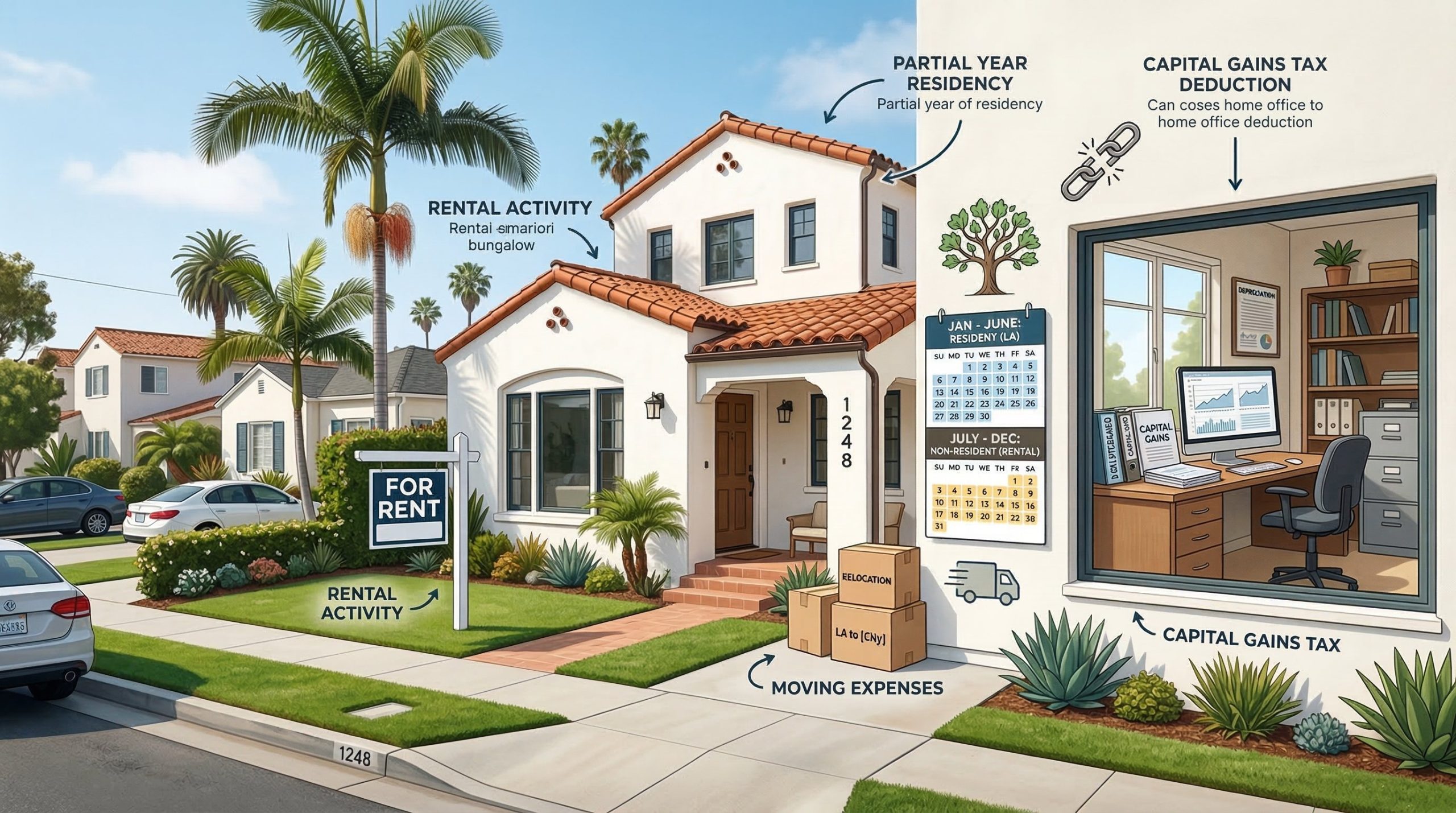
If you rented out the home before making it your primary residence, a portion of the gain may not qualify for the exclusion. The IRS calls this nonqualified use, and those gains are taxable. This comes up often with homeowners who bought a property as a rental and later moved in.
Here are some other common situations worth knowing about.
- Divorce situations: If a spouse is awarded the home and sells it later, they may still be able to count the other spouse’s period of use toward the two-year residency test.
- Inherited homes: If you inherited a home, your cost basis is typically stepped up to the fair market value at the time of the original owner’s death. That can significantly reduce or eliminate the capital gain.
- Partial exclusion: If you have to sell before meeting the two-year test due to job relocation, health issues, or an unforeseen event, the IRS may allow a partial exclusion based on how much of the two-year period you did meet.
- Second homes and vacation properties: The Section 121 exclusion does not apply to investment properties, vacation homes, or second homes. The full gain is taxable.
How to Lower Your Tax Bill Before You Sell
There are legal, smart ways to reduce how much you owe before and at the time of the sale. None of these are shortcuts or loopholes. They are just good planning.
First, gather every receipt and record of improvements you made to the home while you owned it. The more you can add to your adjusted cost basis, the lower your taxable gain. Many sellers leave money on the table here simply because they did not keep good records.
Second, talk to a tax professional before you list the property. They can run the numbers and tell you whether timing the sale in a lower-income year could move you into a lower capital gains bracket. This matters more than people realize, especially if you are close to a bracket threshold.
Third, if the property is an investment property rather than your primary residence, a 1031 exchange may allow you to defer the capital gains entirely by rolling the proceeds into a new investment property. This strategy does not apply to your primary home, but if you are selling a rental, it is one of the most powerful tools available.
If you want to see how a fast cash sale affects the overall financial picture, including timing and net proceeds, our page on selling your house fast in Los Angeles walks through what to expect from start to finish.
For investors considering a 1031 exchange after selling a rental, our detailed guide on using a cash sale to fund a 1031 exchange explains exactly how that works and why speed of closing matters in that strategy.
Have questions about your specific situation or want to get a no-obligation offer on your LA home? Reach out through our contact page and we will be happy to help you think through your options.
Conclusion
Capital gains tax on a home sale in Los Angeles can be significant, but it is also very manageable when you plan ahead. Most primary residence sellers qualify for the Section 121 exclusion, which removes a large chunk of the gain from taxation entirely. The rest can often be reduced by tracking improvements and selling costs carefully.
The part that catches people off guard is California’s treatment of gains as regular income. There is no special lower rate at the state level, so higher earners can face a steep combined tax bill on gains above the exclusion amount.
The bottom line is simple. Do not walk into a home sale without understanding what you will owe. Talk to a tax advisor, track your basis, and make sure you qualify for every exclusion available to you. A little preparation before the sale can keep a lot more of that equity in your pocket.
Frequently Asked Questions
Do I have to pay capital gains tax when I sell my primary residence in LA?
Not necessarily. If you have lived in the home as your primary residence for at least two of the last five years and you have owned it for at least two years, you may qualify for the Section 121 exclusion. This lets single sellers exclude up to $250,000 of gain and married couples filing jointly exclude up to $500,000. If your gain is under those amounts, you may owe nothing in federal capital gains tax. California will still tax any taxable gain as regular income, so state taxes may still apply depending on the size of your gain.
What is the two-year rule for selling a home without paying capital gains?
The two-year rule refers to the Section 121 residency and ownership tests. You must have owned the home for at least two years and lived in it as your primary residence for at least two years within the five-year period before the sale. The two years do not have to be consecutive. If you meet both tests and have not used the exclusion in the past two years, you qualify. IRS Publication 523 covers all the details and exceptions for situations like job relocation, health, or divorce.
How does California tax capital gains on a home sale?
California does not offer a special lower rate for capital gains. The California Franchise Tax Board taxes all capital gains, including those from a home sale, as regular income. That means the state tax rate on your gain follows your regular income tax bracket, which ranges from 1% to 13.3% depending on your total income for the year. If you have a large taxable gain after the federal exclusion, California’s share of the tax bill can be significant.
Can home improvements reduce my capital gains tax?
Yes. The cost of major capital improvements adds to your adjusted cost basis, which reduces your taxable gain. If you added a room, remodeled the kitchen, replaced the roof, or made other significant upgrades, the money you spent on those projects lowers the profit the IRS calculates. Keep receipts and records for every major improvement you made while owning the home. This is one of the most straightforward and legal ways to reduce what you owe at sale time.
What happens if I have to sell before living there for two years?
If you cannot meet the full two-year residency requirement because of a job relocation, a health issue, or another unforeseen event, the IRS may allow a partial exclusion. The partial exclusion is calculated based on how much of the two-year period you did meet. For example, if you lived in the home for one year out of the required two, you may be able to exclude 50% of the normal exclusion amount. You would report the details on IRS Form 8949 and Schedule D when filing your taxes for that year.