
You have been sitting on an investment property for years. It has gone up in value. A lot. And now you are thinking about selling and moving that money into something bigger. But the tax bill on those capital gains is looking pretty brutal. That is where a 1031 exchange comes in, and a fast cash sale might be the best way to kick the whole thing off.
What a 1031 Exchange Is and Why Investors Use It
A 1031 exchange is a tax strategy that lets real estate investors sell an investment property and roll the proceeds into a new one without paying capital gains tax right away. The name comes from Section 1031 of the Internal Revenue Code.
The basic idea is simple. Instead of cashing out and handing a big chunk to the IRS, you keep all your money working in real estate. You sell your old property and use every dollar from that sale to buy a new one that is equal to or greater in value. The tax gets pushed down the road, sometimes indefinitely if you keep doing exchanges over time.
According to Fidelity Investments, federal capital gains taxes on investment property sales can run up to 20 percent, and depreciation recapture taxes are capped at 25 percent of gains. On a property that has appreciated significantly, that tax hit can easily be hundreds of thousands of dollars. The 1031 exchange lets you defer all of that.
The Key Rules You Have to Follow
The IRS is strict about how a 1031 exchange has to work. Getting any of these wrong can blow up your tax deferral and leave you with a surprise tax bill.
First, you cannot touch the money yourself. When you sell your property, the proceeds have to go directly to a qualified intermediary, which is an independent third party who holds the funds until you are ready to buy your replacement property. If the money lands in your account even for a day, the exchange is voided.
Second, you have 45 days from the date you sell your property to identify your replacement property in writing. That clock starts the moment your sale closes, not when you feel ready. Third, you have 180 days total from the sale date to close on that replacement property. And the replacement must be of equal or greater value than what you sold.
Any leftover cash that you do not reinvest is called boot. Boot is taxable, so most investors aim to reinvest every dollar from the sale to defer the full gain.
Why the Type of Sale You Use Matters More Than People Think
Here is something that does not get talked about enough. The type of sale you use to sell your relinquished property has a big effect on whether your 1031 exchange actually works on your timeline.
A traditional sale through a real estate agent with a mortgage-backed buyer can take 45 to 90 days to close, sometimes longer. If deals fall through, you start the process over. All the while, your 180-day 1031 window is either not started yet or ticking down while you wait on a new buyer.
A cash sale moves differently. Cash buyers do not need mortgage approval, appraisals, or lender underwriting. They can typically close in 7 to 21 days. That speed is not just convenient. For a 1031 exchange, it is often the difference between having enough time to find and close on a great replacement property versus scrambling under deadline pressure.
How a Cash Sale Works as the Starting Point for a 1031 Exchange
When you sell to a cash buyer, you get a clean, fast close with no financing contingencies hanging over the deal. Once you close, your qualified intermediary receives the proceeds directly. That triggers the start of your exchange timeline with all your capital intact and ready to deploy.
Because the sale happened quickly and cleanly, you have the full 45 days to identify your replacement property without feeling rushed on the back end of a slow traditional sale. You also avoid the common problem of a deal falling apart at the last minute, which can happen with mortgage-backed buyers and leave you scrambling to restart your timeline.
I have seen investors lose their 1031 window because a traditional sale dragged on, a buyer’s financing fell through twice, and by the time they finally closed they only had a handful of weeks to identify and buy a replacement. That kind of pressure leads to bad decisions. A cash sale up front removes that pressure entirely.
The Step-by-Step Process for Using a Cash Sale in a 1031 Exchange
Here is how the process actually flows when you combine a cash sale with a 1031 exchange.
- Before you list, hire a qualified intermediary. You must have one in place before your sale closes or the exchange cannot work. Do not wait on this step.
- Sell your investment property to a cash buyer. The cash buyer closes fast, typically in 1 to 3 weeks, with no financing contingencies.
- At closing, the proceeds go directly from the closing agent to your qualified intermediary. You never receive or touch the funds personally.
- Within 45 days of closing, identify your replacement property or properties in writing and submit that identification to your qualified intermediary.
- Within 180 days of your original closing, complete the purchase of the replacement property. Your qualified intermediary releases the funds to the title or escrow company to close the deal.
- File IRS Form 8824 with your tax return for the year the exchange was completed to report the transaction and maintain the tax-deferred status.
That is the whole process. Simple in concept, but the deadlines are firm. Miss the 45-day identification window or the 180-day close window and the IRS treats your sale as a taxable event, not an exchange.
What Properties Qualify and What Do Not
Not every property qualifies for a 1031 exchange. The rules are specific. Both the property you are selling and the one you are buying must be held for investment or used in a trade or business.
Your primary residence does not qualify. A vacation home you use personally for more than 14 days a year likely does not qualify either. Fix-and-flip properties held for quick resale generally do not qualify because the IRS views them as inventory held for sale rather than investment.
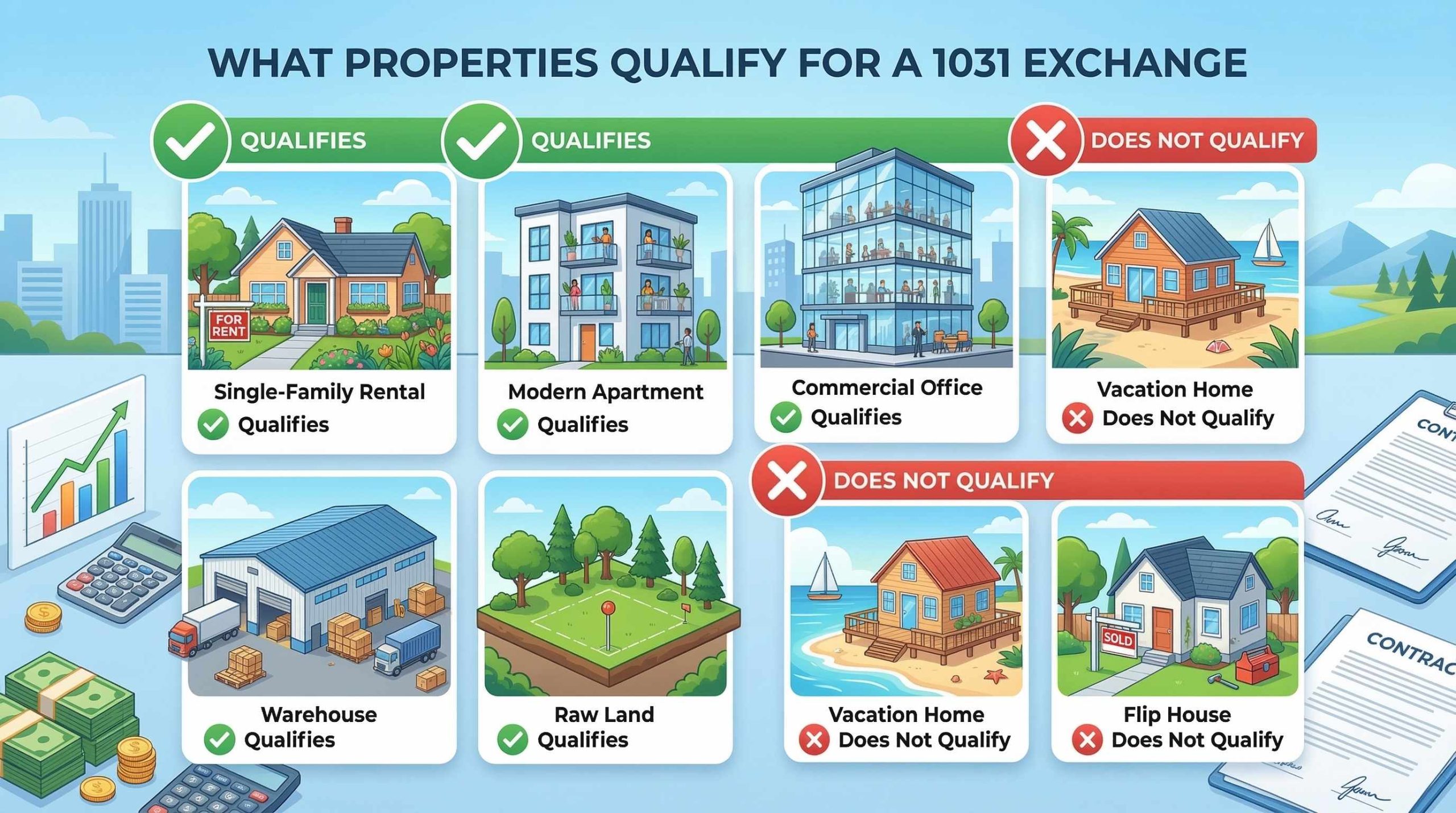
Qualifying properties include rental homes, apartment buildings, commercial properties, raw land held for investment, and office buildings used in a business. And here is a part that surprises a lot of people: you do not have to trade one type for the same type. You can sell a single-family rental and buy an apartment complex. You can sell a warehouse and buy raw land. As long as both properties are held for investment or business use, the exchange works.
According to TurboTax, after 2018 the 1031 exchange can only be used for real property. Prior to that, it could also apply to personal property like machinery and equipment. That door is now closed for anything other than real estate.
Why Investors in Los Angeles Use Cash Sales to Start Their 1031 Exchanges
LA investment properties have appreciated enormously over the past decade. A rental property bought for $400,000 in 2014 might be worth $900,000 or more today. That gain is sitting there waiting to be taxed the moment you sell traditionally.
For investors who want to grow their portfolio rather than hand a big portion of their equity to the IRS, the 1031 exchange is one of the most powerful tools available. And because timing is so important to making the exchange work correctly, starting with a clean cash sale is the most reliable way to get the process rolling.
Cash sales in LA also remove the common complications that derail traditional sales here: low appraisals, lender conditions, long escrow timelines, and deals that fall apart over inspection repairs. Those are real risks in this market, and any of them can wreck your 1031 window.
A Simple Comparison of Traditional Sale vs Cash Sale for a 1031 Exchange
| Factor | Traditional Sale with Mortgage Buyer | Cash Sale |
|---|---|---|
| Average time to close | 45 to 90 days or longer | 7 to 21 days |
| Risk of deal falling through | Higher, financing contingencies | Lower, no lender required |
| Impact on 1031 timeline | Eats into your 180-day window | Starts the clock on your terms |
| Appraisal required | Yes, by the lender | No |
| Repair demands from buyer | Common after inspection | Typically none for as-is buyers |
| Certainty of closing | Less certain | Higher certainty |
Getting Your 1031 Exchange Started the Right Way
The most important thing to do before you sell is get your qualified intermediary in place. According to the IRS, you must have a formal exchange agreement with your intermediary set up before the closing of your relinquished property. If you try to set it up after the fact, the exchange fails.
Once that is in place, a cash sale is the cleanest way to start the clock. You know your close date in advance, you can coordinate with your intermediary and your replacement property search, and there are no surprises at the finish line.
If you own an investment property in Los Angeles and want to explore a cash sale as part of a 1031 exchange strategy, we work with investors throughout the process. We buy investment properties as-is at fair prices with fast, certain closes that give you the clean start your exchange needs.
Reach out through our contact page to talk through your situation and get a no-obligation offer on your property.
And for a broader look at how cash sales compare to the traditional selling process in LA, our post on traditional versus cash home sales covers the full picture from a seller’s perspective.
If you want to understand how cash buyers evaluate investment properties and what they are looking for, our breakdown of why iBuyers are not always the right fit for LA homeowners explains the difference between investor cash buyers and institutional iBuyer programs, and why the right match matters.
You can also visit our sell your house fast in Los Angeles page to learn how the process works from start to finish.
Conclusion
A 1031 exchange is one of the smartest tax deferral tools available to real estate investors, but it only works when the timing and execution are right. A cash sale is the most reliable way to kick off the process because it closes fast, closes clean, and starts your exchange clock on your terms rather than on a lender’s schedule.
If you are sitting on an appreciated investment property in Los Angeles and thinking about your next move, understanding how a cash sale connects to a 1031 exchange could save you a significant amount in taxes while giving you more capital to put to work in your next investment.
Talk to your tax advisor or a qualified intermediary first, then reach out to us when you are ready for the sale.
Frequently Asked Questions
Can I use a cash sale to start a 1031 exchange?
Yes, absolutely. A cash sale is actually one of the best ways to start a 1031 exchange because it closes quickly and cleanly. The proceeds go directly to your qualified intermediary at closing, which starts your 45-day identification window and 180-day purchase window without the delays that can come from a mortgage-backed sale.
What is a qualified intermediary and do I really need one?
A qualified intermediary is an independent third party who holds your sale proceeds between the time you sell your old property and when you close on the new one. The IRS requires you to use one. You cannot receive the money yourself at any point during the exchange, or the whole transaction loses its tax-deferred status and becomes a regular taxable sale.
How long do I have to find my replacement property after selling?
You have 45 days from the date your sale closes to identify your replacement property in writing. You then have 180 days total from your sale date to actually close on the replacement. These deadlines include weekends and holidays and cannot be extended. Missing either one means your capital gains become taxable immediately.
Does my primary residence qualify for a 1031 exchange?
No. A 1031 exchange only applies to properties held for investment or business use. Your primary residence does not qualify. Vacation homes you use personally for more than 14 days a year are also generally excluded. The property you sell and the property you buy both have to be investment or business properties to qualify for the tax deferral.
What happens if I do not reinvest all the money from my sale?
Any leftover cash that you do not reinvest in your replacement property is called boot, and it is taxable. To defer all of your capital gains, you need to reinvest the full amount of your net proceeds into a replacement property of equal or greater value. If you reinvest only part of the proceeds, you defer only part of the gain and pay taxes on the portion represented by the boot.