
What a Reverse Mortgage Buyout Actually Means for Homeowners
A retired couple in Pasadena had been living in their home for thirty-one years. Their mortgage was paid off. But rising property taxes, unexpected medical expenses, and a fixed Social Security income were starting to create real monthly pressure. They had over $900,000 in equity sitting in that house and no good way to access it without selling or taking on a monthly payment they could not afford.
What they did not know was that a reverse mortgage could give them access to a significant portion of that equity without any monthly payment requirement at all, as long as they continued living in the home. And in the right situation, it can be used as a buyout strategy that protects their position in the property while converting locked-up equity into usable funds.
This post explains exactly how a reverse mortgage buyout works, who it makes sense for, what the risks are, and how California homeowners can use this tool strategically to protect equity rather than lose it to financial pressure.
What a Reverse Mortgage Is and How It Works
A reverse mortgage is a loan that allows homeowners who are at least 62 years old to borrow against the equity in their home without making monthly mortgage payments. The loan does not have to be repaid until the borrower no longer uses the home as their primary residence, either because they sell, move out, or pass away. At that point, the loan balance plus accrued interest is repaid, typically from the sale proceeds of the home.
The most common type is the Home Equity Conversion Mortgage (HECM), which is insured by the Federal Housing Administration and regulated by the U.S. Department of Housing and Urban Development. For 2026, the FHA HECM lending limit has been set at $1,249,125, meaning the calculation for how much you can borrow is based on that maximum home value even if your property is worth more. California also has high-value markets where homes routinely exceed this cap, which is where jumbo reverse mortgages, also called proprietary programs, come into play. These private programs can accommodate home values reaching several million dollars and are especially relevant in Los Angeles, Orange County, and San Francisco.
According to Truss Financial Group’s California reverse mortgage guide, a 70-year-old homeowner in a high-value market like San Francisco with a $2.5 million property and no existing mortgage could potentially access over $1 million in available reverse mortgage funds through a jumbo program. For LA homeowners with similar equity positions, these programs represent a genuinely significant source of accessible capital.
Who Qualifies for a Reverse Mortgage in California
The qualification requirements for a reverse mortgage are different from a traditional mortgage. There is no income requirement for a standard HECM, which makes this option accessible to retirees who have home equity but limited monthly cash flow. Here are the core requirements:
- Age requirement. At least one borrower must be 62 or older for a federally insured HECM. Some proprietary jumbo programs allow borrowers as young as 55 in California.
- Primary residence. The home must be your principal residence. You cannot use a reverse mortgage on a vacation home or investment property.
- Home type. Eligible properties include single-family homes, FHA-approved condominiums, and certain manufactured homes. Most standard single-family California homes qualify.
- Property taxes and insurance. You must continue paying property taxes, homeowner’s insurance, and HOA fees if applicable. Falling behind on these can trigger loan default even with a reverse mortgage.
- HUD counseling. All HECM borrowers must complete a session with an approved HUD housing counselor before the loan can close. This is designed to ensure borrowers fully understand the product before committing.
How a Reverse Mortgage Functions as a Buyout Strategy
The term buyout in the context of a reverse mortgage refers to using the loan proceeds to pay off an existing mortgage, buy out a co-owner’s share, or in some cases fund a purchase of a new home. Here is how each version works.
Using a Reverse Mortgage to Pay Off an Existing Mortgage
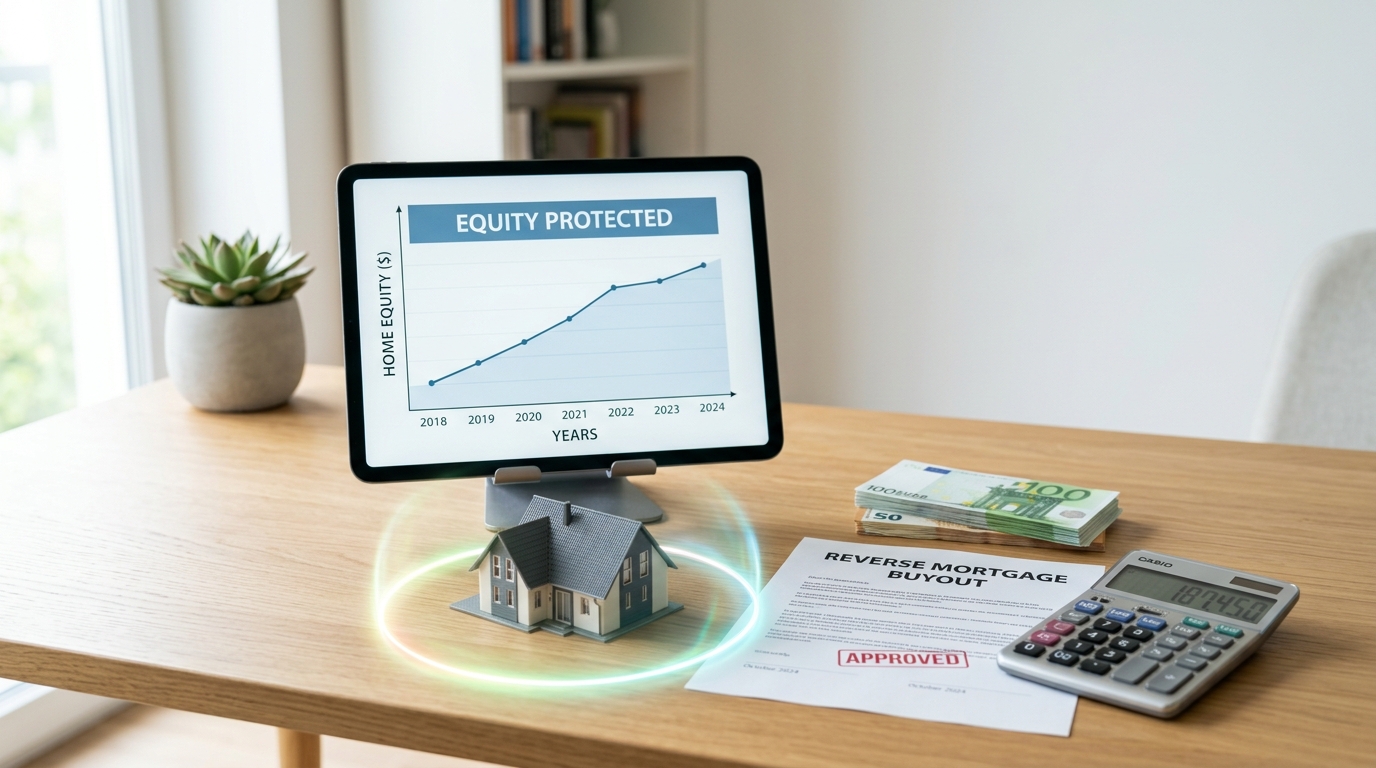
One of the most common uses of a reverse mortgage is paying off a remaining conventional mortgage balance. If a 68-year-old homeowner in the San Gabriel Valley has $200,000 left on a traditional mortgage with a $1,500 monthly payment that is straining their retirement income, a reverse mortgage can pay off that balance entirely. The monthly payment disappears. The homeowner stays in the home. And they can access additional equity as a lump sum, monthly income, or a line of credit depending on the program they choose.
This is the core of what many people mean when they say a reverse mortgage can save your equity. Without it, that homeowner might be forced to sell the home just to eliminate the monthly payment, surrendering all of their remaining equity and the home itself. A reverse mortgage lets them eliminate the payment pressure and stay put.
Using a Reverse Mortgage to Buy Out a Co-Owner
This situation comes up when a home is co-owned and one owner wants to stay while the other wants to cash out their share. This is common in divorces, in estate situations where one sibling inherited the home and wants to live there while others want their share paid out, and in other family property disputes.
If the homeowner who wants to stay is 62 or older and has sufficient equity, a reverse mortgage can provide the funds to buy out the departing co-owner without requiring a sale of the property. The staying owner keeps the home. The departing owner gets their equity. The reverse mortgage balance is repaid when the property eventually sells.
For situations where co-ownership disputes involve a partition action, our guide on the California partition action and how to sell when co-owners disagree explains the legal framework that sometimes runs parallel to the buyout conversation.
The Real Risks Every Homeowner Should Understand
A reverse mortgage is a powerful tool, but it is also frequently misunderstood and misused. The risks are real and specific, and ignoring them can put a homeowner in a worse position than they started.
Equity Decreases Over Time as Interest Accrues
Because you are not making monthly payments, the interest on a reverse mortgage accumulates over time and is added to the loan balance. The longer you stay in the home after taking out the reverse mortgage, the larger the loan balance grows. If you stay for twenty years, the balance at repayment could be significantly larger than the original loan amount. In a high-appreciation market like Los Angeles, rising home values often offset this, but it is not guaranteed.
This is the core trade-off. A reverse mortgage converts equity into current purchasing power at the cost of reducing what you or your heirs will receive from the eventual sale of the home.
Property Taxes and Insurance Obligations Remain
One of the most common ways reverse mortgages go wrong is when borrowers fall behind on property taxes or homeowner’s insurance. These obligations do not go away just because you no longer have a monthly mortgage payment. If you stop paying them, the lender has the right to declare the loan in default and initiate foreclosure proceedings. According to the U.S. Code governing reverse mortgage requirements, the loan becomes due and payable if the borrower fails to maintain the property or pay property charges.
This is especially important for California homeowners because even with Proposition 13 protections limiting annual tax increases on the base value, total property tax bills in LA can still be significant. Always budget for ongoing property obligations before committing to a reverse mortgage.
Impact on Heirs and Estate Planning
If you plan to leave the home to your children or other heirs, a reverse mortgage will reduce the equity they receive. When the loan becomes due, your heirs have a few options. They can sell the home and repay the loan from the proceeds. They can refinance the reverse mortgage into a traditional mortgage if they want to keep the home. Or if the loan balance exceeds the home’s value, which is possible in declining markets, the FHA insurance on a HECM guarantees that neither you nor your heirs will owe more than the home is worth at the time of sale. This is what is called the non-recourse feature of a reverse mortgage.
Our post on selling a house in a living trust in Los Angeles is directly relevant here, since many homeowners considering a reverse mortgage also hold their property in a trust, and the interaction between trust ownership and reverse mortgage qualification is something that needs careful planning with an estate attorney.
Comparing a Reverse Mortgage to Selling the Home Outright
For homeowners weighing whether to use a reverse mortgage or simply sell and move on, here is a straightforward comparison of both paths.
| Factor | Reverse Mortgage | Sell and Relocate |
|---|---|---|
| Stay in Your Home | Yes, as long as you meet obligations | No |
| Monthly Payment Required | No | Not applicable (no home after sale) |
| Access to Equity | Partial, based on age and home value | Full equity minus selling costs |
| Effect on Heirs | Reduced inheritance, home may be sold to repay | No encumbrance on estate |
| Ongoing Obligations | Property taxes, insurance, maintenance | None on sold property |
| Emotional Impact | Allows staying in family home | Requires leaving longtime home |
For many California homeowners, especially those in LA where home values are high but retirement income is fixed, a reverse mortgage is not a last resort. It is a strategic financial tool that can make the difference between being forced to sell and being able to stay in your home on your own terms.
If you want to explore whether a direct sale of your home might actually serve your goals better than a reverse mortgage in your specific situation, our team can walk through both options with you. Reach out through our Contact Us page and we will get back to you quickly.
To see what areas of Los Angeles and California we serve for home purchases, visit our Locations page.
Conclusion
A reverse mortgage is one of the most misunderstood financial tools available to older homeowners. Done correctly, it can eliminate monthly mortgage payments, provide access to equity without a forced sale, and help California homeowners stay in their homes under far less financial pressure.
Done incorrectly, or without fully understanding the risks, it can accelerate the loss of equity and create estate complications that outlast the borrower. The key is going in with complete information, talking to an independent HUD-approved counselor before committing, and being honest about whether staying in the home long-term is truly what you want and need.
If selling eventually makes more sense for your situation, knowing all your options first will make that conversation a lot easier to navigate.
Frequently Asked Questions
What is the minimum age to get a reverse mortgage in California?
For a federally insured HECM reverse mortgage, the minimum age is 62. California also has proprietary jumbo reverse mortgage programs offered by private lenders that allow borrowers as young as 55 to qualify. These jumbo programs are particularly relevant for California homeowners with high-value properties that exceed the standard HECM lending limit of $1,249,125. Always work with a licensed reverse mortgage lender and complete the required HUD counseling session before proceeding.
Can I lose my home with a reverse mortgage?
Yes, under certain conditions. While a reverse mortgage does not require monthly payments, borrowers must continue paying property taxes, homeowner’s insurance, and HOA fees, and must maintain the property in reasonable condition. If any of these obligations are not met, the lender can declare the loan in default. Borrowers can also trigger loan repayment by moving out of the home for more than 12 consecutive months. Understanding these obligations fully before signing is essential.
How much can I borrow with a reverse mortgage in California?
The amount you can borrow depends on your age, current interest rates, and your home’s value up to the program limit. Generally, the older you are and the more equity you have, the more you can access. For a standard HECM, the maximum home value considered is $1,249,125 for 2026. Jumbo proprietary programs can accommodate homes worth $4 million or more with correspondingly larger loan amounts. Borrowers typically access somewhere between 40 and 75 percent of their home’s value depending on age and rate conditions.
What happens to my reverse mortgage when I pass away?
When the last borrower on a reverse mortgage passes away, the loan becomes due and payable. Your heirs typically have about 12 months to either repay the loan and keep the home, or sell the home and use the proceeds to pay off the loan balance. If the loan balance exceeds the home’s sale value, HECM reverse mortgages are non-recourse loans, which means neither your estate nor your heirs owe more than the home is worth. Any remaining proceeds after the loan is repaid belong to the heirs.
Does a reverse mortgage affect my Proposition 13 property tax protections in California?
No. A reverse mortgage does not affect your Proposition 13 property tax protections. The type or amount of mortgage against your property has no impact on how your home is assessed for property tax purposes under Proposition 13. Your base year value and the annual cap on increases remain in place regardless of whether you take out a reverse mortgage. What does not change is your obligation to pay those property taxes. Failure to pay property taxes while holding a reverse mortgage can still trigger loan default.