
Co-owning a property works well until it does not. Maybe you inherited the family home with a sibling and one of you wants to sell while the other wants to keep it. Maybe you bought an investment property with a partner and the relationship has broken down. Maybe you ended a marriage and neither party can agree on what happens to the house. When co-owners reach a deadlock, California law has a solution: the partition action. This post explains what a partition action is, how the process works under California’s updated laws, and why a cash buyer is often the fastest way to end a co-ownership dispute without the full cost of litigation.
What a Partition Action Is and When It Applies
The Basic Right Every Co-Owner Has Under California Law
A partition action is a legal process through which a co-owner of real property can ask a court to either physically divide the property or order it sold when the co-owners cannot agree. The foundational principle behind partition law in California is straightforward: no one can be forced to remain a property owner against their will. This right to partition is considered absolute under California law, meaning any co-owner, regardless of how small their ownership share, can file a partition action to force resolution.
Partition actions come up most often in three situations. The first is an inherited property where siblings or other heirs disagree on whether to sell or keep the home. The second is a jointly purchased investment property where partners no longer agree on how it should be managed or liquidated. The third is a property co-owned by former spouses or partners who cannot agree on what to do with it after separation. In all three cases, if negotiation and mediation fail, a partition action gives any one co-owner the legal tool to force a resolution through the courts.
The Three Types of Partition Available in California
California courts can resolve a partition action in three ways. The first is partition in kind, which physically divides the property into separate portions that each co-owner receives outright. This works for large parcels of land where the division is practical but almost never applies to a single-family home in Los Angeles, which cannot be meaningfully divided into separate usable properties.
The second is partition by sale, which is the most common outcome in residential disputes. The court orders the property sold, either through a court-appointed referee who markets it or by other means, and the proceeds are distributed among co-owners after expenses are deducted. The third is partition by appraisal, which requires mutual agreement between all co-owners and allows one party to buy out the others at a court-determined fair market value, avoiding a forced sale.
How California’s Partition Laws Changed in 2023
The Partition of Real Property Act and What It Means for Co-Owners
In 2023, California enacted the Partition of Real Property Act (PRPA), which significantly changed how certain partition cases proceed. Before this reform, any co-owner could file a partition action and the process moved relatively directly toward a forced sale. The PRPA introduced new protections and procedural steps, particularly for properties held as tenants in common without a written co-ownership agreement.
Under the PRPA, filing a partition action now triggers a mandatory appraisal process rather than immediately proceeding toward sale. A court-appointed neutral appraiser determines the fair market value of the entire property. Once that value is established, non-filing co-owners are given a window of time to elect to buy out the filing party at their proportional share of that appraised value. Only after that buyout window closes with no purchase does the court proceed toward a forced sale or other division of the property.
The Strategic Risk That Comes With Filing First
One of the most important practical effects of the PRPA is that filing a partition action now gives the other co-owner a buyout opportunity they did not have before. If you file, your co-owner can elect to purchase your interest at the court-determined fair market value and prevent the sale from moving forward. This means the decision to file first requires careful thought. If your goal is to force a sale but your co-owner’s goal is to keep the property, filing the partition action hands them the legal mechanism to accomplish exactly that.
This shift in leverage is one reason many co-owners in dispute prefer to explore voluntary resolution options first. A sale agreed upon by all parties, even through difficult negotiation, typically costs far less in time, legal fees, and emotional strain than a full partition lawsuit. The PRPA was designed to encourage exactly that kind of resolution by building buyout opportunities into the process before a forced sale becomes inevitable.
What the Partition Process Actually Looks Like Step by Step
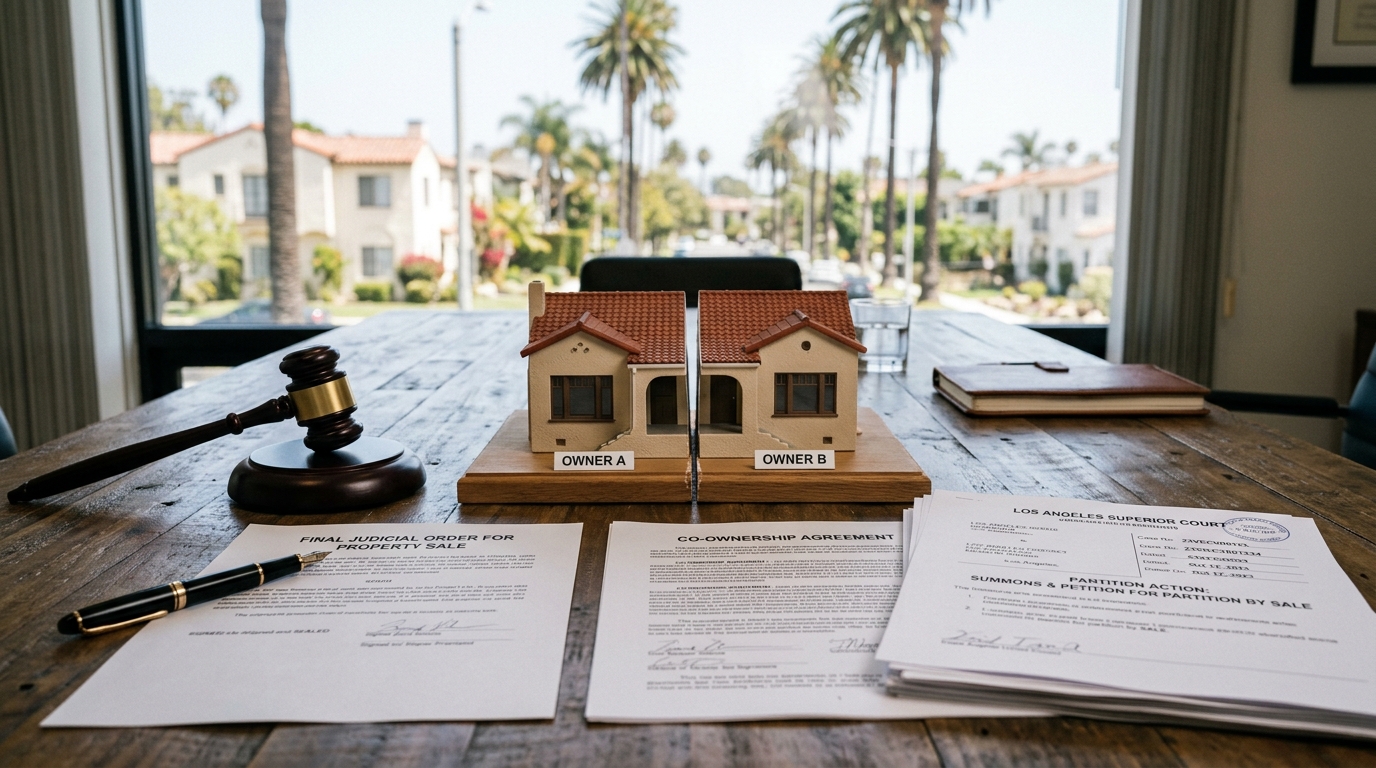
From Filing to Final Distribution of Proceeds
Here is how a partition action typically moves through the California court system from start to finish:
| Stage | What Happens | Typical Timeline |
|---|---|---|
| Complaint filed | Filing party submits complaint describing the property, all co-owners’ interests, and basis for partition | Day 1 |
| Service and response | Other co-owners are served and have time to respond or negotiate | Weeks 2 to 8 |
| Court appoints referee or appraiser | Under the PRPA, a neutral appraiser is appointed to determine fair market value | Months 2 to 4 |
| Buyout window opens | Non-filing co-owners can elect to buy out the filing party at the appraised value | After appraisal |
| Buyout or proceed to sale | If no buyout occurs, court orders property sold | Months 4 to 8 or longer |
| Sale and accounting | Property is sold, expenses deducted, reimbursements credited | After sale accepted by court |
| Proceeds distributed | Each co-owner receives their proportional share after all deductions | Final stage |
The full process can take anywhere from six months to well over a year depending on how contested the case is, how complex the accounting of contributions and reimbursements becomes, and whether appeals are filed. Attorney fees, court costs, and the costs of the court-appointed referee or appraiser all come out of the sale proceeds before distribution.
Why Many Co-Owners Resolve the Dispute Before Court
The Real Cost of Going All the Way Through Litigation
Partition litigation is not cheap. Attorney fees for both sides accumulate over months of court proceedings. The court-appointed referee or appraiser charges fees that are paid from the property proceeds. If disputes arise about what each co-owner is owed for taxes paid, repairs made, or mortgage contributions, the accounting stage can extend the timeline and cost even further. In Los Angeles, where properties are high-value, the percentage of proceeds lost to litigation costs may be smaller in absolute terms, but the delay and stress are real regardless.
Many partition cases settle before a final court judgment because once the process starts, both sides begin to understand what staying in the fight is actually going to cost them. Sometimes filing the complaint is enough to bring the other party to the negotiating table. A voluntary agreement to sell, with both parties agreeing on a buyer and a price, is almost always faster and cheaper than waiting for the court to order a sale through a referee.
How a Cash Buyer Helps Break the Deadlock
One of the cleanest ways to resolve a co-ownership dispute without full litigation is for all parties to agree to sell to a cash buyer. Here is why that option works well in contentious situations:
- A cash sale closes quickly, which limits the amount of time co-owners have to remain in a strained relationship over the property
- There is no lender involved, which means no financing contingency that could fall apart and restart the conflict
- There are no repair negotiations, which removes one common source of disagreement between co-owners about what to fix before sale
- The proceeds are distributed through escrow according to each party’s ownership percentage, with full documentation of what each person receives
- A fast closing means legal fees stop accruing sooner
- If one party needs cash urgently, a seven to twenty-one day close delivers it without waiting months for court proceedings
We have worked with co-owners in exactly these situations. Sometimes both parties come to us together, having agreed on a sale but not on the open market process. Sometimes one party has already filed a partition action and both sides agree that an agreed sale to a cash buyer is preferable to letting the court appoint a referee to run the sale. In either case, we can move quickly, handle the transaction with the documentation a title company requires for co-owned property, and get both parties to the closing table without delay.
If you want to understand what your legal obligations and options look like in a co-ownership dispute before you take any action, our post on whether cash for houses offers are legally binding covers key aspects of what makes a property sale agreement enforceable in California. And if liens or mortgage debt on the co-owned property are part of the dispute, our post on whether you can sell a house if you owe more than it is worth addresses what happens when a sale price may not cover all outstanding obligations.
To talk through your co-ownership situation directly, visit our cash home buyers Los Angeles page or reach out to our team and we will give you an honest assessment of your options with no pressure.
Conclusion
A partition action is a powerful legal tool, but it is also a slow and expensive one. California’s 2023 Partition of Real Property Act added new steps and strategic considerations that every co-owner should understand before filing or responding to a complaint. In many cases, a voluntary sale agreed upon by all parties, especially a fast cash sale that closes before more legal fees accumulate, is the outcome both sides would have preferred from the beginning. If you are in a co-ownership dispute in Los Angeles and want to explore whether a cash sale can resolve it faster than the courts can, we are here to help.
Frequently Asked Questions
Can one co-owner force a sale in California without the other agreeing?
Yes. California treats the right to partition as absolute. Any co-owner, regardless of how small their ownership share, can file a partition action to force a sale or division of jointly owned property. Under the 2023 Partition of Real Property Act, the other co-owner now has a right to elect to buy out the filing party at fair market value before a forced sale proceeds, but they cannot permanently block the partition if they choose not to purchase.
How long does a partition action take in California?
A contested partition action in California typically takes between six months and two or more years to fully resolve, depending on the complexity of the case, the number of co-owners involved, any disputes about contributions and reimbursements, and whether any appeals are filed. Cases that settle before a court judgment, including through an agreed voluntary sale, resolve much faster and at significantly lower cost.
What does the 2023 Partition of Real Property Act change?
The PRPA, effective for partition actions filed on or after January 1, 2023, requires a mandatory appraisal process before a court can order a forced sale of tenants in common property without a written co-ownership agreement. It also gives non-filing co-owners a statutory right to buy out the filing co-owner at the court-determined fair market value. This shifts leverage in partition cases and makes filing first a decision that requires careful strategic consideration.
Do proceeds from a partition sale get split equally?
Not necessarily. Proceeds are distributed in proportion to each co-owner’s ownership interest, which may not be equal. Additionally, before proceeds are divided, the court accounts for each party’s reimbursable contributions, including property taxes paid, mortgage payments made on behalf of the property, and documented repair costs. Disputes over these contributions are common and can prolong the accounting phase significantly.
Can co-owners avoid a partition lawsuit by agreeing to sell to a cash buyer?
Yes, and this is often the most efficient outcome for all parties. If all co-owners agree to sell, they can select a buyer and close on their own timeline without court involvement. A cash buyer is particularly practical in these situations because the fast closing eliminates the financing risk that could cause a traditional sale to fall apart, and there is no lender requiring repairs that co-owners might disagree about completing.