
Finding out that someone is living in your property without your permission is one of the most stressful situations a Los Angeles property owner can face. And the frustration deepens quickly when you realize that simply calling the police and having them removed often does not work the way you would expect. California law grants squatters a set of procedural rights that require property owners to go through a formal legal process before anyone gets removed. For sellers who discover a squatter on a property they are trying to sell, understanding that process is the first step toward resolving it. This post explains how squatter situations work in Los Angeles, what the law allows and does not allow, and how sellers can navigate their options including selling the property even with a squatter present.
What a Squatter Actually Is Under California Law
The Difference Between a Squatter, a Trespasser and a Holdover Tenant
These three categories are often confused and the distinction matters because each is handled differently under the law. A trespasser enters your property without permission but does not attempt to live there or establish residency. Trespassing is a criminal matter and law enforcement can typically remove a trespasser immediately. A holdover tenant once had a valid lease but has remained past its expiration without the owner’s consent. This is a civil matter handled through the unlawful detainer eviction process. A squatter is someone who occupies a vacant or abandoned property without the owner’s permission and with no prior legal right to be there, but who has established what the law considers residency.
The critical distinction in California is that once someone appears to have established residency, the matter shifts from criminal trespass to a civil proceeding. Police will often decline to forcibly remove a person once they claim to live there, even without a lease, because removing them without a court order could expose the property owner to liability for illegal eviction. You need a court order, and getting one requires going through the full unlawful detainer process.
What Adverse Possession Is and Why It Rarely Succeeds
California’s squatter laws include a concept called adverse possession, which allows a person to potentially claim legal ownership of property they have occupied continuously and openly for at least five years, provided they also pay property taxes and meet several other strict conditions. The five requirements are that the possession must be actual, open and notorious, exclusive, hostile (meaning without the owner’s consent), and continuous for the entire five-year period.
In practice, successful adverse possession claims are extremely rare. Most property owners discover and act on squatter situations well before five years pass. Squatters almost never pay the property taxes for five years running. And California’s courts set a high bar for proving all requirements were met simultaneously without interruption. For sellers, the realistic concern is not losing title to a squatter. It is the time and cost of removing one through the legal process.
What the Legal Process for Removing a Squatter Looks Like in LA
Step by Step From Discovery to Sheriff Removal
Here is how the removal process typically unfolds for a Los Angeles property owner:
| Step | What Happens | Typical Timeline |
|---|---|---|
| 1. Call police and file a report | Officers assess whether the situation is trespass (criminal) or squatting (civil). A police report establishes documentation of your ownership and the unauthorized occupation. | Day 1 |
| 2. Serve a 3-day notice to quit | A formal written notice demanding the squatter vacate within 3 days. Must be properly served according to California law. | Days 1 to 3 |
| 3. File an unlawful detainer lawsuit | If the squatter does not leave, file in LA County Superior Court. This formally begins the eviction process. | Day 4 onwards |
| 4. Court hearing | A judge hears the case. If you provide proof of ownership and the squatter has no legal claim, the court issues a judgment in your favor. | Typically 2 to 4 weeks after filing |
| 5. Writ of possession issued | The court issues a Writ of Possession authorizing law enforcement to remove the squatter. | Days after court judgment |
| 6. Sheriff posts 5-day notice | The Los Angeles County Sheriff posts notice on the door. Squatter has 5 days to leave voluntarily. | After writ is received |
| 7. Sheriff enforces removal | If squatter does not leave, sheriff returns to physically remove them. | 5 days after posting |
The entire process from first notice to sheriff removal typically takes between three and eight weeks in Los Angeles depending on court availability and whether the squatter contests the case. If contested, it can run longer. Legal fees, court filing costs, and any property damage the squatter causes during the process all add up.
What Senate Bill 602 Changed for Property Owners in 2024
California Senate Bill 602, which took effect January 1, 2024, gave property owners a meaningful improvement in one specific area: the trespass authorization letter. Before SB 602, owners had to file a new trespass letter with the local sheriff’s department every 30 days to maintain law enforcement’s authority to remove trespassers from their property. Missing even a single deadline reset the process. Under SB 602, those trespass letters are now valid for a full year and can be filed electronically. For permanently closed and properly posted properties, authorization extends to three years.
What SB 602 did not do is make squatting a criminal offense or speed up the formal court eviction process for established squatters. For sellers dealing with an entrenched squatter situation, the civil unlawful detainer process remains the required path to removal.
What Sellers Must Never Do When Dealing With a Squatter
Self Help Removal Is Illegal and Can Backfire Badly
California law is explicit on this point. A property owner cannot remove a squatter by force, change the locks while they are away, shut off utilities, remove their belongings, or take any action designed to make the property uninhabitable as a way of pressuring them to leave. These actions are all considered illegal self-help eviction and can expose the property owner to civil liability. In some cases sellers have found themselves sued by the very squatter they were trying to remove because they attempted to bypass the legal process.
The legal process is frustrating and slow, but it is the only path that protects you from liability. Attempting shortcuts is likely to make your situation worse and more expensive, not better.
Selling the Property When a Squatter Is Present
Your Options as a Seller With an Active Squatter Situation
Sellers facing an active squatter situation have two practical paths. The first is to complete the unlawful detainer process, remove the squatter, assess any damage, and then sell the property. This takes longer but gives the seller a clean, vacant property to present to buyers. The second is to sell the property as-is with the squatter situation still active and let the buyer take over the legal process.
Traditional financed buyers are extremely unlikely to accept a property with an active squatter because their lender will not fund a purchase with an occupied property under dispute. A cash buyer who specializes in difficult situations is the realistic option for a seller who wants to exit before completing the eviction process. Cash buyers who regularly work with distressed properties in Los Angeles understand the unlawful detainer process, can factor the situation into their offer, and can take over the case after closing.
What Sellers Should Do Immediately When They Discover a Squatter
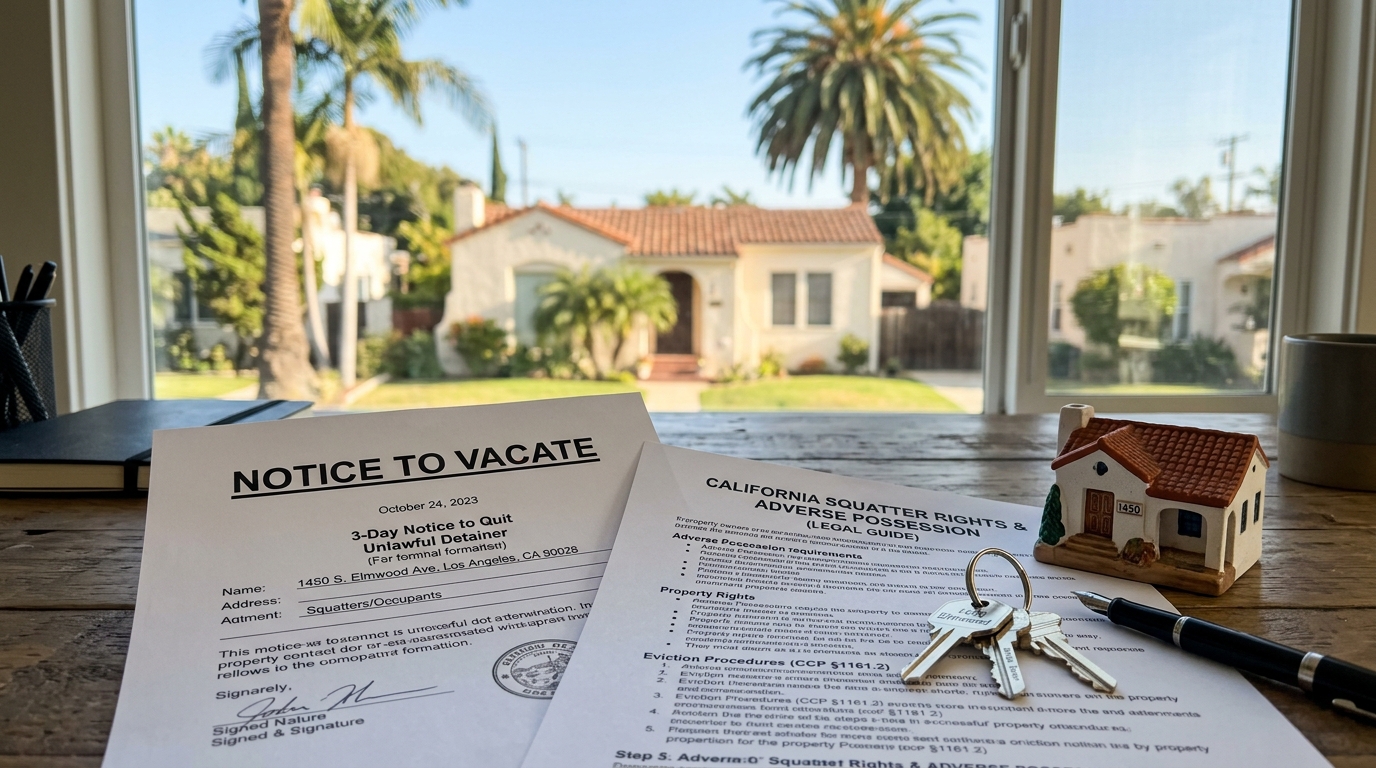
Here is the immediate action list for Los Angeles property owners who discover a squatter:
- Call the LAPD or LA County Sheriff to file a police report and have officers assess whether the situation is criminal trespass or civil squatting
- Document everything with photos, video, and written records including dates and times
- Do not engage in any self-help removal attempts including changing locks or removing belongings
- Serve a proper 3-day notice to quit if officers confirm this is a civil matter
- Consult an eviction attorney who handles unlawful detainer cases in Los Angeles County
- File the SB 602 trespass authorization letter with your local sheriff’s department to preserve law enforcement access to the property
- Contact your property insurance carrier to inform them of the unauthorized occupancy
If you want to understand how a cash sale works when a property is in a difficult situation, our post on whether cash for houses offers are legally binding covers how sale agreements are structured and enforced in California. And if you want to protect yourself from buyers who are not what they claim to be while you navigate this situation, our post on red flags of scam cash buyers in Southern California covers the warning signs to watch for.
If you are dealing with a squatter situation on a property you want to sell in Los Angeles and want to understand your options, visit our cash home buyers Los Angeles page or reach out to our team directly and we will talk through your specific situation honestly.
Conclusion
Squatter situations in Los Angeles are frustrating precisely because the law requires patience and process rather than quick action. You cannot remove someone by force, even from a property they entered illegally. You must serve proper notice, file an unlawful detainer lawsuit if they do not leave, obtain a court judgment, and wait for the sheriff to carry out the writ. That process takes weeks and costs real money. Sellers who want to move on faster do have the option of selling the property as-is to a cash buyer who will take over the situation, and that is sometimes the most practical path forward when time and stress are the limiting factors.
Frequently Asked Questions
Can the police remove a squatter from my Los Angeles property?
It depends on what officers find when they respond. If the person has clearly just broken in and has no belongings or signs of residency, officers may be able to remove them as trespassers. But if the person claims to live there, has belongings present, or receives mail at the address, most officers will treat it as a civil matter and decline to remove them without a court order. You will need to go through the unlawful detainer process to obtain that order.
Can a squatter actually gain ownership of my property in California?
In theory, yes, through adverse possession. In practice, it is extremely rare. A squatter would need to occupy the property continuously for five full years, pay all property taxes during that period, and meet four other strict legal requirements simultaneously. Most squatter situations are resolved through the eviction process long before any adverse possession claim could ripen. The risk for most sellers is not losing title but losing time while the eviction process plays out.
How long does it take to legally remove a squatter in Los Angeles?
The full process from serving a 3-day notice to sheriff removal typically takes three to eight weeks in Los Angeles. If the squatter contests the unlawful detainer lawsuit, the timeline extends further. Court backlogs in LA County can also add time. Acting quickly and working with an experienced eviction attorney gives you the best chance of moving through the process as efficiently as possible.
What did Senate Bill 602 change for California property owners?
SB 602, effective January 1, 2024, extended the validity of trespass authorization letters filed with local sheriffs from 30 days to one full year, and to three years for permanently closed posted properties. It also allows these letters to be filed electronically. What it did not change is the civil eviction process required to remove an established squatter. That still requires proper notice, an unlawful detainer lawsuit, a court judgment, and a sheriff’s writ.
Can I sell a property that has a squatter living in it?
Yes. The option of selling to a cash buyer who will take over the unlawful detainer process after closing exists for sellers who want to exit before completing the eviction themselves. Traditional buyers with lender financing are not a realistic option because lenders will not fund a purchase on an occupied property with an active dispute. A cash buyer experienced in distressed property situations can absorb the risk, price it into the offer, and proceed on a timeline that works for both parties.