
Southern California has one of the most active cash home buying markets in the country. That is a good thing if you need to sell fast, but it also means there are bad actors operating right alongside the legitimate ones. The California Department of Real Estate has issued repeated consumer alerts warning homeowners about predatory buyers, and the FBI reported that real estate fraud resulted in over $173.5 million in losses across the country in 2024 alone. Knowing how to tell the difference between a real cash buyer and a scam before you sign anything can save you from one of the worst financial experiences of your life.
Why Southern California Sellers Are Targeted More Than Most
High Property Values Make This Market Attractive to Fraudsters
Properties in Los Angeles, Orange County, and the surrounding areas carry some of the highest values in the country. That means every transaction involves serious money, and where serious money is involved, bad actors show up. Scammers specifically target homeowners in distress, including people facing foreclosure, dealing with an inherited property, going through a divorce, or simply wanting to move on quickly without the hassle of a traditional listing.
According to a public notice issued by the California Department of Real Estate in January 2025, Los Angeles property owners near wildfire zones were specifically warned to be cautious of unsolicited offers to buy their properties under fair market value. Predatory buyers often swarm after disasters and target sellers who are vulnerable, scared, or under time pressure.
What a Legitimate Cash Buyer Looks Like Before You Compare
Before walking through the red flags, it helps to know what a real cash buyer actually looks like. A legitimate company has a verifiable business presence, a real physical address or registered entity, a track record of closed transactions you can check, and the ability to provide proof of funds without hesitation. They do not pressure you. They do not rush you. They answer your questions directly and refer you to a licensed escrow company to handle the closing. If those basic things are not present, that already tells you something important.
Red Flag 1: They Pressure You to Sign Immediately
Urgency Is a Tool Scammers Use to Stop You From Thinking Clearly
One of the most consistent tactics used by fraudulent cash buyers is manufactured urgency. They tell you the offer is only good for a few hours. They say another buyer is about to sign. They call and text constantly, pushing you to commit before you have had a chance to read the contract or talk to anyone else.
Selling your home is one of the largest financial decisions you will ever make. Any buyer who is not giving you time to read the paperwork, get a second opinion, or involve a real estate attorney is not acting in your interest. A real cash buyer understands the weight of that decision and gives you space to make it properly. Pressure is a red flag. Full stop.
What You Should Do Instead
Never sign anything same-day from a cold approach. Take at least 24 hours to review any written offer. Read every line of the purchase agreement before you initial a single page. Our post on whether cash for houses offers are legally binding explains exactly what makes a purchase agreement enforceable and what your rights are before you sign.
Red Flag 2: They Cannot or Will Not Show Proof of Funds
A Real Cash Buyer Has Real Money and Can Prove It
A legitimate cash buyer will have no problem showing you a current bank statement or an official letter from their financial institution confirming they have enough liquid funds to close. If a buyer claims to have cash but gets evasive when you ask for documentation, that is a serious warning sign.
Some scammers will tell you they need you to pay a small upfront fee to release their funds. Others will claim the money is held in a foreign account or with a private investor who has not yet committed in writing. These are not legitimate explanations. They are stall tactics or setups for a more serious fraud. According to the Rocket Mortgage guide on real estate scams, more than 9,300 people were victims of real estate fraud in 2024, and many of those cases started with a buyer who could not verify their funds but pushed the seller to proceed anyway.
How to Verify Proof of Funds the Right Way
Always ask for proof of funds before you accept any written offer. The document should be on official bank letterhead, dated within the last 30 days, and show a balance at least equal to the purchase price. Then call the bank directly using a number you look up yourself, not one printed on the document. Our dedicated post on how to verify a we buy houses company proof of funds in California walks through this process step by step.
Red Flag 3: The Offer Drops Significantly After a Quick Walkthrough
The Bait and Switch Is One of the Most Common Tactics
This one is frustratingly common. The buyer makes a high offer over the phone to get your attention and your trust. Then they come for a quick 15 to 20 minute walkthrough, barely look at anything, and suddenly come back with an offer that is dramatically lower than what they quoted. They blame the inspection. They cite repairs that are vague or exaggerated. They hope you are already emotionally committed to the deal and will accept the lower number rather than start over.
A real investor does their homework before making an offer. They review comparable sales, assess the property honestly, and give you a number that reflects what they actually plan to pay. When the first number and the final number are miles apart with no clear, documented reason, that is a bait and switch.
What a Fair Offer Process Actually Looks Like
A trustworthy cash buyer will walk your property, take honest notes, and explain exactly how they arrived at their offer. If repair costs are factored in, they should be able to tell you what repairs, what they estimate them to cost, and why. If you cannot follow their logic, or if the numbers seem invented, ask them to put it in writing. A buyer who refuses to document their reasoning is a buyer you should walk away from.
Red Flag 4: The Contract Has Assignment Language or Vague Terms
Wholesalers Often Pose as Direct Cash Buyers
Not every person who says they buy houses for cash actually buys houses with their own money. Some are wholesalers. A wholesaler gets your property under contract and then assigns that contract to a third party buyer, collecting a fee in the process. There is nothing necessarily illegal about wholesaling, but it becomes deceptive when the wholesaler presents themselves as a direct cash buyer without disclosing what they are actually doing.
The clearest sign of this is language in the purchase contract that reads something like the buyer’s name followed by the words and or assigns. That phrase means the person signing the contract reserves the right to hand your deal off to someone else entirely. If you see it, ask directly whether the company is buying your home themselves or assigning the contract. If they cannot give you a straight answer, that tells you everything you need to know.
Other Contract Terms That Should Make You Pause
Here is a quick look at the contract terms that often signal a problem versus those that signal a legitimate buyer:
| Contract Term | What It Means | Red Flag or Normal |
|---|---|---|
| And/or assigns after buyer name | Contract may be handed to a different buyer | Red flag if not disclosed upfront |
| Contingent on business partner approval | Buyer may be shopping your deal to others | Red flag |
| No earnest money deposit | Buyer has no financial stake in closing | Red flag in most cases |
| Very long inspection period | Buyer buying time to find another buyer | Red flag if paired with other signs |
| No licensed escrow company named | Funds will not be held by a neutral party | Serious red flag |
| Clear closing date and escrow named | Buyer is committed and organized | Normal and reassuring |
| Proof of funds attached to offer | Buyer has verified their cash | Normal and reassuring |
Red Flag 5: No Verifiable Business Presence or Online Track Record
Legitimate Buyers Can Be Found and Checked
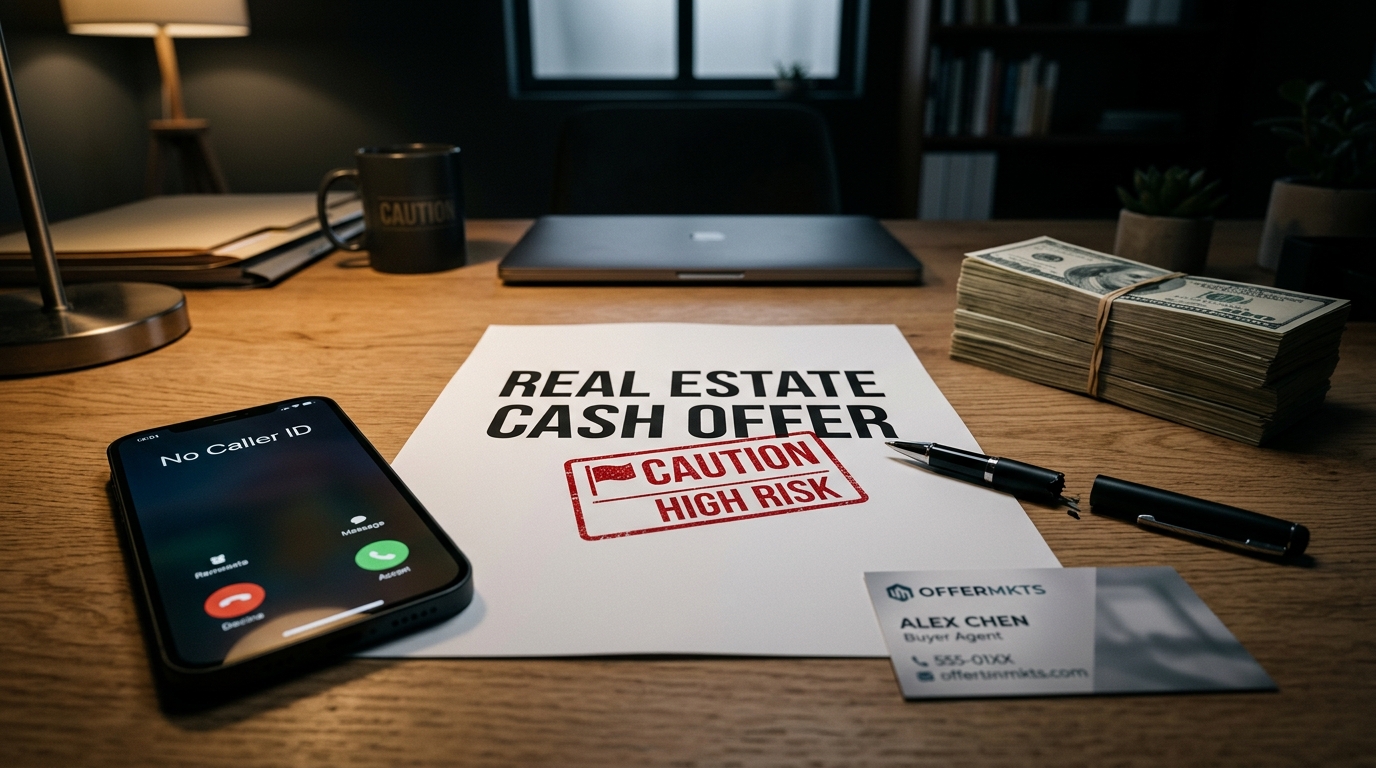
Any reputable cash buying company operating in Southern California should have a real business you can find and verify. That means a registered business entity you can look up with the California Secretary of State, a working website with real contact information, reviews from actual sellers on platforms like Google or the Better Business Bureau, and a track record of closed transactions you can ask about.
If a buyer shows up from an unverifiable phone number, has no website, uses a personal Gmail address, and cannot tell you the name of the title or escrow company they use, those are not technicalities. They are signs that the buyer either does not operate a real business or has something to hide. You have every right to ask for a business license number, a list of recent transactions, or references from sellers they have worked with before.
What to Check Before You Agree to Anything
Before you move forward with any cash buyer in Southern California, run through this list:
- Search the company name with the California Secretary of State to confirm it is a registered entity
- Check Google reviews and the Better Business Bureau for complaints or patterns of bad behavior
- Ask the buyer for the name of the escrow or title company they plan to use and then call that company directly to confirm the relationship
- Request proof of funds and verify it independently by calling the bank using a number you find yourself
- Ask how many properties they have closed in Southern California in the last 12 months and ask for one reference
- Read every line of any contract before you initial or sign anything, and involve a real estate attorney if anything is unclear
- Never pay any upfront fees. In a real estate transaction the money flows from the buyer to you, not the other way around
If you want to work with a cash buyer in the Los Angeles area who has a real track record and handles every transaction through a licensed escrow company, visit our cash home buyers Los Angeles page to see how our process works and what you can expect from us. And if you have a specific situation you want to discuss, reach out to our team directly and we will give you straight answers.
Conclusion
Southern California has plenty of legitimate cash buyers who can close fast, treat you fairly, and handle every step of the transaction properly. But the same market also attracts people who will use pressure, vague contracts, and fabricated urgency to take advantage of sellers who are not paying close enough attention. The five red flags in this post are not rare edge cases. They come up regularly. Knowing them before you sit across from your first buyer puts you in a much stronger position to protect yourself and your property.
Frequently Asked Questions
How common are cash buyer scams in Southern California?
They are more common than most people realize. The FBI reported over 173.5 million dollars in real estate fraud losses nationally in 2024. The California DRE has issued multiple consumer alerts specifically about predatory buyers targeting homeowners in distress, and Southern California, with its high property values and large volume of transactions, is one of the most targeted regions in the state.
Is it legal for a cash buyer to assign a contract without telling me?
Assigning a contract is legal in California if the contract permits it. What is not acceptable is a buyer who presents themselves as a direct cash purchaser without disclosing that they intend to assign the deal to a third party. If you did not know the buyer was a wholesaler and they never disclosed it, you have grounds to raise that with a real estate attorney.
What should I do if a cash buyer refuses to name an escrow company?
Walk away. In California, all residential real estate transactions are required to go through a licensed escrow company. A buyer who cannot or will not name the escrow company they plan to use is either not serious about closing or is trying to avoid the oversight that a neutral third party provides. That is not a buyer you want to work with.
Can I lose my home to a scam cash buyer if I sign a contract?
Once you sign a purchase agreement, it is a legally binding contract. If a scammer gets you to sign one with unfavorable terms, backed out contingencies, or deceptive language, getting out of it may require legal action. This is exactly why you should never sign anything under pressure and always have an attorney or experienced agent review any contract before you commit.
How do I report a suspected cash buyer scam in California?
You can file a complaint with the California Department of Real Estate at dre.ca.gov. If you believe fraud has occurred, you can also report it to the California Attorney General’s office or the FBI’s Internet Crime Complaint Center at ic3.gov. Keep all written communications, contracts, and any documents the buyer gave you as evidence.