
The January 2025 wildfires changed Los Angeles forever. The Palisades Fire and Eaton Fire together destroyed more than 18,000 homes and structures, burned over 57,000 acres, and forced more than 200,000 people to evacuate. Economic damage estimates ranged from $76 billion to $131 billion — making it one of the most expensive natural disasters in American history. For tens of thousands of LA homeowners, the question that followed wasn’t just about rebuilding. It was a harder, more practical one: do I rebuild, or do I sell?
That question applies not only to wildfire survivors but to every Los Angeles homeowner dealing with a structure fire, major plumbing failure, roof collapse, flooding, or water intrusion. Property damage of any kind creates a crossroads — and understanding your options clearly is the only way to make the right decision for your family and your finances.
This guide covers what LA homeowners need to know about selling a fire-damaged or water-damaged property: your legal obligations, your selling options, the rebuild vs. sell calculation, and why a cash sale is often the fastest and least stressful path forward.
The Scale of Fire Damage in Los Angeles
The 2025 Wildfire Context
The January 2025 LA wildfires were historic in their destruction. According to data compiled by Frontline Wildfire Watch:
- The Palisades Fire burned 23,448 acres and destroyed 6,833 structures, including thousands of homes in Pacific Palisades, Malibu, and the surrounding areas. It claimed 12 lives.
- The Eaton Fire burned 14,021 acres and destroyed 9,418 structures in Altadena, Pasadena, and surrounding neighborhoods — making it the deadliest in the outbreak, with 19 lives lost.
- All fires combined burned over 57,000 acres and destroyed more than 18,000 homes and structures.
- As of August 2025, despite 12,048 confirmed structures destroyed, only 184 building permits had been issued — a rebuild bottleneck driven by contractor shortages, permitting backlogs, and soaring construction costs.
Beyond the 2025 wildfires, LA structure fires are an everyday reality. According to the Los Angeles Fire Department, the city responds to thousands of residential structure fires annually, caused by electrical failures, gas leaks, cooking accidents, and other sources. Water damage — from burst pipes, roof failures, flooding, and plumbing catastrophes — affects an even larger number of homeowners every year.
Why the Rebuild Path Is Harder Than It Looks
For homeowners whose properties were damaged or destroyed, the instinct is often to rebuild. But the reality of rebuilding in Los Angeles in 2025–2026 is sobering:
- Construction costs: LA has some of the highest construction costs in the nation. Rebuilding a comparable home after a total loss typically runs $400 to $700+ per square foot, meaning a 2,000 sq ft home could cost $800,000 to $1.4 million to replace — often far exceeding insurance payouts.
- Permit timelines: LA County’s permitting progress after the 2025 fires was painfully slow. As of August 2025, only 184 permits had been issued for 12,048 destroyed structures. Even under streamlined emergency rules, permit approval can take 6 to 18 months.
- Contractor availability: The surge in demand following any major fire event — combined with California’s pre-existing contractor shortage — means wait times of 6 to 24 months for qualified fire restoration specialists.
- Insurance gaps: The California Department of Insurance estimated insured losses from the 2025 fires at around $30 billion, against total economic losses of $76–$131 billion. Many homeowners discovered that their coverage was insufficient to fund a complete rebuild, particularly as construction costs escalated after the disaster.
- Ongoing costs: While waiting to rebuild, homeowners continue paying property taxes, insurance, HOA fees, and often financing costs — on a property that generates no use or income.
For many homeowners, the rebuild path stretches 2 to 4 years or longer, costs far more than anticipated, and requires navigating a bureaucratic and logistical maze that is genuinely overwhelming even for experienced property owners.
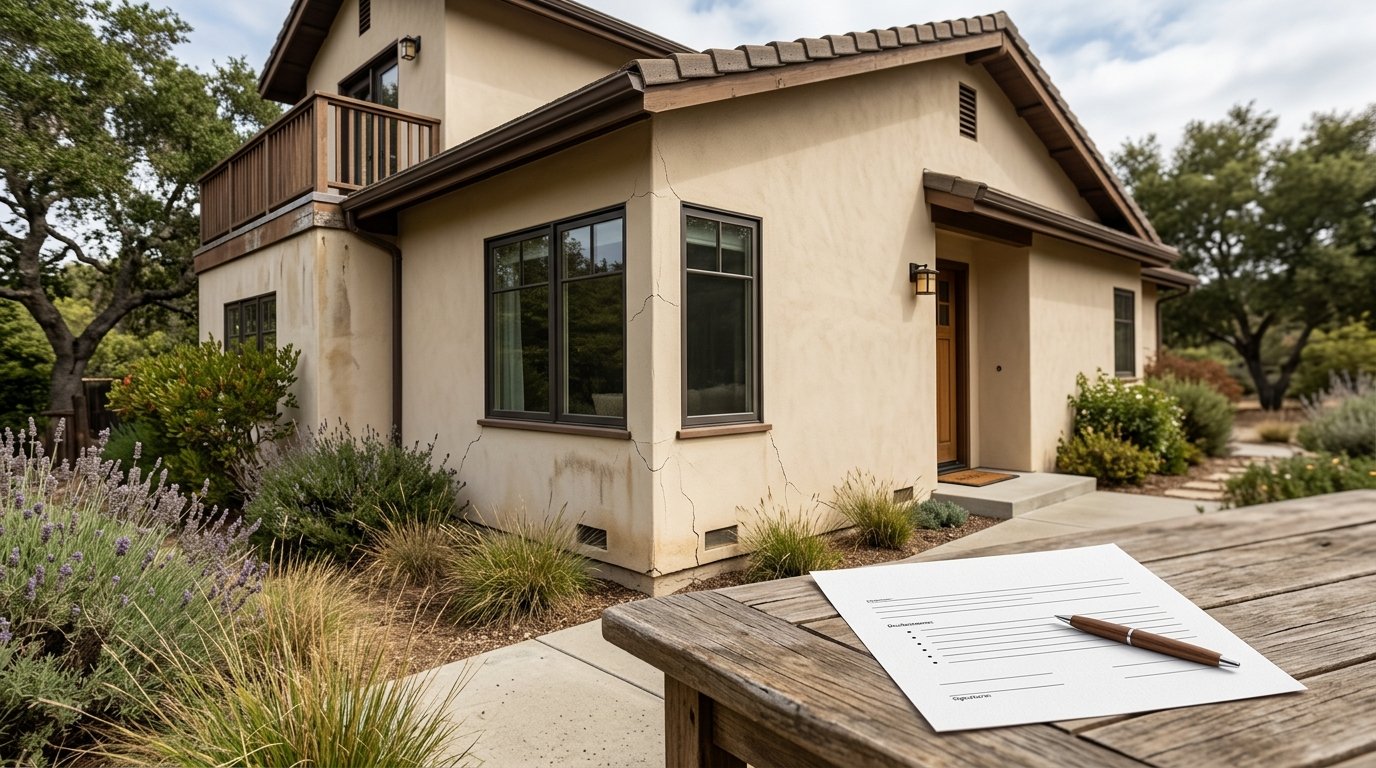
California Disclosure Requirements When Selling a Damaged Property
Before exploring your selling options, it’s essential to understand your legal obligations as a seller of fire-damaged or water-damaged property in California.
The Transfer Disclosure Statement (TDS)
California law requires sellers to complete a Transfer Disclosure Statement (TDS) for all residential property sales. The TDS requires full disclosure of all known material defects and conditions affecting the property — including fire damage, smoke damage, water damage, mold, structural compromise, and any other condition a buyer would consider material to their purchase decision.
Failure to disclose known defects is not only unethical — it exposes sellers to civil liability, potential rescission of the sale, and damages claims from buyers after closing. California courts have consistently held that sellers must disclose all known defects, even when selling as-is.
What You Must Disclose for Fire-Damaged Properties
When selling a fire-damaged home in California, sellers must disclose:
- The fact that the property experienced a fire and the date it occurred
- The extent of known structural damage to walls, roof, foundation, framing, and mechanical systems
- Smoke and soot damage, including hidden penetration into walls, ductwork, and insulation
- Any known hazardous materials exposure (asbestos disturbed by fire, lead paint char, chemical contamination from burned materials)
- Insurance claim history and any settlement amounts received
- Any permits pulled (or required but not pulled) for repair or demolition work
- Known issues identified in any professional inspection or assessment
What You Must Disclose for Water-Damaged Properties
For water-damaged properties, required disclosures include:
- Known history of flooding, water intrusion, or plumbing failures
- Evidence or history of mold, mildew, or fungal growth
- Any damage to structural framing, subfloor, drywall, or foundation from water exposure
- Roof leaks or past roof repairs related to water intrusion
- Insurance claims filed for water damage
The Palisades and Eaton Fire Zone: SB 658 and Additional Requirements
Properties located in the areas impacted by the January 2025 Eaton and Palisades fires face additional regulatory considerations under proposed California Senate Bill 658, which would require sellers of fire-damaged properties in designated zones to follow specific notification procedures and provide qualifying governmental and nonprofit organizations a right to match purchase offers. Sellers in these areas should consult a real estate attorney familiar with the current status of this legislation and any additional county-level requirements before listing or selling their property.
The key takeaway: Disclose everything. Selling to a cash buyer does not reduce your disclosure obligations. A well-informed cash buyer will verify disclosures through their own assessment, and attempting to conceal known damage creates legal exposure that far outweighs any benefit.
Your Four Selling Options for a Damaged Property
Option 1 — Repair First, Then List Traditionally
Best for: Homeowners with adequate insurance coverage, time, and financial resources who want to maximize sale price and have minor to moderate damage.
After completing permitted repairs, a restored property can be listed on the open market at or near full market value. For properties with minor fire or water damage that can be fully remediated, this path can yield the highest sale price. However, it requires:
- Significant upfront capital for repairs (often $50,000 to $500,000+)
- Months to years of project management, contractor coordination, and permitting
- Temporary housing costs while repairs are underway
- Risk of cost overruns, permit delays, and contractor disputes
- No guarantee that the finished sale price will cover the full cost of repairs plus time value of money
Option 2 — Sell As-Is to a Cash Buyer
Best for: Homeowners who want to sell quickly, avoid repair costs and project management, and receive immediate liquidity without a multi-year rebuild or restoration process.
Cash buyers and real estate investors purchase damaged properties in their current condition — fire-damaged, smoke-damaged, water-damaged, or partially demolished. They absorb the repair costs, permitting hassle, and renovation timeline as part of their business model. For sellers, the trade-off is a lower sale price than a fully restored property would command, in exchange for speed, certainty, and freedom from the rebuild process.
In Los Angeles, all-cash home purchases accounted for 25.4% of transactions as of May 2025, even in one of the most expensive housing markets in the country. The market for distressed, as-is, and damaged properties is active and well-developed — cash buyers who specialize in fire and water damage understand these properties and can close fast.
Option 3 — Sell the Land Only
Best for: Properties with total structural losses where the land value alone is significant, or where the homeowner has already completed debris removal.
When a structure is fully destroyed, the remaining value is in the land. In high-value LA neighborhoods — Pacific Palisades, Altadena, Pasadena, Malibu — land values can be substantial even without a structure. Selling land-only requires demolition and debris clearance (which may be handled through LA County’s government debris removal program for fire victims), and pricing is based purely on lot characteristics: size, location, zoning, views, and utilities.
Option 4 — List As-Is on the Open Market (MLS)
Best for: Properties with minor to moderate damage in high-demand areas where investor interest is strong and multiple offers are likely.
A damaged property can be listed on the MLS as-is, with full disclosures. This approach casts the widest net and may attract multiple competing offers from investors and flippers, potentially driving the price higher than a single private cash offer. However, it takes longer, requires agent commissions, and exposes the property to financing-dependent buyers whose deals may fall through when lenders decline to finance damaged properties.
The Rebuild vs. Sell Calculation
For homeowners facing major fire or water damage, the financial decision usually comes down to a direct comparison. Here is a simplified framework:
| Factor | Rebuild | Sell As-Is for Cash |
|---|---|---|
| Timeline to resolution | 2 to 4+ years | 2 to 6 weeks |
| Upfront capital required | $200K to $1M+ | None |
| Carrying costs during process | Property taxes, insurance, temp housing | Stops at closing |
| Outcome certainty | Low (cost overruns, delays, permitting) | High (agreed price, firm close date) |
| Final financial result | Potentially higher, but far from guaranteed | Lower than restored value, but immediate and certain |
| Emotional cost | Very high — years of project management | Low — walk away cleanly |
| Insurance interaction | Complex, ongoing, disputed | Clean break once sale closes |
Neither path is right for every homeowner. But for anyone who lacks the insurance coverage to fund a full rebuild, lacks the time or energy to manage a multi-year construction project, or simply wants to move forward with their life rather than remain tied to a damaged property for years — selling as-is to a cash buyer is the path of least friction and greatest certainty.
Why Lenders Won’t Finance Most Damaged Properties
One of the most important practical realities of selling a fire or water-damaged home is that traditional buyers using mortgage financing cannot purchase it in its damaged state. Lenders require the property to meet minimum habitability and condition standards before approving a loan. Properties with structural damage, major systems failures, health hazards, or active fire/water damage will not appraise at value and will not qualify for conventional, FHA, or VA financing.
This means your buyer pool for a damaged property listed on the open market is almost exclusively cash investors — which is exactly what direct cash buyers are. Bypassing the MLS and going directly to a cash buyer simply eliminates the middleman, the agent commission, and the open market timeline.
What Happens to Your Insurance Proceeds?
A question many sellers have: if I sell my fire-damaged home rather than rebuild, what happens to the insurance money? This depends on your policy and the timing of your claim:
- If you’ve already received an insurance payout for dwelling coverage: In most cases, you can sell the damaged property and keep the insurance proceeds. The proceeds are not automatically required to be used for repair — though your policy language and lender requirements may impose conditions. Review your policy carefully and consult with a public adjuster or attorney before making this decision.
- If your insurance claim is still pending: You can typically sell the property before the claim is settled. The buyer takes the property in its damaged condition, and the insurance proceeds flow to you as the policyholder. This is a common structure in investor sales of damaged properties — just ensure your attorney or escrow officer confirms how the claim assignment works with your specific insurer.
- If you have an outstanding mortgage: Your lender has a security interest in the property. If you sell for less than the loan balance, the lender must agree to the short payoff. If you sell for more than the balance (including after insurance proceeds), the mortgage is simply paid off at closing from escrow — the same as any standard sale.
Fire Debris, Hazardous Materials, and Selling Obligations
Properties damaged in the 2025 LA wildfires are subject to a two-phase debris removal process under a Health Officer Order from the LA County Department of Public Health:
- Phase 1: Removal of household hazardous waste (HHW) — batteries, chemicals, asbestos-containing materials, and other hazardous items. This is conducted by government teams at no cost to the property owner.
- Phase 2: Removal of fire ash, structural debris, contaminated soil, and burned materials. For eligible properties, this can be done by the government program at no cost, or by the homeowner using private contractors who must comply with the Health Officer Order requirements.
Properties that have not completed debris removal can still be sold — cash buyers frequently purchase properties at the land-value or pre-debris-clearance stage and absorb the debris removal costs as part of their acquisition. However, the status of debris removal should be clearly disclosed in the sale, and any outstanding obligations of the property owner must be clearly addressed in escrow.
The Cash Sale Process for Damaged Properties in LA
Working with a cash buyer on a damaged property follows the same general process as any cash sale, with a few additional steps:
- Step 1 — Initial conversation and basic property information: Share what happened, when it occurred, the approximate extent of damage, and what documentation you have (insurance reports, fire department reports, inspection findings).
- Step 2 — Property assessment: The buyer will assess the property — in person for significant damage — to evaluate the scope of repairs needed, determine land value, and calculate an as-is cash offer. This assessment incorporates structural damage, hazardous materials, debris status, and lot characteristics.
- Step 3 — Written cash offer: You receive a written, no-obligation offer reflecting the property’s current as-is value. See our guide on how we calculate cash offers in the LA market to understand our valuation process.
- Step 4 — Title search and escrow: A title company confirms ownership, identifies any liens or encumbrances, and prepares closing documents. Damaged properties often have clean title — the damage affects the structure, not the ownership chain.
- Step 5 — Closing: The buyer pays cash, the title transfers, and you receive the proceeds (after mortgage payoff and any liens) — typically within 7 to 30 days of accepting the offer. You move on with your life.
Special Considerations for Water-Damaged Properties
Water damage presents its own specific challenges that sellers and buyers need to understand:
Mold: The Hidden Cost
Water intrusion that isn’t remediated within 24 to 72 hours typically leads to mold growth inside walls, subfloors, insulation, and framing. Mold remediation in a significant water-damage event can cost $10,000 to $100,000 or more and requires professional environmental assessment and licensed remediation contractors. Mold must be disclosed as a known defect, and traditional lenders will not finance a property with active mold without completed remediation documentation.
Structural Compromise from Water
Prolonged water exposure weakens wood framing, causes concrete degradation, and can compromise foundations. Properties with long-term roof leaks, flood damage, or major plumbing failures may have structural issues that aren’t visible on the surface. A professional structural inspection is important both for your own understanding of what you’re selling and to properly complete your TDS disclosures.
Insurance Exclusions
Standard homeowners’ insurance covers sudden and accidental water damage (like a burst pipe) but typically excludes gradual leaks, seepage, and flooding from external sources (which requires a separate flood insurance policy). Many water-damaged LA homeowners discover after the fact that their damage falls into an excluded category. Selling as-is to a cash buyer allows you to move forward regardless of insurance coverage status.
Ready to Explore Your Options?
Whether your LA property was damaged by the 2025 wildfires, a structure fire, a major plumbing failure, flooding, or water intrusion — you have options. A cash sale doesn’t require repairs, permits, contractors, or months of uncertainty. It gives you a clear offer, a firm closing date, and the ability to walk away with whatever equity you have intact, quickly and privately.
Contact us today for a confidential, no-obligation assessment of your damaged property. We work with LA homeowners throughout the county — from Altadena and Pasadena to Pacific Palisades, from the Valley to the South Bay. No pressure, no judgment, no obligation. Just a clear picture of what your property is worth in its current condition and what we can close for if you decide to move forward. Also see our guide on how to get a cash offer on your LA home in 24 hours.
Conclusion
Fire and water damage are traumatic — and the decision of what to do with a damaged property is one of the most consequential financial decisions a homeowner will face. For many LA homeowners, especially those caught in the aftermath of the 2025 wildfires or dealing with major structural damage, the rebuild path is longer, more expensive, and more uncertain than it first appears. A cash sale offers a defined exit: real money, a real timeline, and the freedom to move forward rather than remain tethered to a property in limbo for years. If you own a damaged property in Los Angeles, the most important step you can take right now is understanding your options — before someone else makes that decision for you.
Note: This article is for general informational purposes only and does not constitute legal or financial advice. California real estate law and disclosure requirements are complex. Always consult a licensed California real estate attorney, public adjuster, and/or tax professional before making decisions regarding a damaged property sale.
Frequently Asked Questions
Can I legally sell a fire-damaged or water-damaged home in California?
Yes. California law allows homeowners to sell property in any condition, including severely damaged. You are required to fully disclose all known damage in the Transfer Disclosure Statement (TDS) and any other applicable disclosure forms. Cash buyers and investors specifically look for distressed properties and purchase them as-is. The key is full transparency — attempting to conceal known damage exposes you to significant legal liability.
Do I have to repair my home before selling it?
No. You can sell a fire or water-damaged home in its current, unrepaired condition. Selling as-is to a cash buyer means no repairs, no inspections on your behalf, and no permits required before the sale. The buyer absorbs the repair and restoration responsibility after closing.
What happens to my insurance proceeds if I sell the damaged home instead of rebuilding?
In most cases, insurance proceeds paid to you for dwelling coverage are yours to keep even if you sell rather than rebuild. However, policy language varies, and your mortgage lender may have conditions on how proceeds are used if there is an outstanding loan. Consult a public adjuster or attorney familiar with California insurance law before making this decision, as individual policy terms differ significantly.
My home was damaged in the Palisades or Eaton Fire — are there special rules for selling?
Yes. Properties in the Palisades and Eaton fire impact zones are subject to special state and county regulations, including the debris removal program requirements, health officer orders regarding hazardous waste, and potentially additional notification requirements under pending legislation such as SB 658. Consult a California real estate attorney familiar with fire recovery transactions before proceeding with a sale in these areas.
How is a cash offer calculated for a damaged property?
Cash buyers evaluate damaged properties based on the land value and location, the estimated cost of repairs or demolition, the current state of permits and debris removal, and comparable sales of similar properties in the area. The offer reflects the property’s as-is value — not what it would be worth after a full restoration. The trade-off is accepting a lower price in exchange for certainty, speed, and freedom from the rebuild process. See our full guide on how we calculate cash offers in the LA market.