
If you own or invest in commercial property in Los Angeles, one thing is sure: the market never stays the same for long. Prices go up. Then they come down. Buyers show up. Then they disappear. And when the market shifts, selling your property can go from easy to nearly impossible. That is what liquidity is all about. And in LA, market cycles control it more than most people think.
What Are Commercial Real Estate Market Cycles?
The Four Phases Every Investor Should Know
Commercial real estate moves through four main phases: recovery, expansion, hypersupply, and recession. Each one changes how easy or hard it is to buy, sell, or refinance a property. Knowing where you are in the cycle can help you make smarter moves.
Recovery is when things start getting better after a tough period. Vacancies slowly drop. Buyers start coming back. Then comes expansion, when demand is high, rents go up, and deals happen fast. After that, a hypersupply shows up when too many new properties flood the market. And finally, recession hits, sales slow down, prices fall, and liquidity dries up.
According to JPMorgan Chase, the commercial real estate cycle generally follows a pattern of recovery, expansion, hypersupply, and recession, and there is no set duration for each phase.
Why Los Angeles Has Its Own Cycle Rhythm
LA is not like other cities. It has massive ports, a global entertainment industry, and millions of people packed into different neighborhoods, from downtown to the San Fernando Valley. All of this means the market here reacts differently than, say, Miami or Houston.
In Q4 2021, major research showed that Los Angeles office properties were classified in the recession phase, while cities like Miami were still in expansion. That gap tells you everything. LA cycles can be deeper and longer, especially in specific property types like office space.
I once spoke with an investor who had been riding office building investments in LA since 2017. He told me he saw the 2020 shift coming but underestimated how long the downtown vacancy rate would stay elevated. “I thought it’d bounce back in a year,” he said. Four years later, he’s still waiting on one asset. That’s the LA cycle, it can be slow and brutal at the same time.

What Is Commercial Property Liquidity and Why It Matters
Liquidity Simply Explained
Liquidity just means how fast you can sell something and get your money. If you can sell your building in 30 days, you have high liquidity. If it takes 18 months to find a buyer, liquidity is very low.
In stocks, liquidity is easy; you click a button and sell. But with commercial real estate in LA, it’s never that simple. The size of deals, local rules, taxes, and buyer confidence all slow things down, or speed them up, depending on where we are in the market cycle.
How Cycle Phases Change Liquidity Directly
During expansion, liquidity is at its best. Buyers compete for properties. Deals close fast. Cap rates compress, and prices rise. But when the market moves into recession or even hypersupply, the whole game changes.
In Q3 2024, Los Angeles County office building sales dropped by 55.4% compared to Q3 2020, totaling just $1.01 billion. That’s not a small dip. That’s a market where finding a willing buyer became very hard, especially for office properties.
I’ve talked to investors who bought office buildings in LA back in 2019, thinking they were safe long-term plays. By 2023, they couldn’t exit the position even at a loss. That’s what low liquidity feels like in real life, you’re stuck.
Market Cycle Phases vs. Liquidity in Los Angeles
| Cycle Phase | Liquidity Level | Buyer Activity | Price Trend |
| Recovery | Low–Medium | Cautious | Stabilizing |
| Expansion | High | Very Active | Rising |
| Hypersupply | Medium | Slowing | Flat to Dropping |
| Recession | Very Low | Minimal | Declining |
Key Factors That Squeeze Liquidity in the LA Market
Measure ULA: The Transfer Tax That Changed Everything
In April 2023, the City of Los Angeles launched Measure ULA, a property transfer tax that hit deals hard. Properties selling above $5 million face a 4% tax, and those above $10 million face a 5.5% tax. By mid-2024, those thresholds rose to $5.15 million and $10.3 million.
The result? Sales dropped dramatically. There was a 39.8% year-over-year drop in sales volume, $1.9 billion less than the prior year, just in the City of LA. Sellers started holding. Buyers started hesitating. Liquidity took a direct hit.
Honestly, I was surprised by how fast this one policy change cooled the market. It’s a reminder that local government decisions can shake liquidity just as fast as any national recession. For more on local tax policy, visit the City of Los Angeles Office of Finance at
Interest Rates and the Federal Reserve’s Influence
High interest rates are one of the biggest killers of commercial property liquidity. When borrowing costs go up, fewer buyers can afford to finance deals. This pushes cap rates higher and property values lower.
In September 2024, the Federal Reserve cut rates by 50 basis points, bringing the federal funds rate to a range of 4.75% to 5.00%. It was the first cut since the pandemic. For LA investors, that was a small breath of fresh air. But cap rates on office properties in LA were already at 6.9%, sitting 270 basis points above the 10-Year Treasury Yield, still showing major stress in that sector.
The funny part is, even when rates drop a little, people don’t rush back in. Trust takes time to rebuild in real estate. Keep up with the Federal Reserve’s monetary policy.
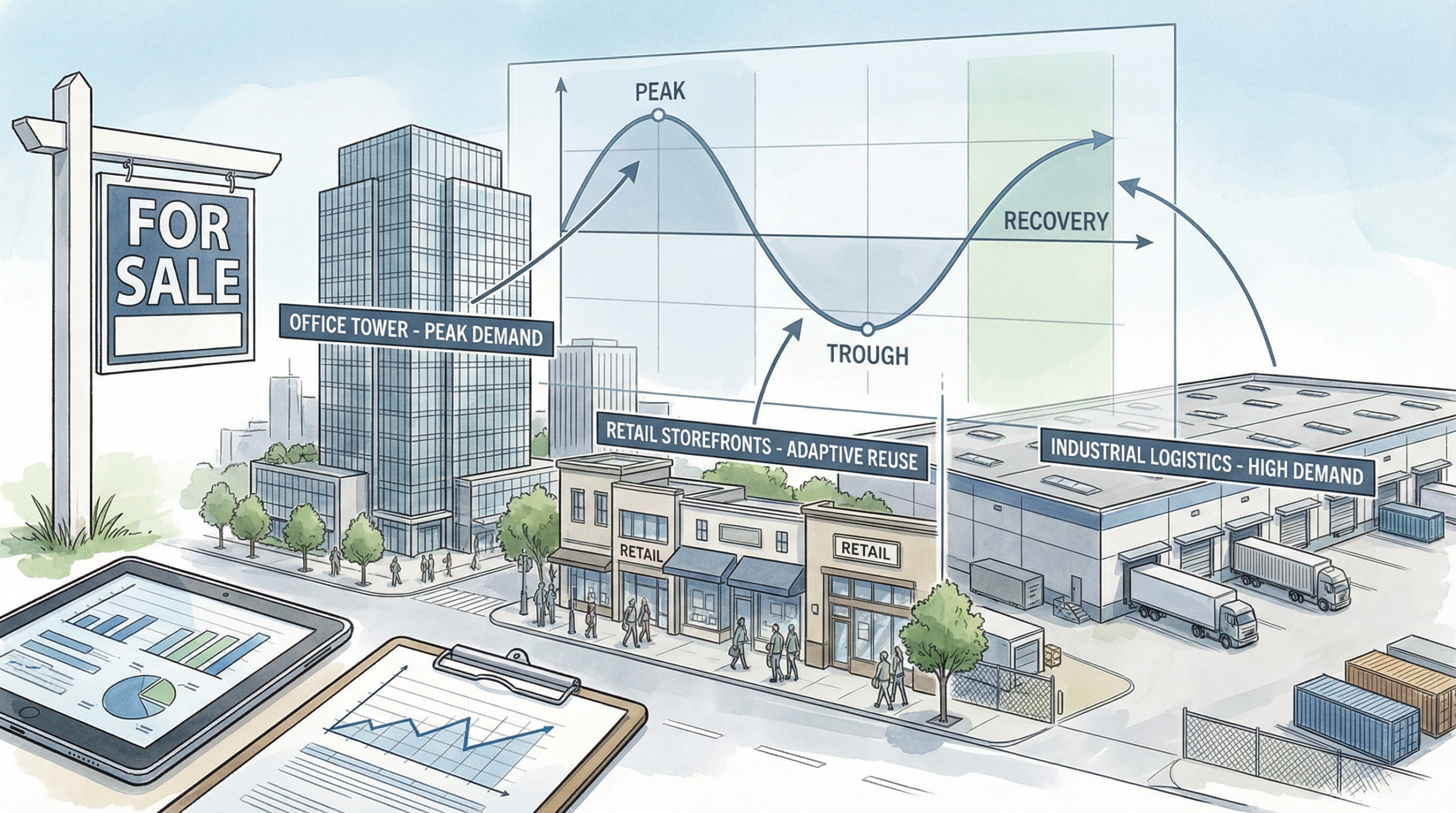
How Each Property Type Reacts to the Cycle in LA
Office Space, The Hardest Hit Sector
The LA office market has been in serious trouble. The shift to remote work gutted demand. By Q1 2025, the overall office vacancy rate in Los Angeles climbed to 23.4%, one of the highest in the city’s recent history, according to Cushman & Wakefield’s market reports.
That means almost one in four office buildings in LA has empty space right now. Selling an office building in this environment is extremely tough. Buyers are few, and the ones who do show up want deep discounts. This is textbook low liquidity during a prolonged cycle downturn.
Industrial and Retail, A Split Story
LA’s industrial market near the Ports of Los Angeles and Long Beach had been booming post-pandemic. But by Q4 2025, industrial vacancies rose to 4.6%, the highest in a decade, as demand cooled and new regulations like AB 98 added uncertainty for warehouse development and local jobs.
Retail is its own story. Vacancies are climbing, retail bankruptcies are rising, and landlords are offering big concessions, rent reductions, and tenant improvement allowances, just to keep tenants. But investment activity in retail stayed more resilient, which tells you that some buyers still see long-term value even in a tough cycle.
Not all property types move through the cycle at the same time in LA. I’ve watched industrial investors celebrate while their office-owning neighbors panic, both in the same calendar year. The lesson? Know your asset class, not just the city.
Smart Strategies to Protect Liquidity Through Any Market Cycle
What Investors Are Doing Right Now
Most experienced investors in LA right now are not panicking. They’re holding and watching. As one senior capital markets expert put it, “Everybody’s holding their chips and looking for opportunities to strategically deploy them.”
Here’s what the smartest investors are doing to stay liquid in any cycle phase:
- Keeping cash reserves ready so they can move fast when distressed properties appear at bottom-of-cycle prices
- Avoiding over-leveraged deals, especially in office and retail sectors where vacancies remain high
- Focusing on multifamily properties, which have shown more stable cash flow and rent growth in LA County
- Using longer lease terms to lock in strong rents at the top of the cycle, leapfrogging the downturn
- Monitoring Federal Reserve decisions closely, since rate changes directly impact buyer activity and financing costs
- Diversifying across property types so one sector’s recession doesn’t freeze their whole investment portfolio
Using Liquidity Management as a Competitive Edge
One thing that separates good investors from great ones in LA is how they handle cash flow during slow periods. Rising operational costs, especially insurance, are eating into margins. Smart investors are finding ways to streamline payments and cut unnecessary costs without letting property quality slip.
According to JPMorgan Chase’s commercial real estate team, investors can strengthen their cash position by using smarter payment systems and managing vendor terms more carefully. Liquidity management planning, including working with treasury services teams, helps investors deploy capital efficiently at every stage of the cycle. Read more at
Need to buy or sell a property in Los Angeles? Buy Your Properties helps homeowners and commercial owners explore fast, hassle-free selling options with no pressure.
👉 Contact us today to discuss your situation and see what your property may be worth.
Conclusion
Market cycles are always moving in Los Angeles. They push liquidity up during expansion and pull it down during recession. As an investor, your job is not to predict the cycle perfectly; that’s almost impossible. Your job is to understand where you are in the cycle right now and make smart decisions based on that.
Office properties are struggling. Industrial is cooling. Multifamily is holding steady. Measure ULA is keeping big deals on pause. Interest rates are slowly easing. All of these things together tell a story about where LA is in its current cycle, and what that means for how liquid your property really is.
The investors who survive, and even thrive, are the ones who stay patient, keep cash ready, and never fall in love with a property so much that they can’t let it go at the right time. If you’ve had your own experience navigating the LA commercial market, I’d love to hear your thoughts.
Frequently Asked Questions (FAQs)
1. What does liquidity mean in commercial real estate?
Liquidity in commercial real estate means how fast you can sell a property and get your money back. High liquidity means buyers are active and deals close quickly. Low liquidity means it’s hard to find buyers, and selling can take a very long time, sometimes more than a year in tough markets like LA.
2. How does the expansion phase affect property sales in Los Angeles?
During expansion, demand goes up, rents rise, and buyers compete for good properties. This makes it much easier to sell commercial buildings quickly and at strong prices. Cap rates compress, financing becomes easier, and the overall market feels confident. It’s the best time for sellers in the LA market.
3. Why did commercial property sales drop so much in Los Angeles after 2023?
Several things hit at once: high interest rates, the introduction of Measure ULA (the property transfer tax), and falling demand for office space after remote work became normal. All of these reduced buyer activity and pushed liquidity very low across many property types in LA County.
4. Is the Los Angeles multifamily market still a good investment during a downturn?
Yes, multifamily has stayed more stable than office or retail in LA. Vacancy rates stayed relatively low, and average asking rents even reached a record high of $2,183 per unit per month in early 2024. It’s not risk-free, but multifamily has held up better than most other property types through the current cycle.
5. How can investors stay liquid during a commercial real estate recession in LA?
The best way is to keep cash reserves ready, avoid over-leveraging, focus on property types with steady demand like multifamily, and watch the Federal Reserve’s rate decisions closely. Building strong relationships with brokers and lenders also helps, because when deals do come, moving fast matters a lot.