
If you own a bungalow court in Los Angeles, you own something rare. These properties go back over 100 years and represent one of the most interesting chapters in the city’s housing story. But knowing the history is just part of the picture. If you are thinking about selling, you need to understand what makes these properties valuable today, who is buying them, and how to get the best outcome from the sale.
What Is a Bungalow Court and Why Does It Matter
A Brief History of the Bungalow Court in Los Angeles
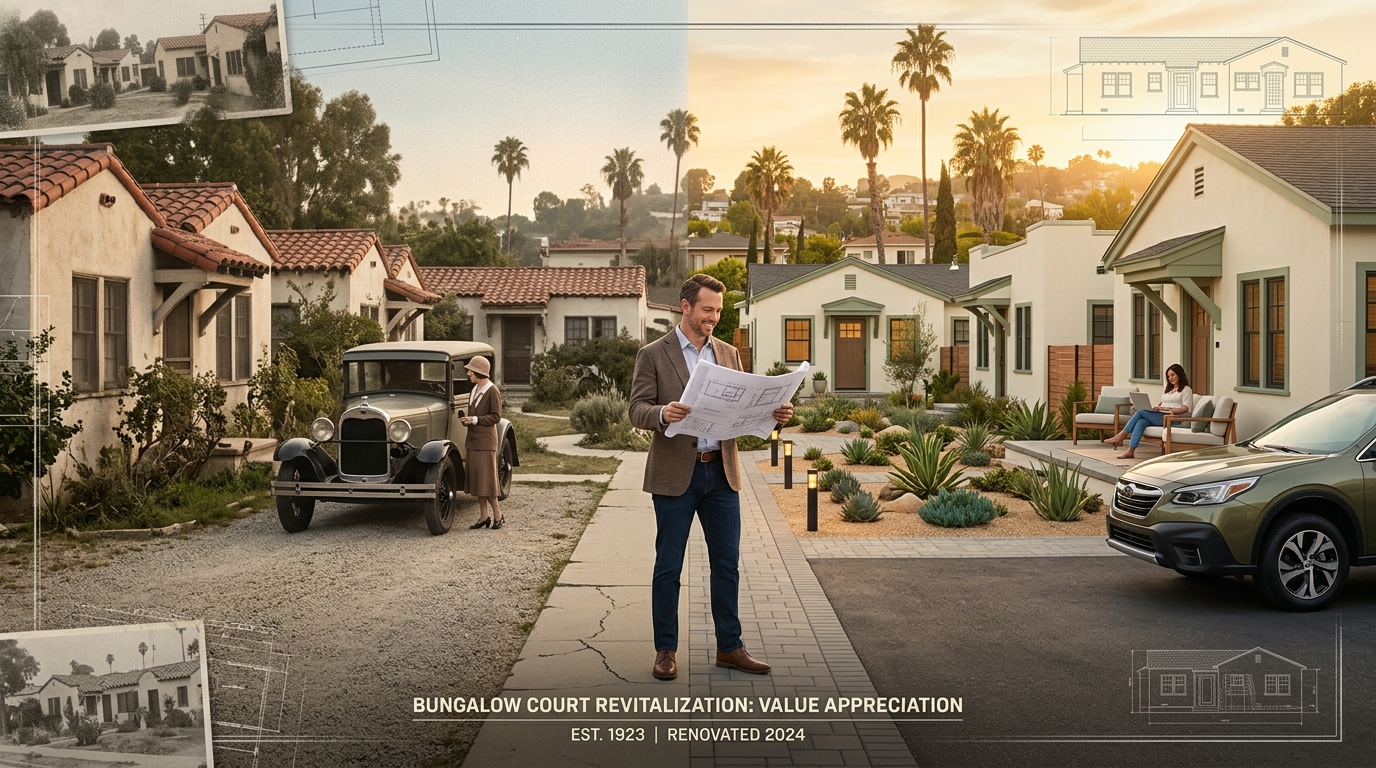
According to Wikipedia’s entry on bungalow courts, this housing type was created in Pasadena, California, in 1909 and became the dominant form of multi-family housing in Southern California from the 1910s through the 1930s. The design placed multiple small, low-rise homes around a shared central courtyard or walkway, giving residents the feel of a private home combined with the community feeling of shared outdoor space.
The Pasadena City Council actually passed an ordinance requiring all new multi-family construction to include a landscaped courtyard, which gave the bungalow court its distinctive layout. Developers embraced the format because it let them build more units on a single lot than a standard apartment building, at a lower construction cost. The style spread from Pasadena into East LA, South LA, Los Feliz, and Hollywood during the 1920s building boom.
By the 1950s, many of these courts were demolished and replaced with dingbat apartments as the city’s needs changed. What survived is now rare, historically significant, and genuinely sought after by a specific type of buyer.
What Makes a Bungalow Court Architecturally Distinct
Bungalow courts are easy to recognize once you know what to look for. The units are typically one story, rarely larger than 1,200 square feet, arranged in two neat rows facing each other across a shared courtyard. Common design styles include Craftsman, Spanish Revival, and Colonial Revival. Each unit often has its own front porch and a sense of separation from the neighbors, even though the units are close together.
What makes this housing type special is that sense of community combined with privacy. Residents share a green outdoor space but still feel like they are living in their own home. That feeling has actually gotten more valuable over time, not less, as Los Angeles faces a housing shortage and residents increasingly want human-scale, walkable neighborhoods.
The Investor Appeal of Bungalow Courts Today
Why Investors Are Paying Attention
A bungalow court is essentially a small apartment complex with a unique design and a loyal tenant base. In the right Los Angeles neighborhoods, tenants in bungalow courts stay for years. The courtyard creates a sense of belonging that a standard apartment building just does not offer. Low turnover means lower vacancy costs for the owner, which directly improves cash flow.
From a pure numbers standpoint, bungalow courts often sit on lots that are zoned for the density they already have, plus sometimes more. In neighborhoods where new missing middle housing is encouraged, a well-located bungalow court on an adequately sized lot may even have redevelopment potential. That is an extra layer of value that investors consider when they are evaluating the purchase price.
According to reporting from the Los Angeles Conservancy, more than 60% of Angelenos rent rather than own, and Los Angeles has some of the most beautiful older and historic multifamily housing in the country, including bungalow courts. Preservation-minded investors and community-focused buyers specifically seek these properties out.
The Heritage Value and Its Effect on Pricing
Some bungalow courts in Los Angeles and Pasadena are listed on the National Register of Historic Places or are eligible for listing. Properties with historic designation can bring both benefits and complications for sellers. On one hand, a recognized historic property can command a premium price from buyers who want a piece of genuine LA history. On the other hand, historic status often comes with restrictions on what can be modified or demolished.
Even without official designation, the architectural character and age of a bungalow court often appeals to buyers who are tired of cookie-cutter apartment buildings. I have seen bungalow courts in Echo Park, Los Feliz, and Silver Lake sell at a premium simply because they offered something that newer buildings cannot replicate. The courtyard, the porch, the mature landscaping. Those details matter to a certain buyer, and that buyer will pay for them.
How to Value and Price Your Bungalow Court
Income Approach and Per-Unit Comparisons
Like any multi-unit residential property, a bungalow court is primarily valued based on the income it produces. Buyers will look at your net operating income (NOI), which is your gross rent minus operating expenses, and apply a cap rate to arrive at a value. In desirable LA neighborhoods, cap rates for small multifamily properties typically run in the 4% to 6% range, though this shifts based on the market and the specific location.
Here is a simple way to think about it. If your bungalow court generates $80,000 in NOI per year and similar properties in your neighborhood are selling at a 5% cap rate, a buyer would estimate the property’s value at $1.6 million. Raising rents even modestly, filling any vacancies, or reducing operating costs before you sell can meaningfully improve that number.
| Factor | How It Affects Value | What to Do Before Selling |
|---|---|---|
| Vacancy rate | Higher vacancy lowers NOI and value | Fill vacant units before listing |
| Below-market rents | Limits current income but shows upside | Document legal rent increases taken |
| RSO coverage | Caps rent growth, must be disclosed | Verify RSO status and disclose early |
| Historic designation | Can add premium or add restrictions | Confirm status and any use limitations |
| Deferred maintenance | Lowers perceived value and increases risk | Handle visible repairs before listing |
What Makes Bungalow Courts Harder to Sell Than Standard Multifamily
Honestly, there is a narrower buyer pool for a bungalow court than for a standard six-unit apartment building. Not every investor knows what they are looking at or how to value it. Some buyers will be confused by the layout. Others will be put off by the age of the buildings or the lack of parking in older configurations.
This is why marketing matters so much. A bungalow court needs to be presented to the right kind of buyer. That means writing a property description that tells the story of the asset, not just the numbers. Investors who understand LA’s history and are looking for something distinctive will pay more than a generic investor who is only looking at the cap rate spreadsheet.
Preparing to Sell Your Bungalow Court
Documents and Details to Organize First
Just like any income property, selling a bungalow court requires having your paperwork in order. Buyers will want to see a complete picture of how the property has been operated before they make an offer. Being organized speeds up due diligence and reduces the chance of a deal falling apart late in the process.
Here is what you should have ready before going to market:
- Complete rent roll showing each unit, current rent, and lease expiration date
- Operating expense history for the past two to three years
- RSO registration and any rent history filed with the city
- Any historic designation documents or deed restrictions
- Recent capital improvements and maintenance records
- Current mortgage payoff balance and any existing liens
- Zoning documentation confirming legal non-conforming status if applicable
Find a Buyer Who Understands What They Are Getting
The best buyers for a bungalow court are investors who specifically appreciate historic Los Angeles multifamily properties. These buyers exist and they are active in neighborhoods like Los Feliz, Silver Lake, Echo Park, and Hollywood. They are often willing to pay more because they value the character of the asset, not just the income statement.
A real estate broker who works in the LA multifamily space and understands small apartment investment can help you reach this buyer pool directly. Marketing through the right channels, telling the property’s story properly, and being transparent about the rent roll and any RSO considerations puts you in the best position to attract serious offers.
If your bungalow court has some deferred maintenance or tenant complications alongside its charm, our post on selling a property with building code violations walks through how to handle those situations honestly. And if you are also considering selling other investment properties at the same time, our guide on liquidating a portfolio of rental properties quickly is worth reading first. When you are ready to move forward, contact us here for a direct conversation about your bungalow court and what it could sell for in today’s market.
Conclusion
A bungalow court in Los Angeles is not just a piece of real estate. It is a piece of the city’s history, and that story has real value to the right buyer. Selling it well means understanding how income-producing properties are valued, knowing who your ideal buyer is, and presenting the property honestly and completely. With the right preparation and the right team, you can turn that historic asset into a strong financial outcome while making sure the next owner appreciates what they are getting.
Frequently Asked Questions
What is a bungalow court in Los Angeles?
A bungalow court is a multi-unit housing type where several small, low-rise homes are arranged around a shared central courtyard or walkway. The style was created in Pasadena in 1909 and was the most common form of multifamily housing in Southern California from the 1910s through the 1930s.
Are bungalow courts covered by LA rent control?
Many bungalow courts in the City of Los Angeles are covered by the Rent Stabilization Ordinance because they were built before October 1978 and have two or more units. RSO limits rent increases and restricts evictions to just cause reasons. Sellers should verify their property’s status and disclose it to buyers early.
How is a bungalow court valued when selling?
Bungalow courts are valued like other small multifamily properties, primarily using the income approach. Buyers divide the net operating income by a market cap rate to estimate value. Historic character and desirable neighborhood location can also support a premium over what the raw income numbers might suggest.
Who are the best buyers for a bungalow court?
The best buyers are typically investors who specifically appreciate historic Los Angeles multifamily properties, community-minded real estate developers, and preservation-focused groups. These buyers value the architectural character and tenant stability that bungalow courts offer. Marketing to them directly produces better offers than a generic listing.
Does a historic designation affect the sale of a bungalow court?
Yes. A property listed on the National Register of Historic Places or with a local historic designation may qualify for certain tax benefits, but it also comes with restrictions on modifications and demolition. Buyers will want to know exactly what the designation allows and prohibits before they make an offer.