
How to Sell Your Los Angeles House Without Ever Flying Back
You moved away from Los Angeles, but you still own property there. Maybe it was a job relocation, a desire for lower costs, or a move to be closer to family. Whatever the reason, you now have an out-of-state property in one of the most complex real estate markets in the country — and the thought of managing a sale from hundreds or thousands of miles away feels overwhelming.
The good news is that selling your LA home remotely is entirely possible. Thousands of out-of-state sellers do it every year. With the right team, the right tools, and a clear plan, you can close your sale without ever stepping foot back in California.
Why More LA Homeowners Are Selling From Out of State
California has seen consistent net out-migration in recent years, with many homeowners relocating to states like Texas, Nevada, Arizona, and Florida. That leaves behind a growing number of people who still own Los Angeles real estate but no longer live nearby.
Some of these sellers have already moved and are carrying the cost of a vacant property. Others inherited a home in LA and live out of state. Some are expats or non-residents who own investment property in the LA market. In all of these cases, the challenge is the same: how do you sell effectively when you can’t be there in person?
The Real Challenges of Remote Property Sales
Selling from a distance is manageable, but it does come with real complications that local sellers don’t face:
- Property preparation — You can’t walk through the home yourself to assess repairs or staging needs
- Contractor coordination — Any maintenance or repairs require trusting a local contact to supervise
- Showing management — You won’t be available to open the door or monitor who enters
- Document signing — California real estate closings require notarized signatures, which means coordinating with a notary wherever you are
- Vacant home risks — Empty properties are more vulnerable to vandalism, water damage, and insurance complications
- Time zone gaps — If you’ve moved abroad, coordinating calls and reviews across time zones adds friction to every step
None of these problems are dealbreakers. But they do require planning upfront so they don’t derail the sale later.
Your Options for Selling an LA Property Remotely
There are two main paths for out-of-state sellers. Which one is right for you depends on your timeline, your property’s condition, and how much involvement you want in the process.
Option 1: Traditional Listing With a Local Agent
Listing your property on the open market through a local real estate agent can yield the highest sale price — but it requires the most coordination. You’ll need to manage property preparation remotely, coordinate showings, and be available for negotiations and paperwork despite the distance.
This works well if your property is in good condition, you have time to wait for the right buyer, and you have a trusted local contact or agent willing to handle the physical side of things. The drawback for many out-of-state sellers is that it can drag on for weeks or months, all while carrying costs like property taxes, insurance, and any HOA fees.
Before committing to this path, it’s worth understanding what a traditional sale really costs. Take a look at our breakdown of the hidden costs of selling a home with a realtor in Los Angeles — many out-of-state sellers are surprised by how much comes out before they receive their proceeds.
Option 2: Direct Cash Sale to a Local Buyer
For many out-of-state owners, selling directly to a local cash buyer is the cleaner solution. There are no showings to manage, no repairs to coordinate, no staging, and no waiting on buyer financing to come through. A cash buyer handles the property as-is, which removes the single biggest logistical headache for remote sellers.
Cash sales can close in a matter of weeks, and the entire process — from offer review to signing to receiving your proceeds — can be handled remotely. If speed, simplicity, and minimal contact with the property are your priorities, this path is usually the best fit for out-of-state owners.
Want to see what a fair cash offer looks like for your LA property? You can get a cash offer for your LA home in as little as 24 hours — without traveling back.
How to Handle Signing and Closing From Another State
The most common question from remote sellers is about paperwork. Specifically: do you need to physically be in California to sign closing documents?
The short answer is no — and here’s how it works.
Electronic Signatures for Most Documents
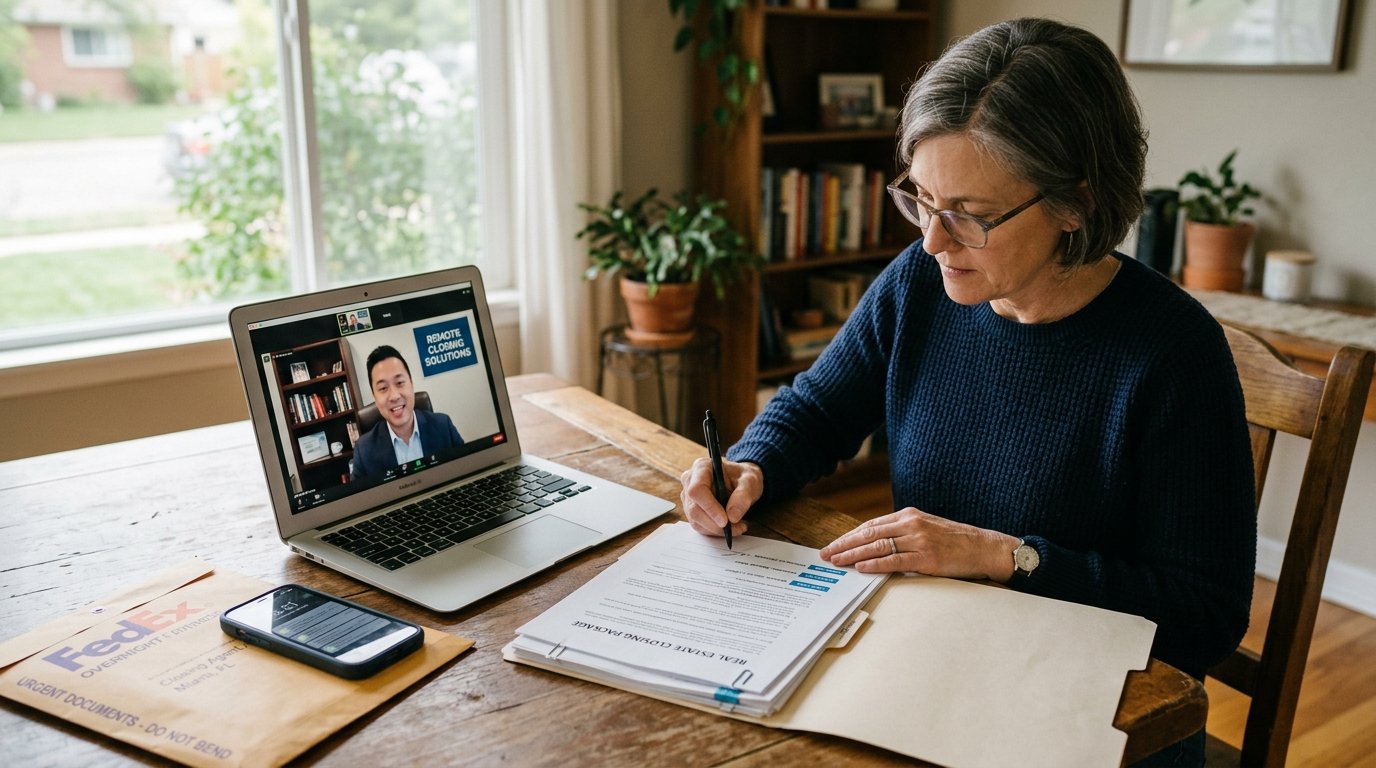
The majority of real estate contracts, disclosures, and counteroffers can be signed digitally through platforms like DocuSign. Your agent or escrow officer will send documents electronically, you review and sign from wherever you are, and the process moves forward without delay. This covers a large portion of what you’ll need to sign during a typical sale.
Notarization for the Grant Deed
California has specific notarization rules for real estate documents. The Grant Deed — the document that transfers ownership — requires a notarized original signature before it can be recorded with the county. California law currently requires the signer to appear before a notary public in person for real estate documents.
If you’re in another state, your escrow company can send the Grant Deed to you early. You simply visit a local notary, sign and notarize the document, and return it — usually by overnight courier. Most notary offices in any state can handle this. If you’re abroad, you can have documents notarized at a US Consulate.
Power of Attorney as an Alternative
If coordinating notarization is difficult — for example, if you’re in a remote location or traveling — you can grant a trusted person a real estate Power of Attorney (POA). This allows them to sign closing documents on your behalf at the LA escrow office. Under California law, a POA used for real estate transactions must itself be notarized and recorded with the county before your agent can sign on your behalf. This takes a little advance planning but eliminates the need for you to handle any physical paperwork at all.
What to Do About the Property Itself
Before listing or accepting a cash offer, you need to know the condition of your LA property. Here’s how experienced remote sellers handle this.
Get a Virtual Walkthrough
Ask your agent, a trusted neighbor, or a local contact to do a live video walkthrough via FaceTime or Zoom. Go room by room and note anything that looks like it needs attention. Even a basic assessment gives you a realistic starting point for pricing and repair decisions.
Deciding What to Fix — And What to Skip
Here’s a comparison of the two main approaches for remote sellers when it comes to property condition:
| Approach | Best For | Time Required | Remote Difficulty |
|---|---|---|---|
| Sell as-is to a cash buyer | Sellers who want speed and simplicity | 2–4 weeks | Low — no repairs needed |
| Light cosmetic repairs + MLS listing | Sellers with time and a local contact | 6–12 weeks | Moderate — needs coordination |
| Full renovation before listing | Sellers maximizing price, good condition | 3–6 months+ | High — significant oversight needed |
For most out-of-state sellers, the as-is or light repairs route makes the most sense. Remote renovation management is stressful and expensive, and the return on investment rarely justifies the effort when you factor in carrying costs while the work is underway.
Managing a Vacant Property Safely
If the property will be empty while you’re getting it ready to sell, take a few steps to protect it. Ask a neighbor or local contact to check in periodically and report any visible issues. Notify your homeowner’s insurance company — many policies have specific conditions for vacant properties, and failing to disclose vacancy can affect coverage. A smart lock or a lockbox installed for your agent can control access without requiring anyone to be there full time.
Tax Considerations for Out-of-State Sellers
Selling an LA property from out of state comes with a couple of important tax points worth knowing upfront.
California Withholding on Non-Resident Sellers
California requires that a portion of the sale proceeds from non-resident sellers be withheld at closing for potential state income tax obligations. The withholding rate is 3.33% of the gross sale price (or 12.3% of the gain for individuals). This is not a final tax — it’s a prepayment that gets reconciled when you file your California tax return. Your escrow officer will handle the mechanics, but be aware this affects your net proceeds at closing.
If you’re also planning to reinvest your proceeds into another investment property, a 1031 exchange may help you defer capital gains taxes entirely. Check out our guide on 1031 exchange rules for real estate investors to see if this strategy applies to your situation.
Primary Residence Exclusion
If the LA home was your primary residence for at least two of the last five years before the sale, you may qualify for the federal capital gains exclusion — up to $250,000 for single filers or $500,000 for married couples filing jointly. This is a significant benefit worth confirming with a tax professional before you close.
The Simplest Path for Most Out-of-State LA Sellers
Here’s the honest truth: the easiest and fastest remote sale is almost always a direct cash sale to a buyer who knows the LA market. You skip the prep work, the showings, the agent negotiations, and the waiting. The buyer takes the property as-is, the escrow process is straightforward, and you receive your funds without making a single trip back to California.
If you’re ready to explore this option — or just want to understand what your property is worth before deciding — contact us here. We work with out-of-state sellers regularly and can make the entire process smooth from start to finish.
Conclusion
Selling your Los Angeles property remotely is not as complicated as it seems. With the right approach — a trusted local buyer or agent, digital tools for signing, and a clear plan for notarization — you can close your sale from anywhere in the world. The key is choosing the path that fits your timeline and how much complexity you want to manage. For most out-of-state owners, a direct cash sale is the path of least resistance and the fastest way to move on.
Frequently Asked Questions
Do I need to be in California to sell my LA home?
No. You do not need to be physically present in California to sell your property. Most documents can be signed digitally. The main exception is the Grant Deed, which requires a notarized signature — but this can be handled at any notary office in whatever state you’re in and mailed back to the escrow company.
What is a Power of Attorney and do I need one to sell remotely?
A Power of Attorney (POA) lets you designate a trusted person to sign closing documents on your behalf in California. It’s not required, but it’s a useful option if you’re in a remote location or want to avoid handling any physical paperwork. For a real estate POA in California, the document must be notarized and recorded with the county before your representative can act on your behalf.
Will California take taxes out of my sale proceeds?
Yes — California requires non-resident sellers to have 3.33% of the gross sale price (or 12.3% of the gain) withheld at closing as a prepayment toward potential state income tax. This is reconciled when you file your California return. It’s not an extra tax — just an advance payment. Your escrow officer will manage this automatically.
Can I sell my LA property as-is from out of state?
Absolutely. Selling as-is is actually the most practical choice for most remote sellers because it eliminates the need to manage repairs and contractors from a distance. A cash buyer will purchase the property in its current condition, which makes the entire process simpler and faster.
How long does a remote sale take?
With a direct cash buyer, a remote sale can close in as little as 2–4 weeks. A traditional MLS listing typically takes 6–12 weeks from listing to close — sometimes longer depending on buyer financing and inspection negotiations. If you’re in a hurry or want to minimize hassle, the cash route is almost always faster.