
San Pedro has been flying under the radar for years. While everyone was watching Venice and Culver City and Silver Lake, this coastal neighborhood at the southern tip of Los Angeles was quietly getting ready for its moment. That moment is 2026. If you are a real estate investor and you have not looked closely at San Pedro yet, I would say stop what you are doing and look now.
What Is Happening in San Pedro Right Now
The West Harbor Project Is Changing Everything
The biggest story in San Pedro right now is the West Harbor development. This is a $500 million, mile-long waterfront project being built on the former Ports O’ Call Village site along the main channel of the Port of Los Angeles. According to the official West Harbor website, the project is opening in phases throughout 2026, with a grand opening planned for later in the year.
When it is fully open, West Harbor will include over 200,000 square feet of waterfront dining, shopping, and entertainment. It has a one-mile waterfront promenade, a 1,200-foot public dock, a 6,200-seat outdoor amphitheater run by Nederlander Concerts, and a 175-foot Ferris wheel that is being billed as California’s tallest. There is also pickleball, tall ship sailing, and year-round programming.
Think about what that does for a neighborhood. You go from a quiet working-class port community to having one of Southern California’s most talked-about entertainment destinations on your waterfront. That kind of anchor development does not leave property values unchanged. It never does.
Residential Development Is Already Moving Fast
The residential side of San Pedro is already responding. According to the Los Angeles Business Journal, about 5,000 multifamily units are either in design, construction, planning, or up for permitting in and around downtown San Pedro. Some have already opened. West Harbor’s developers have described this wave of development as a rising tide that is going to raise property values across the surrounding community.
Just this week, the LA City Council gave the green light to the One San Pedro Collaborative’s plan to triple the housing capacity at the Rancho San Pedro Housing Project. The plan calls for replacing 478 existing units with up to 1,553 new residential units, including over 1,000 income-restricted affordable units. That is a 20-year redevelopment vision on 20 acres right next to the port. And construction also just started on a mixed-use project at 155 W. 6th Street that will bring 281 apartments over ground-floor retail.
Why Investors Are Paying Attention Now
Price Per Door Is Still Below the Peak
I want to talk numbers for a second because this is where San Pedro gets really interesting. In the multifamily market, one of the most important metrics for investors is price per door, which is the average cost per unit in a building. In San Pedro’s 5-plus unit market, price per door is currently sitting around $222,000 to $255,000. At the pandemic peak, it was closer to $289,000 per door.
That means you are buying in at a meaningful discount compared to where this market was just a few years ago, and you are doing it right before a $500 million waterfront development opens and 5,000 new residential units start bringing new residents and economic activity into the neighborhood. That combination is exactly what investors look for.
I have talked to long-term investors who have been buying in San Pedro for years. The consistent message is this is not a flip play. This is a hold-and-watch-the-city-grow-around-you market. That kind of patient investing works especially well when you buy in ahead of a transformation that is already clearly underway.
The 2028 Olympics Are Adding Even More Momentum
San Pedro does not sit in isolation. The Port of Los Angeles runs through it, and the port is one of the busiest in the world. When the FIFA World Cup comes to Los Angeles this summer and the Olympics arrive in 2028, commercial activity at the port is expected to increase. San Pedro is also hosting a World Cup Fan Zone at West Harbor this summer during the tournament’s final rounds, which will put this neighborhood on a world stage it has never had before.
For investors thinking long-term, that visibility matters. A neighborhood that gets international attention during two of the world’s biggest sporting events in consecutive years is going to attract a different kind of buyer and renter going forward. That is not speculation. That is just how these things work in cities that host global events.
Breaking Down San Pedro by Submarket
Northwest San Pedro Is a Family Neighborhood With Strong Schools
Not all of San Pedro is the same, and that matters when you are making investment decisions. Northwest San Pedro is the quieter, more suburban part of the neighborhood. It has some of the more highly rated elementary schools in the area and draws families who want coastal proximity without the noise of the port. The median sale price for single-family homes in Northwest San Pedro has been around $969,000, with an average price per square foot near $641. That is still affordable compared to what similar coastal proximity costs in Redondo Beach or Manhattan Beach.
Central San Pedro is where all the action is and where the development is most intense. This is the area closest to the port, the West Harbor site, and the downtown arts district. It is denser, busier, and where the commercial-to-residential conversion opportunities are strongest. Coastal San Pedro, on the southern end, has some of the area’s largest and most expensive homes, with ocean views and landmarks like the Point Fermin Lighthouse and the Korean Friendship Bell.
How San Pedro Compares to Nearby Markets
One of the reasons investors are moving toward San Pedro is that it is still more affordable than comparable coastal markets while offering a very similar value proposition. Here is a quick comparison of what you get across nearby South Bay and harbor area neighborhoods.
| Neighborhood | Coastal Access | Major Development | Multifamily Price Per Door | Investment Outlook |
|---|---|---|---|---|
| San Pedro (Central) | Yes, waterfront | West Harbor, Rancho San Pedro redevelopment | $222K to $255K | High potential |
| Long Beach | Yes, urban waterfront | Ongoing mixed-use | Higher range | Solid but mature |
| Redondo Beach | Yes, beach access | Limited new supply | Premium pricing | Stable, less upside |
| Wilmington (adjacent) | Industrial waterfront | Affordable housing | Lower range | Moderate |
| San Pedro (Northwest) | Nearby | Suburban residential | Under $300K median | Steady family demand |
What to Look for When Buying in San Pedro
Things That Give a San Pedro Property Extra Investment Value
Not every property in San Pedro will perform the same way. If you are buying as an investor, here are the factors that separate good picks from great ones in this market right now.
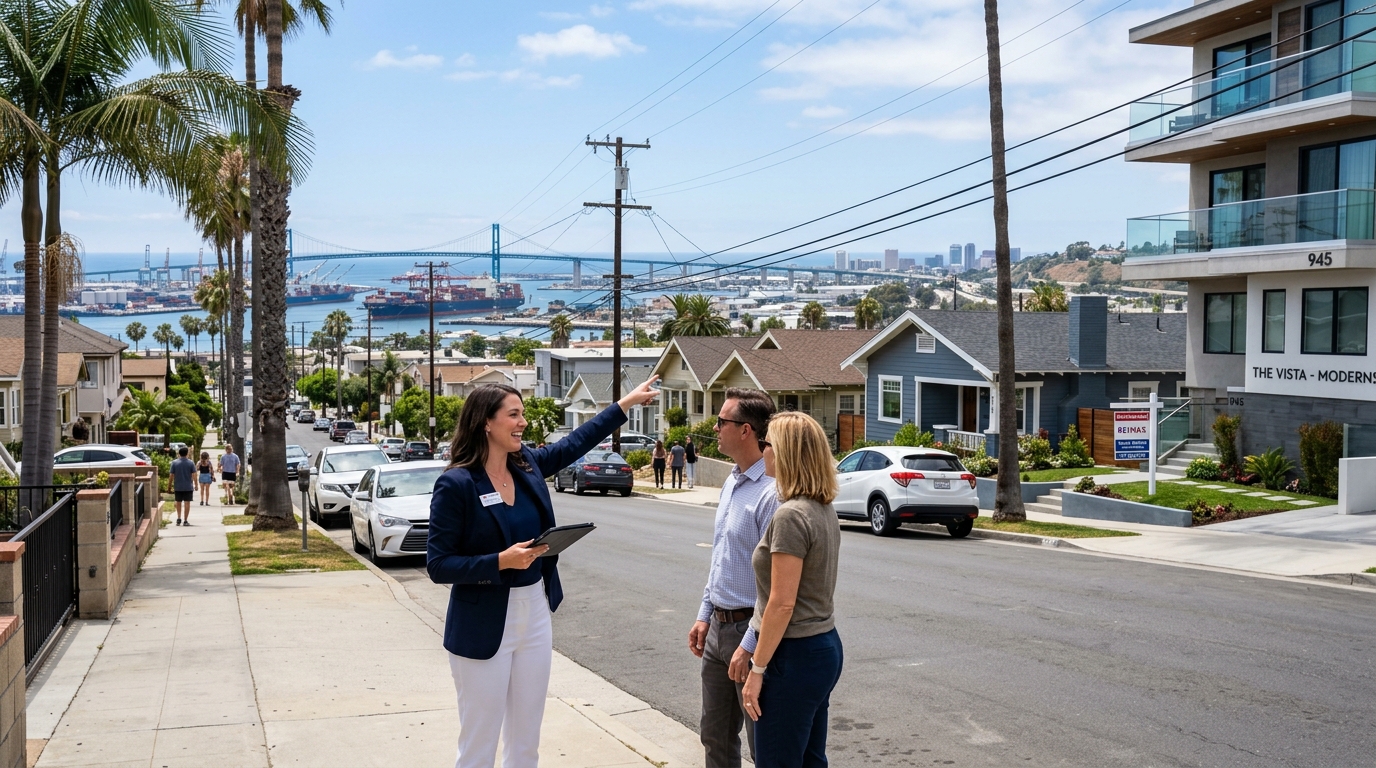
- Proximity to the waterfront and West Harbor. Properties within walking distance of the promenade and the new entertainment complex will see the strongest demand from renters who want the lifestyle that comes with it.
- Multifamily zoning near transit corridors. San Pedro’s downtown area has lots that qualify for density bonuses under LA’s TOC program. If a lot is near a bus corridor or transit node, it opens up more development potential.
- Properties priced below the $289,000 peak per door. If you are buying a 5-plus unit building and the numbers work at current price per door levels, you are buying at a discount to where this market was at its top.
- Low vacancy in the surrounding block. Even before West Harbor fully opens, well-priced units in San Pedro are moving in under 40 days. That tells you demand is real, not projected.
- Lot size and lot shape for future ADU or expansion. State ADU laws allow additional units on many residential lots. A property with a larger lot gives you more options to add value over time.
Honest Risks Every Investor Should Know
I would be doing you a disservice if I did not mention the risks too. San Pedro has taken longer to develop than many people expected. West Harbor was originally planned to open years earlier than it is now. These projects get delayed, and if you are counting on a specific timeline, you can get frustrated.
The Port of Los Angeles is also still a major industrial presence in the neighborhood. The noise, the truck traffic, and the industrial character of certain blocks are real factors for some renters and buyers. San Pedro is not going to become Santa Monica. What it can become is a unique coastal neighborhood with a working port heritage and a world-class waterfront entertainment scene. That is a different kind of appeal, and it is not for every buyer.
If you want to talk about whether a San Pedro property fits your investment goals, check out our investment opportunities page for how we work with LA investors. You might also want to read our post on how transit lines change LA property values since transit access is part of the longer-term story for this area too. And for a broader look at how LA neighborhoods are shifting, our piece on the best commutes to DTLA and their effect on property values gives useful context.
Conclusion
San Pedro is at that rare point where the fundamentals are lining up at the same time. You have a $500 million waterfront development opening this year. You have 5,000 new residential units in various stages of planning and construction. You have price per door still sitting below the pandemic peak. You have the World Cup Fan Zone this summer and the 2028 Olympics adding national and global attention. And you have multifamily inventory that is still moving fast when priced right. That is a compelling case for any investor who is thinking ahead. If you want to talk through what this means for your specific situation, reach out through our Contact Us page and we will help you figure out your next move.
Frequently Asked Questions
Is San Pedro a good place to invest in real estate in 2026?
Yes, and the timing is strong right now. The West Harbor waterfront development is opening in phases throughout 2026, about 5,000 new residential units are in various stages of development in the area, and multifamily price per door is still below the pandemic peak. Investors who buy before the full impact of these projects prices in are getting in at a discount to where this market is likely headed.
What is the West Harbor development in San Pedro?
West Harbor is a $500 million, mile-long waterfront development being built on the former Ports O’ Call Village site along the Port of Los Angeles main channel. It includes over 200,000 square feet of dining, shopping, and entertainment space, a 6,200-seat outdoor amphitheater, a 175-foot Ferris wheel, a one-mile waterfront promenade, and recreational attractions. The project is opening in phases throughout 2026 with a grand opening scheduled later in the year.
How does San Pedro compare to Long Beach for real estate investment?
San Pedro is generally more affordable than Long Beach on a price-per-door basis and currently has more large-scale development projects driving near-term appreciation potential. Long Beach is a more mature market with established values. San Pedro offers more upside because the transformation is still actively in progress, which means buyers today are getting in before a lot of the development impact is fully priced in.
How many residential units are being built in San Pedro?
According to the Los Angeles Business Journal, about 5,000 multifamily units are in design, construction, planning, or permitting in and around downtown San Pedro. Additionally, the LA City Council recently approved a plan to triple the housing capacity at the Rancho San Pedro Housing Project, adding up to 1,553 new residential units on 20 acres near the port. Construction also recently started on a 281-unit mixed-use project on West 6th Street.
Will the 2028 Olympics affect real estate in San Pedro?
It is expected to, yes. San Pedro’s West Harbor is already hosting a World Cup Fan Zone this summer, which will bring international attention to the neighborhood. The 2028 Olympics will add to that visibility, drive commercial activity at the Port of Los Angeles, and continue the general infrastructure investment that LA is making across the city ahead of the games. All of that tends to support property values in neighborhoods that are already in the path of development.