
People always talk about which option gets you more money. But most of the time, nobody actually runs the numbers.
I remember talking to a homeowner who assumed selling with a realtor was obviously better because the listing price was higher. But after we went through the full math together, including commissions, repair costs, and the time her home sat on the market, she was surprised by how close the numbers actually were.
The truth is, your net profit depends on a lot more than just the sale price. Let me walk you through both options, line by line.
What It Actually Costs to Sell With a Realtor
When you sell with a real estate agent, you are paying for their experience and their network. That is valuable. But it comes with real costs.
The biggest one is commission. According to Bankrate, sellers typically pay the listing agent between 2.5% and 3% of the sale price. Depending on the deal, you may also cover the buyer’s agent, adding another 2.5% to 3%. In total, you could be paying 5% to 6% in agent fees alone.
On a $400,000 home, that is $20,000 to $24,000 in commissions right off the top.
Then there are pre-sale repairs. Most agents want the home to show well. Paint, fixes, staging, and cleaning can run $3,000 to $10,000 or more depending on the shape of the property. Standard closing costs like title fees, escrow, and taxes add another 1% to 2% of the sale price on top of that.
What You Get When You Sell to a Cash Buyer
A cash buyer, like a real estate investor or a company that buys homes directly, works very differently.
You typically pay zero agent commissions because there is no listing agent involved. Many cash buyers also cover their own closing costs. And since they buy homes as-is, you do not need to make any repairs before the sale.
The trade-off is the offer price. Cash buyers often offer somewhere between 70% and 85% of the property’s fair market value. They need to account for repairs, their holding costs, and their target return. So while you save on fees, you are starting from a lower number.
The real question is: which one puts more money in your pocket when you add everything up?
Breaking Down the Numbers on Both Sides
Let me use a real example. Say your home is worth $400,000 on the open market.
A Realistic Example With Real Figures
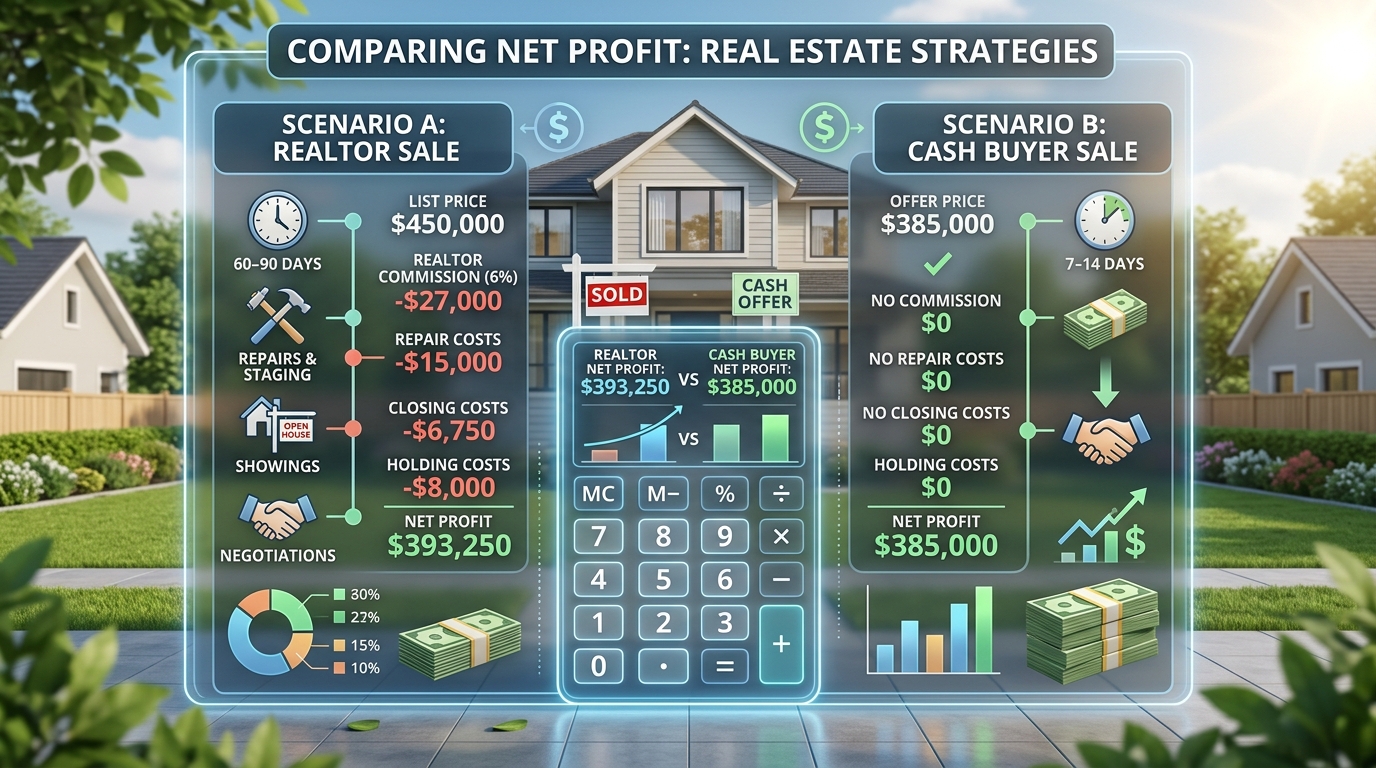
Here is what the math looks like when you sell with a realtor versus a cash buyer on that same $400,000 home.
Selling with a realtor:
- Sale price: $400,000
- Agent commissions at 6%: minus $24,000
- Pre-sale repairs and staging: minus $5,000
- Closing costs at 2%: minus $8,000
- Carrying costs for 3 months while listed (mortgage, utilities, insurance): minus $4,500
- Total you actually keep: around $358,500
Selling to a cash buyer:
- Cash offer at 80% of value: $320,000
- Agent commissions: $0
- Repair costs: $0
- Closing costs often covered by buyer: $0
- Carrying costs (closes in 2 weeks): near zero
- Total you actually keep: around $318,000 to $320,000
The gap is roughly $38,500 in this example. The realtor sale wins, but only if everything goes smoothly.
Hidden Costs That Can Surprise You
The numbers above assume a best-case scenario for the realtor sale. In real life, that does not always happen.
Here are costs that can quietly shrink your realtor-side net profit that most sellers never account for upfront.
- Price reductions if the home sits on the market too long without offers
- Buyer repair demands after the home inspection comes back with issues
- Appraisal gaps where the lender values the home below the agreed sale price
- Deal fall-throughs that force you to relist the home and start over
- Extended carrying costs if the home takes three or four months to sell
Any one of these issues can shrink your realtor-side take-home by thousands. Some sellers have had deals fall through twice before finally closing, adding months of extra costs each time.
According to the Consumer Financial Protection Bureau, closing costs for sellers include more line items than most people expect, and many sellers do not account for all of them when they compare their options.
What Eats Into Your Profit on Each Path
Here is a plain-language breakdown of the costs that eat into your final take on each option.
When selling with a realtor:
- Agent commission of 5% to 6% of the sale price
- Pre-sale repair and staging costs
- Escrow, title, and government transfer fees
- Carrying costs during the listing period
- Possible price reductions if the home sits
When selling to a cash buyer:
- Below-market offer price, usually 70% to 85% of fair market value
- Little to no additional deductions if the buyer covers closing costs
Realtor Fees and How They Add Up
Commission is the single biggest cost in a traditional sale. On a $500,000 home at 5.5%, that is $27,500 going to the agents before anything else comes off the top.
Most sellers know commissions exist. What many do not fully appreciate is how commissions interact with all the other costs. You lose the commission, you spend on repairs, you carry the home for months, and you may still end up agreeing to a price cut. Each of those bites away at the number you thought you were getting.
For more on how selling costs and taxes affect your bottom line, our post on ways to avoid capital gains tax on property sales breaks down strategies that can help you keep more of what you earn.
Cash Buyer Discounts and Why They Offer Less
Cash buyers offer below market value because they are taking on risk you are not. They buy the home as-is. They pay for all the repairs themselves. They carry the property through the renovation. And they take on the risk that costs might run higher than expected.
That cost has to come from somewhere. It comes from the offer price.
That said, a good cash buyer will be transparent about how they calculated their number. You can ask them to walk through the logic. A fair offer should make sense once you see the math behind it.
If you want to understand how the closing process works when selling directly, our guide on the escrow process step by step is a helpful read.
Side-by-Side Net Profit Comparison
| Category | Realtor Sale | Cash Buyer Sale |
|---|---|---|
| Sale Price | Full market value | 70% to 85% of market value |
| Agent Commissions | 5% to 6% | None |
| Repair and Staging Costs | $3,000 to $10,000 or more | None |
| Closing Costs | 1% to 2% | Often covered by the buyer |
| Time to Close | 45 to 90 days or more | 7 to 21 days |
| Deal Fall-Through Risk | Higher | Lower |
| Net Profit on $400K Home | Around $358,500 (best case) | Around $318,000 to $320,000 |
So Which One Puts More Money in Your Pocket?
In a best-case scenario, selling with a realtor nets you more. The higher sale price more than covers the fees when everything goes right, the home sells fast, and there are no surprises after inspection.
But best-case scenarios are not always what happens.
When Selling With a Realtor Makes Financial Sense
Selling with a realtor is the right move when your home is in great shape, the market is active, and you have time to wait. If your home can attract multiple offers and sell near or above list price, the net profit from a realtor sale can beat a cash offer by a significant amount.
If your property is in a hot neighborhood and buyers are competing for homes in your area, listing it makes a lot of financial sense. Let the market do the work for you.
When a Cash Sale Wins on Net Profit
A cash sale wins more often than people expect.
If your home needs serious repairs, the cost to fix it up before listing might actually be more than the discount you take from a cash buyer. If you are carrying a mortgage while the home sits listed for three or four months, those monthly costs eat into your profit fast.
According to the National Association of Realtors, the typical time on market varies widely depending on location and season. In slower markets, the time cost of a traditional sale becomes very real and very expensive.
We buy properties directly and can give you a fair, no-pressure offer with zero fees or last-minute surprises. If you want to compare your options, reach out through our Contact Us page or learn more on our residential property page.
Conclusion
There is no single right answer here. Selling with a realtor usually gives you a higher gross sale price. But selling to a cash buyer gives you speed, simplicity, and certainty, which can close the gap or even flip the equation once you factor in all the real costs.
Before you decide, run the actual numbers for your own situation. Add up the commissions, repair costs, closing fees, and carrying costs. Then compare that total to a fair cash offer. The math might surprise you more than you expect.
Frequently Asked Questions
Does selling with a realtor always net more money than a cash sale?
Not always. While the listed price is usually higher, commissions, repair costs, closing costs, and carrying costs can significantly reduce your net profit. In some situations, a cash offer nets a similar or even better result once all the deductions are accounted for.
How much commission does a realtor typically charge?
A listing agent typically charges between 2.5% and 3% of the sale price. Depending on the agreement, the seller may also cover the buyer’s agent, bringing the total to 5% to 6% of the final sale price.
What does selling as-is mean when working with a cash buyer?
Selling as-is means the cash buyer purchases the property in its current condition with no repairs required from the seller before closing. The buyer takes on the responsibility and cost of any work that needs to happen after the sale.
How fast can a cash buyer actually close?
Most cash buyers can close in 7 to 21 days. A traditional realtor sale typically takes 45 to 90 days or longer. That speed difference also means fewer carrying costs, which matters a lot when you are paying a mortgage and utilities while waiting.
Is a cash offer always lower than market value?
Typically yes. Cash buyers usually offer 70% to 85% of fair market value to account for repairs, their own operating costs, and their profit margin. However, because you are also eliminating commissions, repair bills, and extended carrying costs, the gap between what you actually keep is often much smaller than people assume.