
There are not many moments in the history of Los Angeles where you can point to a single project and say that thing is going to change what homes are worth in this area. The Metro D Line Extension, which most people still call the Purple Line Extension, is one of those moments. For homeowners and buyers in the Miracle Mile, this is not a distant event to watch from the sidelines. The first three stations, including two that directly bookend the Miracle Mile, opened on May 8, 2026. If you own here or want to buy here, you need to understand what that means for your money.
What the Purple Line Extension Actually Is and Why It Matters
The Biggest Transit Project in LA History
The Metro D Line Extension is a nine-mile heavy rail subway project that runs from Koreatown all the way to Westwood, with seven new stations added across three sections. According to LA Metro’s official project page, Section 1 opened on May 8, 2026, adding three new underground stations at Wilshire/La Brea, Wilshire/Fairfax, and Wilshire/La Cienega. This is the first time rail transit has ever served Wilshire Boulevard west of the Koreatown station at Wilshire/Western.
Trains will connect riders from the Miracle Mile to Union Station in downtown Los Angeles in about 20 minutes. That same trip on the bus today takes about 40 minutes. For commuters, that is a huge change. And when commute times drop dramatically, housing demand near those stations tends to go up.
The Two Stations That Frame the Miracle Mile
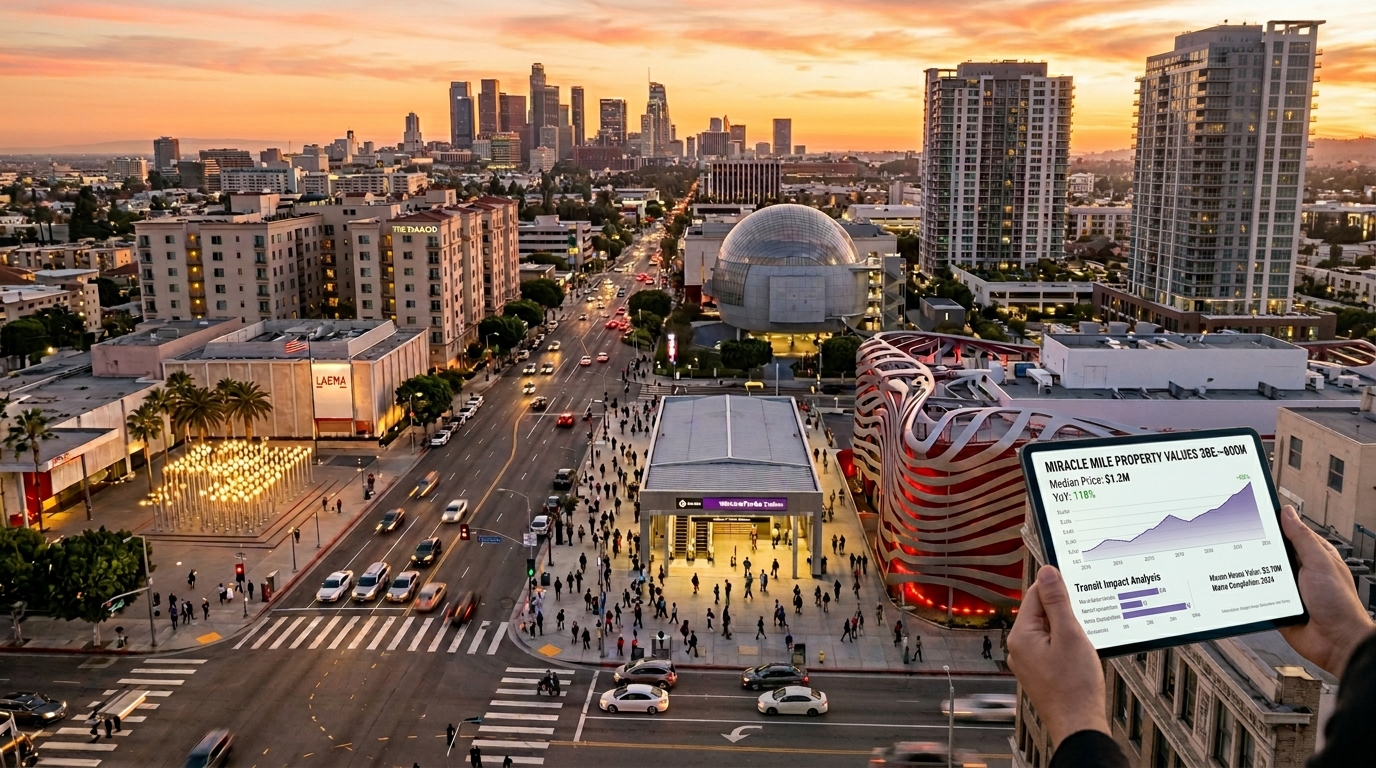
The Wilshire/La Brea station sits at the eastern edge of the Miracle Mile. The Wilshire/Fairfax station is at the western edge. Together they put the entire stretch of Miracle Mile real estate within easy walking distance of subway access. That is not a small thing in Los Angeles, a city that has historically been defined by driving.
The Wilshire/Fairfax station is literally steps from LACMA, the La Brea Tar Pits, the Academy Museum of Motion Pictures, the Petersen Automotive Museum, and Craft Contemporary. These are world-class cultural institutions, and they now have a subway stop at their front door. Buyers and renters who want easy access to that kind of neighborhood will now factor transit into their decisions in a way they simply could not before.
How Transit Changes Home Prices in Los Angeles
What Happened to Areas Near Other LA Rail Lines
The Purple Line is not the first Metro expansion to reshape an LA neighborhood’s property values. The Expo Line is the clearest example of what subway access can do. When the Expo Line opened and started connecting Culver City to downtown LA, that neighborhood started drawing a completely different kind of buyer and renter. Prices moved up significantly as demand for transit-adjacent properties increased.
The Purple Line is expected to have a similar or larger effect on the Miracle Mile and nearby neighborhoods because the line runs under Wilshire Boulevard, one of the busiest and most important commercial corridors in the entire region. The neighborhoods that will benefit are already among the most desirable in LA. Adding fast, reliable subway access to that mix is a strong combination.
What the Numbers Already Show in Miracle Mile
Even before Section 1 opened, the Miracle Mile real estate market was already showing movement. According to data from Redfin, Miracle Mile home prices were up 18.2 percent compared to the prior year in late 2025, with a median sale price of $1.6 million. Homes were still selling at close to their asking prices despite longer days on market compared to the year before.
That kind of price growth happening before the subway even opened tells you something important. Buyers who do their homework understand what is coming and they buy ahead of it. The sellers who list now or in the near future are going to benefit from both the current appreciation and the momentum that comes from new rail service actually being operational.
What Changes in the Miracle Mile Now That the Subway Is Open
New Development Already Moving Into the Area
Transit does not just bring buyers. It brings developers. The Miracle Mile has already seen new development proposals tied directly to the subway stations. One example is the Mirabel project, a proposed 42-story tower on Wilshire Boulevard that is positioned to have tenants walk one block to the Wilshire/La Brea station. According to the Larchmont Chronicle, the developer specifically cited the subway station as a major factor in the project’s appeal to future tenants.
When large-scale residential and mixed-use development moves into a neighborhood, it tends to raise values across the board. More residents, more foot traffic, better-supported retail, and a stronger overall street presence all contribute to making a neighborhood more desirable. The Miracle Mile is already in a strong position. New development near its subway stations will push it further.
Office and Commercial Space Near the Stations
The Purple Line impact is not limited to residential real estate. According to research from JLL cited by GlobeSt, approximately 19.6 million square feet of Class A and B office space sits within 0.25 miles of the seven new Purple Line stations. Miracle Mile, Beverly Hills, Century City, and Westwood all have high concentrations of financial services and legal sector tenants who already deal with some of the highest parking costs in Los Angeles.
When those workers can leave their cars at home and take the subway, it makes those office buildings more attractive, not less. Companies use transit access to recruit younger workers who want alternative commuting options. A home or condo near those same stations becomes even more appealing when the commute to a major Westside employer is now a simple subway ride.
Comparing Miracle Mile to Nearby Neighborhoods on Transit Value
How Station Proximity Stacks Up Across the Corridor
Not all neighborhoods along the Purple Line will benefit equally. Proximity to the actual station entrance, walkability of the surrounding streets, and existing home prices all factor into how much of a boost each area will see. Here is how the Miracle Mile compares to other parts of the corridor in terms of position and expected impact.
| Neighborhood | Section 1 Stations | Approx. Walk to Station | Median Home Price (2025) | Transit Value Boost Potential |
|---|---|---|---|---|
| Miracle Mile | Wilshire/La Brea and Wilshire/Fairfax | Under 10 min for most properties | $1.6M | Very High |
| Hancock Park | Wilshire/La Brea (nearby) | 10 to 15 min walk | High range | Moderate to High |
| Fairfax District | Wilshire/Fairfax | 5 to 12 min walk | Mid to High range | High |
| Koreatown (west end) | Wilshire/Western (existing) | Varies | Mid range | Moderate |
| Beverly Hills (La Cienega) | Wilshire/La Cienega | 10 min walk from some parts | Very High range | Moderate |
Why Miracle Mile Has an Edge Over Its Neighbors
The Miracle Mile has a specific advantage that its neighbors on either side do not quite match. It has two stations instead of one, which means a much larger portion of the neighborhood is within reasonable walking distance of a subway entrance. It also sits right next to Museum Row, which gives it cultural anchor institutions that attract renters and buyers who want more than just a transit connection.
On top of that, the neighborhood is zoned mostly residential with good walkability scores already in place. Adding subway access to a neighborhood that is already very walkable and culturally rich is a stronger combination than adding it to a car-dependent area. The Miracle Mile gets the benefit without having to fix the walkability problem first.
What Buyers and Sellers in Miracle Mile Should Do Right Now
If You Are Thinking About Buying
Honestly, the window to buy into the Miracle Mile before the subway effect fully prices in has already started closing. Prices were already up 18 percent year over year before the stations even opened. Once the operational reality of having a working subway sets in for the broader buyer pool, demand and prices are likely to stay elevated or push higher.
If you are a buyer, look at how far each property is from the Wilshire/Fairfax or Wilshire/La Brea station entrance on foot. Properties within a 10-minute walk are the ones most directly affected. Check what is walkable from the property to those stations too, not just the distance, but the actual street-level experience. That is what your future tenants or buyers will care about most.
If You Are Thinking About Selling
If you are a Miracle Mile homeowner thinking about selling in the next year or two, you are in a strong position. The subway opening has given buyers a concrete, functional reason to pay a premium for proximity. You can now market your property with transit access as a real selling point, not just a future promise.
Make sure your listing clearly states the walking time to each station. Buyers in 2026 and beyond will be searching for transit-adjacent properties in the same way they searched for good school zones a decade ago. If your property is close to either Wilshire station, that is a headline feature, not a footnote.
If you want to know more about how we help LA homeowners evaluate their property value based on transit and location, check out our post on the best commutes to DTLA and what they mean for property value. And if you are ready to talk about your Miracle Mile home specifically, head to our cash home buyers Los Angeles page to learn how we work with sellers across the city.
Conclusion
The Purple Line Extension is the most significant transit infrastructure addition the Miracle Mile has ever seen. With two bookending stations now open, travel times cut in half for downtown commuters, and a pipeline of new development responding to the rail connection, the case for rising home values in this neighborhood is solid. Prices were already moving before the stations opened. The long-term impact of having a working heavy rail subway through one of LA’s most culturally rich neighborhoods is still unfolding. Whether you are buying, selling, or investing, understanding how this transit line changes the math in the Miracle Mile gives you a real edge. Reach out through our Contact Us page and we will help you figure out your next move.
Frequently Asked Questions
When did the Purple Line Extension open near Miracle Mile?
The first section of the Metro D Line Extension, which most people call the Purple Line Extension, officially opened on May 8, 2026. It added three new underground stations including Wilshire/La Brea and Wilshire/Fairfax, which sit at the eastern and western edges of the Miracle Mile. This was the first time subway service had ever run on Wilshire Boulevard west of Koreatown.
How much have Miracle Mile home prices increased recently?
According to Redfin data from late 2025, Miracle Mile home prices were up 18.2 percent compared to the prior year, with a median sale price of around $1.6 million. That growth was happening even before the subway stations opened, which suggests buyers were already pricing in the expected impact of the transit expansion.
Does proximity to a Metro station actually increase home values in LA?
Yes, and there is real evidence from other LA rail lines to support this. When the Expo Line opened and connected Culver City to downtown, property values in that area responded noticeably. Research from real estate firms including JLL has documented that transit-adjacent properties in Los Angeles tend to see stronger long-term appreciation than comparable properties without rail access.
What else is being built near the Miracle Mile subway stations?
Several large development projects have been proposed or are moving through approvals near the new stations. One notable example is Mirabel, a proposed 42-story mixed-use tower on Wilshire Boulevard positioned within one block of the Wilshire/La Brea station. The developer specifically noted the subway stop as a key feature for future tenants. More projects are expected as the rail line becomes fully operational and developers see confirmed ridership.
When do the next sections of the Purple Line Extension open?
According to LA Metro, Section 2 of the D Line Extension, which brings the subway to downtown Beverly Hills and Century City, is anticipated to open in 2027. Section 3, which extends the line to Westwood Village and the VA Medical Center campus, is also expected in 2027. The full nine-mile project is planned to be complete in time for the 2028 Olympic Games in Los Angeles.