
You found a house that needs some work. The price is low, the bones look good, and you’re thinking — maybe this is the one. But is buying a fixer-upper as your first home a smart move, or a costly mistake? Let me walk you through everything you need to know before you make that call.
What Is a Fixer-Upper and Why Do First-Time Buyers Consider It?
A fixer-upper is a home sold at a lower price because it needs repairs, updates, or renovations. It could be a fresh coat of paint and new floors — or it could be a roof replacement and full kitchen gut. The range is huge.
First-time buyers are drawn to fixer-uppers mostly because of price. In many markets, a move-in ready home is simply out of reach. A fixer-upper lets you get into a neighborhood you love — even if it means putting in more work later.
The Real Appeal: Lower Price, Big Potential
The purchase price is lower. That’s the main draw. According to the Federal Reserve Bank of St. Louis, the median price for an existing home in the U.S. was $393,400 in January 2025 — while new homes averaged $446,300. A fixer-upper can bring that number down further, sometimes by tens of thousands.
Less competition is another perk. Most buyers don’t want the hassle. That means fewer competing offers, more bargaining power, and a better chance of actually getting the home you want. I’ve seen first-time buyers lose five or six offers on move-in ready homes, then finally win on a fixer-upper — and end up loving it.
Cosmetic vs. Structural Issues: Know the Difference
Not all fixer-uppers are the same. Some just need new paint, updated light fixtures, or fresh flooring — those are cosmetic issues. They’re cheap and easy to fix yourself or with a small budget.
But structural problems are a different story. Foundation cracks, roof damage, bad plumbing, or outdated electrical systems? Those can cost tens of thousands before you even unpack your boxes. Always get a detailed home inspection before you fall in love with a property.
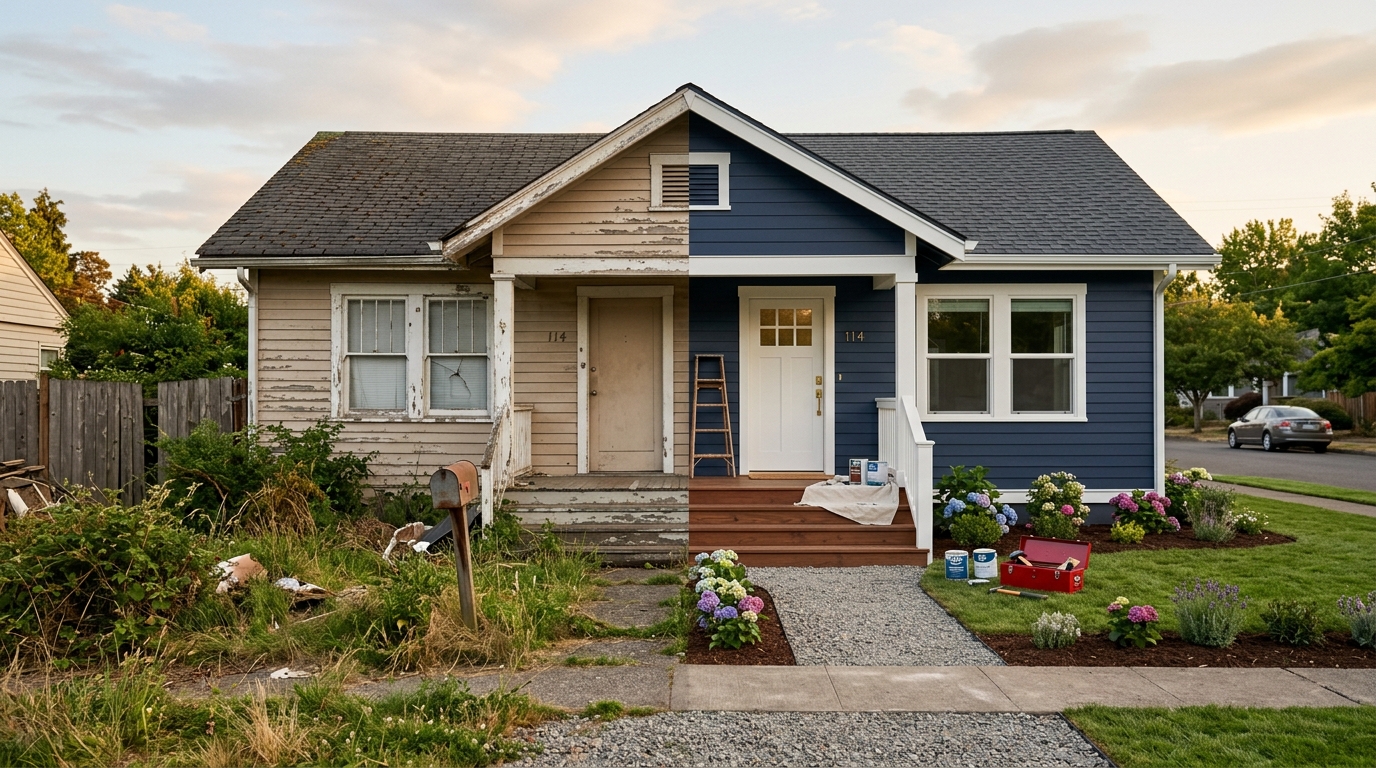
Pros and Cons of Buying a Fixer-Upper as Your First Home
Let’s lay it all out. Here’s what you get — and what you’re signing up for — when you buy a home that needs work.
The Real Benefits Worth Knowing
- Lower purchase price compared to move-in ready homes in the same area
- Less buyer competition, giving you more leverage in negotiations
- Customization freedom — you can build your dream space from scratch
- Equity building — smart renovations can significantly increase home value
- Access to better neighborhoods that would otherwise be out of your budget
- Renovation loan options like FHA 203(k) that bundle purchase and repair costs
According to a 2025 survey by Today’s Homeowner, 79% of fixer-upper buyers said they would buy the same home again. That’s a strong satisfaction rate.
The Honest Challenges You Need to Prepare For
Here’s the part most people skip over. The costs almost always go higher than planned. You budget $30,000 for renovations — surprise, there’s hidden water damage. Now it’s $50,000. This happens more than anyone wants to admit.
| Challenge | What to Expect |
|---|---|
| Cost overruns | Budget 10–20% extra for surprises |
| Time delays | Major renovations can take 6–12+ months |
| Financing hurdles | Some lenders won’t finance poor-condition homes |
| Living in a construction zone | Dust, noise, and chaos for months |
| Contractor challenges | Finding reliable contractors can be hard |
| Unexpected issues | Old homes hide problems even inspections miss |
Financing Options for Fixer-Upper Buyers
Getting a regular mortgage on a fixer-upper can be hard — many lenders won’t approve loans for homes in poor condition. But there are programs built exactly for this situation.
FHA 203(k) and Other Renovation Loan Programs
The FHA 203(k) loan is the most popular option for first-time buyers. It combines the purchase price and renovation costs into a single mortgage, with a down payment as low as 3.5%. According to the U.S. Department of Housing and Urban Development (HUD), the Standard 203(k) allows for structural changes, while the Limited version covers cosmetic repairs up to $35,000.
Other options include the Fannie Mae HomeStyle Renovation Mortgage and the Freddie Mac CHOICERenovation loan. Both allow you to borrow based on the home’s value after renovations — which can give you a bigger budget to work with. You can also check guidance from the Consumer Financial Protection Bureau for detailed loan comparisons.
If you’re a veteran or active-duty service member, a VA renovation loan lets you buy and renovate with zero down payment — one of the best deals in home financing.
How to Calculate If It’s Really Worth It
Here’s a simple formula that real estate pros use:
Purchase Price + Renovation Costs + 15% Buffer = Total Cost
Compare that to what similar homes sell for in the same neighborhood. If your total cost is still below market value, you’ve likely found a good deal. If it’s about the same or more — walk away.
Don’t forget to think about your down payment options and whether you have enough cash reserves to cover both the deposit and renovation costs at the same time.
Tips to Buy a Fixer-Upper Smartly
I’ve talked with many buyers who bought fixer-uppers and loved the experience — and some who regretted it. The difference usually comes down to preparation.
What to Check Before You Make an Offer
Location matters more than the house itself. You can fix a kitchen, but you can’t fix a bad neighborhood. Look for fixer-uppers in areas with rising property values, good schools, and low crime — even if the house itself looks rough.
Always hire a licensed home inspector — and consider a specialist if there are signs of foundation or structural issues. Get quotes from at least two or three contractors before you close. The numbers will surprise you, in ways good and bad.
Also, be honest with yourself about what you can DIY. Many first-timers overestimate their skills and underestimate the time involved. If you’re planning to hire out most of the work, the savings shrink fast. According to the National Association of Home Builders (NAHB), labor costs typically represent 40–50% of total renovation expenses.
If you need help figuring out your next steps, our team at Buy Your Properties is happy to guide you through the process.
For more on how to evaluate a property before purchasing, check out our guide on how homes are priced in your market and our tips on high-ROI home improvements to understand what renovations actually pay off.
Is a Fixer-Upper the Right First Home for You?
If you have patience, a realistic budget, a good inspector, and some flexibility on your move-in timeline — a fixer-upper can be one of the smartest first buys you’ll ever make. You get a home in a neighborhood you want, at a price you can afford, with the freedom to make it your own.
But if you need to move in right away, have a tight budget with no buffer, or feel stressed just thinking about contractors — it’s okay to look at move-in ready homes instead. There’s no shame in knowing what you need.
Conclusion
Buying a fixer-upper as your first home can be a great move — or a very expensive lesson — depending on how well you prepare. The key is knowing what you’re walking into. Get a solid inspection, run the real numbers, explore renovation loan options, and choose a location with strong growth potential. If you go in with eyes open, a fixer-upper can give you more home, more equity, and more satisfaction than buying something move-in ready at a higher price.
Frequently Asked Questions
Is it smart to buy a fixer-upper as a first-time buyer?
Yes, it can be very smart — especially if you find a home in a great location at a lower price. The key is having a realistic renovation budget and getting a thorough home inspection first.
What loans are available for buying a fixer-upper?
The most popular option is the FHA 203(k) loan, which combines the home purchase and renovation costs into one mortgage. Fannie Mae HomeStyle and VA renovation loans are also available depending on your situation.
How do I know if a fixer-upper is worth the money?
Add up the purchase price plus estimated renovation costs plus a 15% buffer. If that total is still less than what similar renovated homes sell for nearby, it’s likely worth it.
What are the biggest hidden costs in a fixer-upper?
Foundation problems, old electrical wiring, outdated plumbing, roof damage, and water damage are the most common — and most expensive — surprises. Always budget extra for things you can’t see before you buy.
Can I live in a fixer-upper while renovating?
Yes, in most cases. But it depends on the extent of the work. Cosmetic renovations are usually livable. Major structural or systems work may require you to stay somewhere else temporarily, which adds to your overall cost.