
If you own a home in Los Angeles, you are probably sitting on more potential than you realize. One of the most talked-about ways homeowners here are increasing their property value and generating real income is by adding an ADU. And honestly, the timing has never been better to look into it.
What an ADU Actually Is
An ADU stands for Accessory Dwelling Unit. It is a second, fully independent living space on your property that has its own kitchen, bathroom, and sleeping area. People call them different things: granny flats, in-law suites, backyard cottages, casitas. They all mean the same thing.
According to the California Department of Housing and Community Development, ADUs have been growing rapidly across the state as one of the most practical answers to California’s housing shortage. Over 80,000 ADUs have been permitted in California since the first major ADU reform bill passed in 2016. That tells you this is not a niche thing. This is mainstream.
In Los Angeles specifically, ADUs now account for 1 in 3 new housing units being built. That number alone should tell you how much demand exists and why cities have been working hard to make the process easier.
The Different Types of ADUs You Can Build in LA
Not all ADUs are the same, and the right type for your property depends on your budget, your lot size, and what you want to use the space for. Here is a quick breakdown of the most common options.
- Detached ADU: A completely separate structure built in your backyard. It has its own foundation, walls, and roof. These offer the most privacy and tend to add the most value, but they are also the most expensive to build.
- Attached ADU: An addition connected to your main home. It shares at least one wall with the existing house and is a good option when you have limited yard space.
- Garage Conversion ADU: One of the most popular options in LA. You take an existing garage and convert it into a livable unit. It is faster to build, less expensive, and the structure already exists.
- Junior ADU (JADU): A smaller unit of up to 500 square feet that is contained within the existing home itself, often carved out of a bedroom or garage attached to the main house.
Each type comes with its own permit process, cost range, and rules around setbacks and height limits. Knowing which one fits your property is the first step.
How California ADU Laws Changed Everything in 2024 and 2025
A few years ago, building an ADU in LA was a real headache. Parking requirements, owner-occupancy rules, and slow permit processes made it difficult for many homeowners to move forward.
That changed significantly starting in 2020 and has kept improving since. As of 2025, California law permanently prohibits cities from imposing owner-occupancy requirements on ADUs. That means you do not have to live on the property to build and rent one out. This opened up ADUs to investors in a serious way.
California also now requires all cities to offer pre-approved ADU plan programs, making it much faster to get through the permit process. The LA County Planning Department approved an updated ADU ordinance effective August 2025 that brings local rules in line with the latest state law. Most conforming ADUs in Los Angeles now get approved within 60 days.
How ADUs Add Real Value to Your Property
Here is where it gets interesting for property owners. An ADU does not just add living space. It adds financial value in multiple ways at the same time.
The National Association of Realtors reports that homes with ADUs typically sell for about 35 percent more than comparable homes without them. In high-demand markets like Los Angeles, that number can go even higher. According to recent data, LA homeowners adding an ADU can see their property value increase by $200,000 to $500,000 depending on the size and type of unit.
That is a significant jump. And on top of the resale value, the rental income is ongoing. A well-located ADU in LA can generate $2,000 to $4,000 per month in rental income. Over a few years, that rental income can cover a large portion of what it cost to build.
ADU Construction Costs vs. Value Added in Los Angeles
The most common question people ask is whether the cost to build is worth it. Here is a general breakdown of what to expect based on current 2025 data for the Los Angeles area.
| ADU Type | Typical Build Cost (LA 2025) | Estimated Value Added | Monthly Rental Potential |
|---|---|---|---|
| Garage Conversion | $100,000 to $150,000 | $150,000 to $250,000 | $1,800 to $2,800 |
| Junior ADU (JADU) | $50,000 to $100,000 | $100,000 to $200,000 | $1,200 to $2,000 |
| Attached ADU | $150,000 to $250,000 | $200,000 to $350,000 | $2,000 to $3,200 |
| Detached ADU (1 story) | $200,000 to $350,000 | $300,000 to $450,000 | $2,500 to $4,000 |
| Detached ADU (2 story) | $350,000 to $400,000 | $400,000 to $500,000 | $3,000 to $4,500 |
These are general ranges. Location within LA makes a big difference. An ADU near Venice Beach or Silver Lake will command higher rents than the same unit in a less central neighborhood. But across the board, the return on investment is strong compared to most other home improvements you could make.
The Rental Income Side of the Equation
I have talked to a lot of LA homeowners who added an ADU and the ones who did it right do not regret it. The rental income alone changes the math on owning a property in this city.
Think about it this way. If your ADU brings in $2,500 per month, that is $30,000 per year. Over ten years, that is $300,000 in rental income on a unit that may have cost you $150,000 to build. You broke even in five years and everything after that is pure return, on top of the increase in your property value.
New ADUs built after February 1995 are exempt from California’s rent caps, though they must follow just cause eviction laws. That gives landlords more flexibility on setting market-rate rents while still following state tenant protection rules.
What You Need to Know Before Building an ADU in LA
Before you start calling contractors, there are some practical things you need to check. Not every property in LA is automatically eligible for every type of ADU.
First, check your zoning. ADUs are allowed on single-family and multifamily zoned properties throughout LA. For properties in the City of Los Angeles, you can verify your zoning through the ZIMAS system on the city’s website. Setback requirements typically mean the ADU must sit at least 4 feet from the rear and side property lines.
Height limits are generally 16 feet for detached ADUs, though this can vary by zoning. Parking is not required if your property is within half a mile of public transit, which covers a large portion of LA.
For financing help, the CalHFA ADU Grant offers up to $40,000 for pre-development costs for qualifying homeowners. There are also local loan programs available through NHS LA County for lower-income homeowners.
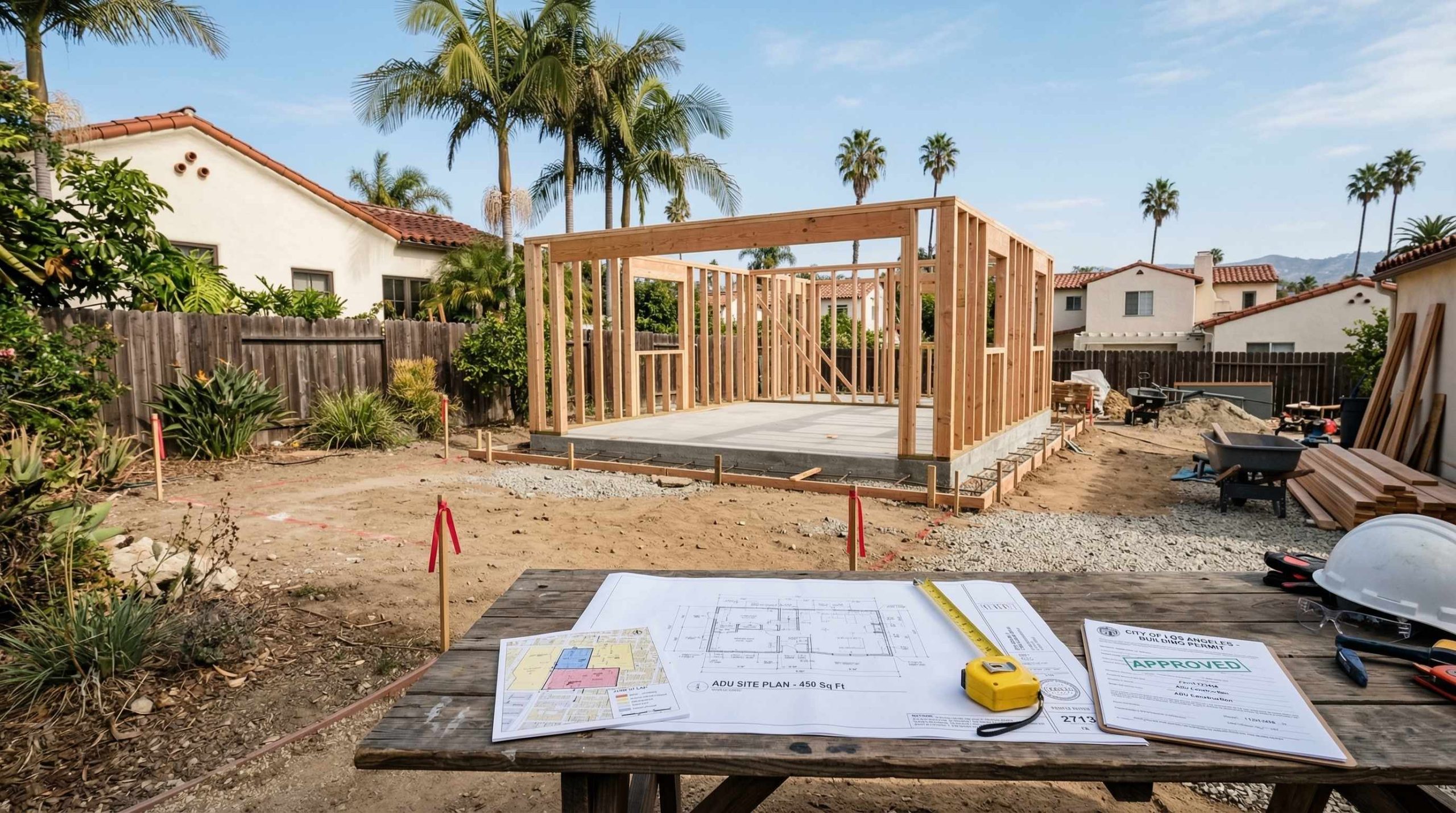
The permit process through the Los Angeles Department of Building and Safety now includes pre-approved ADU plan options that can shorten your timeline significantly. If you choose a pre-approved plan rather than a custom design, you could get approved in 2 to 3 weeks instead of 3 to 6 months.
How an ADU Affects Your Home Sale Down the Road
Here is something a lot of people do not think about until they are ready to sell. An ADU on your property does not just add value. It changes who wants to buy your home.
Buyers who see a property with a rental unit already in place know they can offset their mortgage costs from day one. That makes your home attractive to a much broader pool of buyers than a single-family home without that income potential. In a competitive market like LA, that broader pool often translates into stronger offers and faster sales.
If you are thinking about selling a home with an ADU or a property that has potential for one, our post on whether LA home improvements actually pay off covers how different upgrades stack up in terms of real return on your investment.
And if you want to understand how cash buyers think about properties with ADUs and income potential, our comparison of why iBuyers are not always the best choice for LA homeowners breaks down how different types of buyers value what your property actually offers.
Is Building an ADU Right for Your Property Right Now?
It depends on a few things. If you have the lot space, access to financing, and plan to stay in your home for at least a few years, building an ADU is almost always worth it in Los Angeles. The rental market here supports it, the property values support it, and the laws have made it easier than ever to actually complete the process.
If you are closer to selling your home and wondering whether adding an ADU first would get you a better price, that is a calculation worth doing carefully. In some cases, selling as-is to a cash buyer who will develop the ADU themselves is faster and less stressful than going through the build process before listing.
If you want to talk through how an ADU might affect your specific property value and selling options, reach out to us through our contact page. We work with LA homeowners all the time on exactly these kinds of questions.
You can also explore how we work with sellers of all kinds of properties by visiting our sell your house fast in Los Angeles page.
Conclusion
ADUs are one of the best tools an LA homeowner has for building wealth right now. They generate rental income, boost your property value by hundreds of thousands of dollars, and make your home more attractive to buyers when you do decide to sell.
California laws have made the process faster and more accessible than it has ever been. Whether you are thinking about a simple garage conversion or a full detached unit in your backyard, the math on ADUs in Los Angeles is hard to argue with.
The key is knowing your property, understanding the permit process, and making sure the type of ADU you build fits your budget and your goals.
Frequently Asked Questions
How much does it cost to build an ADU in Los Angeles in 2025?
Build costs in LA range from around $50,000 for a Junior ADU carved out of existing space to $350,000 to $400,000 for a full two-story detached unit. Garage conversions typically run $100,000 to $150,000 and are one of the most cost-effective ways to add a rental unit. Soft costs like plans, permits, and engineering add another $10,000 to $25,000 on top of construction.
Does an ADU increase property value in Los Angeles?
Yes, significantly. In the LA market, adding an ADU typically increases your property value by $200,000 to $500,000 depending on the size and type of unit. The National Association of Realtors reports that homes with ADUs sell for about 35 percent more than comparable homes without them. In high-demand LA neighborhoods, that premium can be even higher.
Do I have to live on the property to build an ADU in California?
No. As of 2025, California law permanently prohibits cities from imposing owner-occupancy requirements on ADUs. This means you can own the property, rent out both the main home and the ADU, and you are not required to live there yourself. This rule applies to new ADU projects permitted going forward.
How long does it take to get an ADU permit approved in Los Angeles?
Most conforming ADUs in LA are now approved within 60 days after fees are paid. If you use a pre-approved ADU plan from the city’s program, approval can happen in as little as 2 to 3 weeks. Custom designs take longer, typically 3 to 6 months for plan review and approval. Total construction time after permits are issued generally adds another 6 to 12 months.
How much rental income can I make from an ADU in Los Angeles?
Rental income from LA ADUs varies by location and size, but most units bring in $1,800 to $4,500 per month. A studio or one-bedroom ADU in a central LA neighborhood typically rents for $2,000 to $3,200. A two-bedroom detached unit in a high-demand area can command $3,500 to $4,500 per month. Proximity to employment centers, universities, and public transit drives the higher end of the rental range.