
Selling a home in Virginia sounds exciting until you see how much of your money goes out the door at closing. Between agent commissions, transfer taxes, title fees, and all the other costs, it can feel like everyone gets a piece of your sale except you. But it does not have to be that way. There are real, practical ways to lower or even skip several of these costs so you walk away with more money in your pocket.
What Are Closing Costs When Selling a House in Virginia
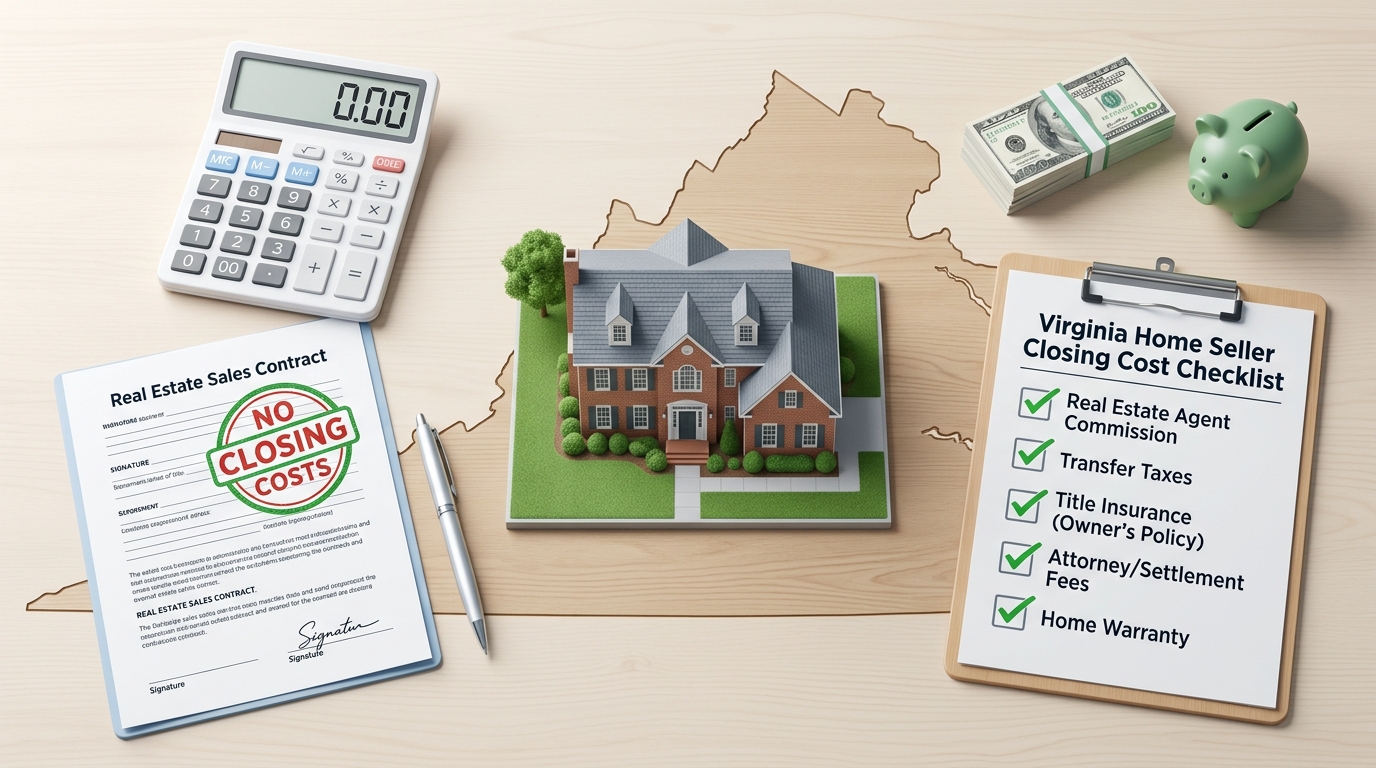
Common Fees Virginia Home Sellers Pay
Closing costs are fees that come due when a home sale is finalized. As the seller, you are responsible for some of them. Knowing what they are is the first step to figuring out what you can cut.
Here are the most common costs Virginia home sellers deal with:
- Real estate agent commission: Usually 5% to 6% of the sale price. This is typically the biggest cost for sellers.
- Grantor’s tax: Virginia sellers pay $0.50 for every $500 of the home’s value. Northern Virginia adds an extra $0.10 per $100 on top of that.
- Title insurance: Protects the buyer from ownership disputes. Sellers often cover this cost, usually between $500 and $1,500 or more.
- Recording fees: Your county charges this to officially record the ownership change. The amount varies depending on where you live.
- HOA fees: If your home is in a community with a homeowners association, expect to pay HOA transfer fees, outstanding dues, and possible document fees.
- Settlement fees: The closing company charges a fee to handle the paperwork. This can range from a few hundred to over a thousand dollars.
- Attorney fees: Virginia does not require an attorney to sell a home, but if you hire one, expect to add $500 to $1,500 to your costs.
How Much Do Seller Closing Costs Add Up To
According to Bankrate, seller closing costs in Virginia average about 1.7% of the home’s sale price, not including realtor fees. On a $400,000 home, that is around $6,800 in fees. Add in agent commissions and you could be looking at 6% to 9% of the total sale price going out the door.
For a $400,000 home, that could be anywhere from $24,000 to $36,000 in total costs. That is a big chunk of money, which is exactly why learning how to reduce or avoid these costs is worth your time.
How to Avoid or Reduce Your Closing Costs in Virginia
Sell Directly to a Cash Buyer and Skip the Fees
One of the fastest and easiest ways to avoid closing costs is to sell your home directly to a cash buyer. When you do this, there is no listing agent, no buyer’s agent, and in most cases, the buyer covers the closing costs. That means you skip the biggest chunk of what sellers normally pay.
Cash buyers also buy homes as-is. You do not need to fix anything, clean the property, or stage it for showings. Sellers who go this route often keep an extra $15,000 to $25,000 compared to a traditional listing once you factor in no repairs, no commissions, and no closing costs on your end.
You can get in touch with our team here if you want to find out what a cash offer could look like for your Virginia home. There is no obligation, and it takes just a few minutes.
List Your Home FSBO and Cut the Agent Commission
FSBO stands for For Sale By Owner. When you go this route, you handle the sale yourself without hiring a listing agent. Since listing agent fees typically run between 2.5% and 3% of the sale price, going FSBO saves you a real chunk of money.
On a $450,000 home in Virginia, that is up to $13,500 back in your pocket right there. The tradeoff is that you take on more work. You handle showings, negotiations, and some of the paperwork. But if you are organized and willing to put in the effort, many Virginia sellers find it well worth it.
You can also use a flat fee MLS service to get your home listed in front of more buyers while still avoiding the full listing commission. These services charge a one-time flat fee, usually a few hundred dollars, and your home gets listed on the MLS just like any agent-listed property.
Negotiate Closing Costs With Your Buyer
What Costs Can You Ask the Buyer to Cover
Many sellers do not know this, but closing costs are negotiable. The Consumer Financial Protection Bureau (CFPB) confirms that buyers and sellers can agree on who pays what during the closing process. Nothing is set in stone unless it is a fixed government tax.
As a seller, you can ask the buyer to cover things like recording fees, settlement fees, or even part of the title insurance. In a seller’s market where there are more buyers competing for fewer homes, you have a lot of leverage. Buyers who really want your home are often willing to take on extra costs if it means securing the deal.
Even in a normal market, it does not hurt to ask. The worst they can say is no. And if they really want the home, they are likely to meet you somewhere in the middle.
Tips for Getting the Best Deal in Negotiations
Negotiating closing costs does not have to be stressful. A few simple strategies can help you come out ahead.
First, know the local market before you start. If homes in your area are selling fast and over asking price, you have more power to push costs onto the buyer. If the market is slower, you may need to offer some concessions to close the deal.
Second, get a full cost estimate from the title company before negotiations start. That way you know exactly what you are dealing with and you are not surprised at the closing table. Understanding your wire transfer after a property sale also helps you stay on top of your timeline and avoid last-minute confusion.
Third, consider offering buyer incentives in exchange for keeping more of your closing costs. For example, you could offer a small repair credit and ask the buyer to cover the settlement fee. This kind of trade-off often works well for both sides.
Use Tax Exclusions to Keep More From Your Sale
How the IRS Home Sale Exclusion Works
Here is a cost-saving tip that a lot of sellers completely miss. If you have lived in your Virginia home as your main residence for at least two of the last five years, you may qualify for a home sale tax exclusion from the IRS.
According to the IRS, single filers can exclude up to $250,000 of profit from capital gains tax. Married couples filing jointly can exclude up to $500,000. That is a massive amount of money you get to keep completely tax-free at the federal level. This is a legal exclusion built into the tax code specifically to help everyday homeowners.
Does Virginia Tax Your Home Sale Profit
Virginia taxes capital gains as regular income, at a rate of up to 5.75%. So even if your federal taxes are covered by the IRS exclusion, you may still owe state tax on any profit above the excluded amount.
For example, if you are a single filer and made a $400,000 profit on your sale, the first $250,000 is excluded from federal tax. But that remaining $150,000 could still be subject to Virginia income tax. Planning ahead and talking to a tax professional before you close can save you thousands.
Also check out our FAQs page if you have other questions about the home selling process in Virginia and what to expect at each step.
Virginia Seller Closing Costs at a Glance
| Cost Type | Who Pays It | Estimated Amount | Can It Be Reduced or Skipped |
|---|---|---|---|
| Agent Commission | Seller | 5% to 6% of sale price | Yes, sell FSBO or use a cash buyer |
| Grantor’s Tax | Seller | $0.50 per $500 of value | No, this is a fixed state tax |
| Recording Fees | Usually buyer | Varies by county | Can be negotiated to buyer |
| Title Insurance | Seller | $500 to $1,500+ | Sometimes, ask buyer to take it |
| HOA Transfer Fees | Seller | $100 to $500+ | Fixed by your HOA rules |
| Settlement Fee | Either party | $300 to $1,000 | Yes, can often be negotiated |
| Capital Gains Tax | Seller | Varies based on profit | Yes, IRS exclusion may apply |
How Cash Buyers Compare to a Traditional Sale in Virginia
One of the biggest decisions Virginia sellers face is whether to go with a traditional listing or sell directly to a cash buyer. Both paths have their place, but the financial difference can be surprising.
With a traditional sale, you pay agent commissions, closing costs, repair expenses, and often wait months to close. With a cash buyer, most of those costs disappear. The offer might look smaller on paper, but when you do the math on what you actually keep after all the fees, many sellers come out ahead with the cash route.
Think about it this way: a $400,000 traditional sale with 6% in commissions and 3% in other costs leaves you with around $364,000. A $375,000 cash offer where you pay no fees leaves you with $375,000. The cash deal actually puts more money in your hands. If you want to learn even more about how title situations work before closing, this is a solid read: How to Clear a Title Issue Without Hiring an Expensive Lawyer.
Conclusion
Closing costs in Virginia can feel like a lot, but you have more control than you might think. Whether you choose to sell to a cash buyer, go FSBO, negotiate fees with the buyer, or plan around the IRS exclusion, every one of these steps puts more money back where it belongs: with you.
The most important thing is to do your research before you commit to anything. Know what you owe, know what you can push back on, and do not be afraid to explore all your options. If you are ready to take the next step, contact us today and let us show you how simple selling your Virginia home can be.
Frequently Asked Questions
Can I completely avoid closing costs when selling my house in Virginia?
You cannot avoid every single cost since some, like the grantor’s tax, are required by Virginia law. But you can eliminate or reduce many of the biggest ones. Selling to a cash buyer skips agent commissions, and negotiating with your buyer can shift other costs off your plate entirely.
Who typically pays closing costs in Virginia, the buyer or the seller?
Both the buyer and the seller pay some costs. Sellers usually cover agent commissions, the grantor’s tax, and title insurance. Buyers typically pay mortgage-related fees. However, many of these costs can be negotiated during the sale depending on current market conditions.
How much are closing costs for home sellers in Virginia?
Not counting agent fees, Virginia seller closing costs average around 1.7% to 3.17% of the home’s sale price. Add in realtor commissions and the total can reach 6% to 9%. On a $400,000 home, that could mean $24,000 to $36,000 going out at closing.
What is the grantor’s tax in Virginia and can I avoid it?
The grantor’s tax is a Virginia state fee sellers pay when transferring ownership of a property. The rate is $0.50 per $500 of the home’s value. In Northern Virginia, an extra $0.10 per $100 applies. This tax is fixed by law and cannot be avoided or negotiated away.
Is selling to a cash buyer a good way to avoid closing costs in Virginia?
Yes, it is one of the most effective ways. When you sell to a cash buyer, you skip agent commissions, avoid repair costs, and many cash buyers also cover the closing costs on your behalf. When you add up all the savings, you often keep more money than you would from a traditional sale, even if the offer price looks a bit lower on paper.