
Selling a house as-is sounds simple until you realize most people are not totally sure what it actually means or what to expect. Does as-is mean you can skip the repairs? Can buyers still walk away? Will you get lowballed? This guide answers all of that in plain terms so you can go into the process knowing exactly what you are doing and why.
What Selling a House As-Is Actually Means in Dallas
The Real Definition Most Sellers Get Wrong
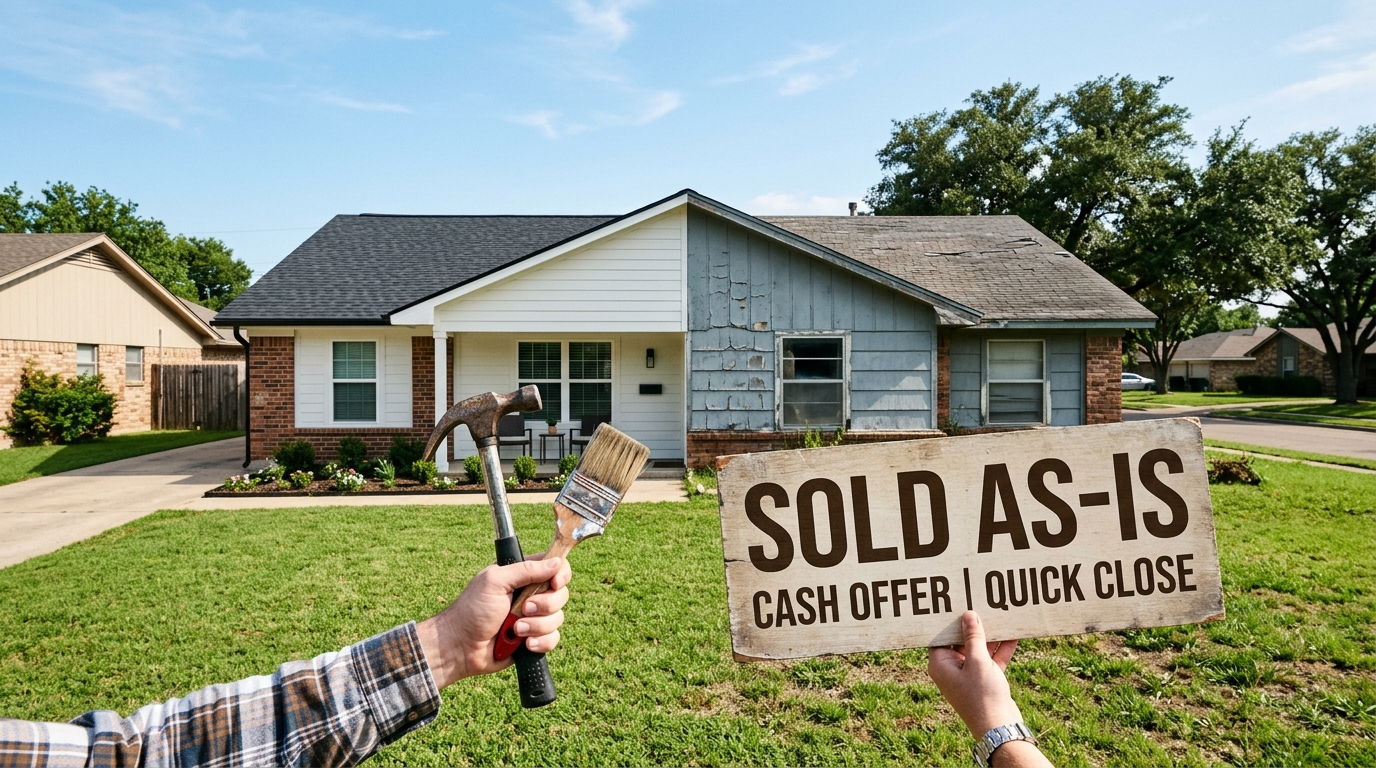
Selling as-is means you are selling the property in its current condition without agreeing to make any repairs before closing. You are telling the buyer upfront: what you see is what you get. It does not mean you hide problems. In Texas, you still have to disclose known defects. But you are not obligated to fix them.
A lot of sellers think as-is means a below-market free-for-all where buyers can demand whatever they want. That is not how it works. You set the price. The buyer decides whether that price makes sense given the condition of the property. If they do not like it, they walk. If they do, you close.
According to the U.S. Department of Housing and Urban Development, property condition disclosures are a standard part of any home sale and protect both the buyer and the seller. Selling as-is does not mean selling without disclosure. It means selling without the obligation to make changes.
How As-Is Sales Work Under Texas Law
In Texas, sellers are required to fill out a Seller’s Disclosure Notice that lists known material defects with the property. This applies even in an as-is sale. What you are waiving with as-is language is not disclosure. You are waiving the obligation to repair those defects.
The Texas Real Estate Commission provides standard disclosure forms and guidance for sellers navigating this process. If you are selling on your own without an agent, it is worth reviewing their materials to make sure your disclosure is done correctly. An improperly completed or missing disclosure can create legal problems after closing even in an as-is sale.
Who Typically Buys Homes As-Is in Dallas
Cash Investors and Home Buying Companies
The most common buyer in an as-is sale is a cash investor or professional home buying company. These buyers purchase properties in whatever condition they are in, fix them up, and either resell them or keep them as rentals. They are experienced at seeing past the surface-level issues that scare traditional buyers away.
Cash buyers are also not tied to lender requirements. A conventional mortgage lender will often refuse to finance a home with significant structural damage, foundation issues, or code violations. Since cash buyers do not need a lender, none of that matters to them. They can buy the home no matter what shape it is in and close quickly.
I worked with a seller in East Dallas whose home had a serious foundation issue she had been living with for years. She got three quotes for repairs that all came in north of $20,000. Rather than put that money in before selling, she reached out to a cash buyer, disclosed the foundation issue, and accepted an offer that was priced to reflect the problem. She closed in 12 days and walked away without spending a dollar on repairs.
Traditional Buyers Who Are Willing to Take on Projects
Not every as-is buyer is a cash investor. Some traditional buyers, especially first-time buyers looking for a deal or experienced homeowners who know how to renovate, will buy a property as-is with a conventional loan if the condition is not too severe. The challenge is that lenders have their own requirements, and certain defects may prevent financing from going through even if the buyer is willing.
If you are listing as-is on the open market, you should expect that your buyer pool will be smaller than if you fixed the problems first. That is just the reality. But smaller pool does not mean no buyers. It means the right buyer at the right price.
What As-Is Really Costs You as the Seller
The Price Difference Between As-Is and Fixed-Up
This is the honest conversation most sellers need to have before deciding. Selling as-is almost always means a lower sale price compared to selling a fully updated and repaired home. How much lower depends on what is wrong with the property and what the Dallas market looks like in your specific neighborhood.
Here is a rough breakdown of how common issues affect as-is pricing in the Dallas area. These are general estimates based on market patterns and not hard numbers for every situation.
| Property Issue | Typical Repair Cost | Estimated Price Impact When Sold As-Is |
|---|---|---|
| Foundation problems | $8,000 to $25,000 | 10 to 20 percent below market |
| Roof replacement needed | $10,000 to $18,000 | 5 to 12 percent below market |
| HVAC system failure | $5,000 to $12,000 | 3 to 8 percent below market |
| Major plumbing issues | $4,000 to $15,000 | 4 to 10 percent below market |
| Cosmetic issues only | $2,000 to $8,000 | 1 to 4 percent below market |
Before you assume as-is always costs you more, do the math on your specific situation. If repairs would cost $30,000 and you could only raise the sale price by $25,000 by doing them, selling as-is at a lower price actually puts more money in your pocket. To understand your full financial picture going into a sale, check out our post on how to calculate your home equity in 5 minutes so you know exactly what you are working with before you commit to any approach.
The Hidden Costs of Selling the Traditional Way Instead
People sometimes forget what it costs to do a full traditional sale in Dallas. Agent commissions alone can run 5 to 6 percent of the sale price. Add in repairs the buyer requests after the inspection, staging costs, professional photography, carrying costs while you wait for a buyer, and closing costs. All of that adds up fast.
When you sell as-is, especially to a cash buyer, many of those costs go away. No staging. No repairs. Often no commissions. A faster closing means fewer months of mortgage payments. For the right seller in the right situation, the net proceeds from an as-is cash sale can actually be competitive with a drawn-out traditional sale even though the headline price is lower.
How to Price Your Dallas Home for an As-Is Sale
Start with What Fixed-Up Homes Are Selling For
The right way to price an as-is home is to start with comparable sales of similar homes in good condition in your neighborhood. Then subtract an estimated cost for the repairs your home needs, plus a margin for the buyer’s risk and profit since they are taking on the uncertainty of the repairs themselves.
This is not a guessing game. It is math. If a fixed-up home on your street is selling for $320,000 and your home needs $40,000 in foundation work, you should expect offers somewhere in the $240,000 to $270,000 range depending on how motivated the buyer is and what else they are seeing on the market.
Getting Multiple Offers So You Can Compare
One of the best things you can do when selling as-is is to get more than one offer. Cash buyers each have their own pricing models and risk tolerances. One company might offer $230,000. Another might offer $255,000 for the same home. The difference can be significant and there is no way to know unless you ask more than one.
Do not accept the first offer you get out of desperation or impatience. Give yourself a few days to collect two or three offers and then compare them not just on price but on terms. Closing timeline, any contingencies, and who covers closing costs all matter when you are looking at the full picture of what you walk away with.
If you are planning to leave personal belongings or large items in the home, our post on what to do with leftover junk after a cash sale covers exactly how cash buyers typically handle that and why it is usually not the problem most sellers expect it to be.
Steps to Sell Your House As-Is in Dallas Without Making Mistakes
What to Do Before You Contact a Buyer
A little preparation before you reach out to buyers makes a real difference. You do not need to make repairs, but you should know what you are dealing with. Buyers will find out eventually and sellers who know their own property’s issues upfront come across as trustworthy, which can actually help your negotiating position.
- Get a pre-listing inspection if you have not had one recently. Knowing exactly what is wrong helps you price accurately and disclose fully, which protects you legally and practically.
- Fill out your Texas Seller’s Disclosure Notice carefully and honestly. Do not leave blanks where you know there are issues. Incomplete disclosure is a legal risk even in an as-is sale.
- Pull together your basic documents. Mortgage payoff information, your deed, and your property tax records will all be needed during the closing process regardless of how you sell.
- Do a basic cleanout. You do not have to deep clean or stage, but removing obvious trash and personal clutter makes the property easier to assess and shows buyers you are organized.
- Take honest photos. If you are reaching out to cash buyers remotely, clear photos of every room including any problem areas help buyers make faster and more accurate offers.
- Know your minimum number before you talk to anyone. Having a bottom line going in keeps you from accepting an offer in the moment that you will regret later.
How the Closing Process Works on an As-Is Sale in Dallas
Once you accept an offer on an as-is sale, the closing process works pretty much the same as any other sale. A title company is brought in to do a title search, handle the paperwork, and manage the funds. If there are liens or other title issues, they surface here and are typically paid off from the sale proceeds.
One important note: even in an as-is sale, the buyer may have an inspection contingency in their contract. That means they can still have the home inspected and potentially walk away or renegotiate if what they find is significantly worse than expected. If you are selling to a cash buyer who waives the inspection contingency, you lose that potential complication and the sale is more certain from the day you sign.
According to the Consumer Financial Protection Bureau, having a clear title is one of the most important parts of any real estate transaction. If you know of any liens or ownership disputes on your property, it is worth getting ahead of them before closing to avoid delays.
To see how we handle as-is purchases in Dallas and what our process looks like from your side, visit our Dallas Texas page or reach out to us here and we can walk you through everything before you commit to anything.
Conclusion
Selling your Dallas home as-is is a real option and for the right seller it is often the smartest one. You skip the repairs, you skip the drawn-out negotiation process, and you get to close on your own timeline. The key is knowing what your home is worth in its current condition, disclosing honestly, getting more than one offer, and picking a buyer you actually trust to close. Do those things and you will be in a much better position than sellers who rush in blind and wonder later why things went sideways.
Frequently Asked Questions
Do I still have to disclose defects if I am selling as-is in Texas?
Yes. Selling as-is does not remove your obligation to disclose known material defects in Texas. You are still required to complete the Seller’s Disclosure Notice accurately. What as-is means is that you are not agreeing to fix those defects before closing, not that you can hide them.
Can I sell my Dallas home as-is if there is a lien on it?
Yes. A lien on the property does not prevent a sale. In most cases, the lien is paid off at closing from the sale proceeds before you receive your net proceeds. The title company handles this as part of the closing process. Make sure your buyer and title company are aware of any liens upfront.
Will a traditional buyer finance an as-is home in Dallas?
It depends on the condition. Minor cosmetic issues are usually fine with conventional lenders. But significant structural problems like foundation damage, a failing roof, or safety code violations may cause lenders to decline financing. Cash buyers have no such restrictions and are the most reliable option for homes with major issues.
How fast can I close on an as-is sale in Dallas?
With a cash buyer who waives the inspection contingency and skips the lender, you can often close in 7 to 14 days. Traditional buyers even on an as-is sale typically take 30 to 45 days because of lender timelines. If speed matters, cash is the path.
What happens if a buyer tries to renegotiate price after inspection on an as-is sale?
Even in an as-is contract, some buyers try to use the inspection to push for a lower price. You are not obligated to agree. You can hold your price and let the buyer walk, or you can accept a lower number if keeping the deal together is worth it to you. Having multiple offers gives you leverage in that moment. Cash buyers who waive inspection contingencies eliminate this risk entirely.