
Should You Sell Your Home Now or Wait for Interest Rates to Drop?
A lot of homeowners right now are doing the same thing. They are sitting on their homes, waiting for interest rates to come down before they sell. It sounds like a smart plan on the surface. But when you actually run the numbers, the picture looks very different.
I have talked to sellers who waited a full year expecting rates to drop enough to matter. By the time they decided to list, home prices in their area had gone up and they were competing with a lot more sellers who had the same idea. Waiting cost them more than it saved them.
Let me walk you through the real math on this so you can make a decision based on facts instead of hoping a rate drop saves the day.
Why Sellers Think Waiting for Rate Drops Will Help Them
The logic sounds right at first. When interest rates drop, more buyers can afford homes. More buyers means more competition. More competition could push your sale price higher. So waiting should get you a better deal, right?
Well, sort of. But there is a problem with that thinking. When rates drop and more buyers flood the market, more sellers come out too. Every homeowner who has been waiting does the same thing you are doing. Suddenly there are a lot more homes for sale, and that extra supply can keep prices from going up as much as you expected.
According to Bankrate, even after the Federal Reserve cut rates three times in the second half of 2024, mortgage rates actually went higher in early 2025. The Fed does not directly control mortgage rates. That is a really important thing to understand.
How Long Could You Actually Be Waiting?
This is where the math gets uncomfortable. According to a March 2025 survey by U.S. News and World Report, four out of five homebuyers were still waiting for mortgage rates to fall before buying. About 25% of them wanted rates below 5% before they entered the market. Experts say rates below 5% are not expected in the next several years.
So if you are waiting for rates to drop to a level where demand really surges, you could be waiting a long time. And during that time, your home is costing you money every single month.
The Real Costs of Waiting to Sell
Every month you hold onto a home you are ready to sell, there are real costs adding up. Most sellers focus only on what they hope to gain by waiting. They do not count what they are losing while they wait.
What Carrying Costs Add Up to Over a Year
Here is a realistic look at what it costs to hold a home for 12 months while waiting for rates to move. These numbers will vary by location and situation, but they give you a solid idea of what is at stake.
- Mortgage interest payments each month on an outstanding loan balance
- Property taxes prorated through the year
- Homeowner’s insurance premiums
- Maintenance and upkeep costs that come up every year
- Any HOA fees if your property has them
- Opportunity cost of the equity sitting tied up in the home
- Possible price cuts if the market softens while you wait
On a home with a $300,000 mortgage balance at 6.75%, the interest alone is about $1,687 per month. Over 12 months that is more than $20,000 in interest paid just while you are waiting. That money does not come back to you.
What If Home Prices Go Up While You Wait?
Here is the part that cuts both ways. If home prices go up while you wait, yes, your home is worth more. But the home you plan to buy next is also worth more. So you are not actually winning anything on that exchange. You are just selling at a higher number and buying at a higher number.
According to data from the Federal Reserve Bank of St. Louis, the median sale price of single-family homes in the U.S. was $410,800 in the second quarter of 2025. That number has been rising consistently for years. There is no strong signal that prices will drop significantly anytime soon.
So waiting costs you carrying costs, and you do not necessarily come out ahead on the price side either. That is a tough spot to be in.
Selling Now vs Waiting: A Side-by-Side Numbers Breakdown
Let me show you two paths on a real example. Assume your home is currently worth $420,000 and you have a $280,000 mortgage balance with a monthly payment of around $2,100.
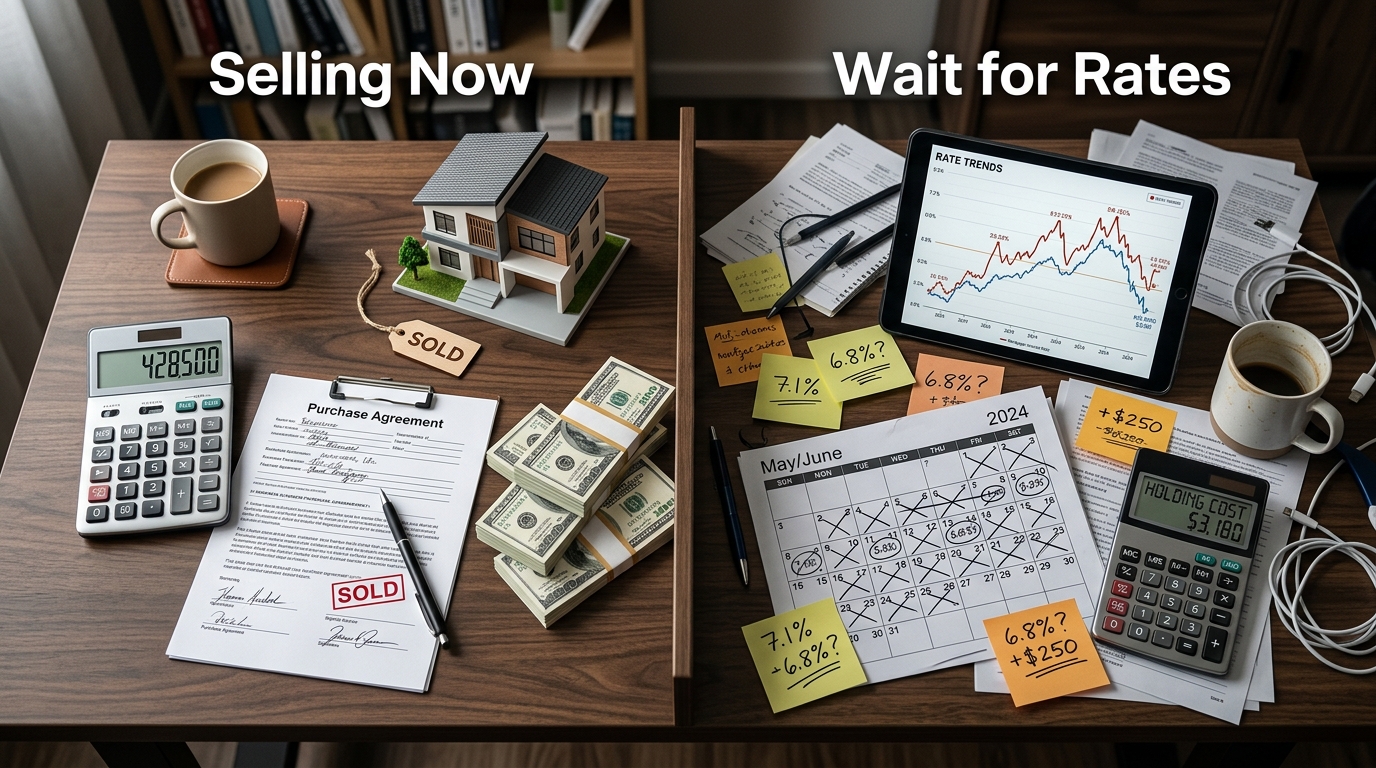
| Factor | Selling Now | Waiting 12 Months |
|---|---|---|
| Current Home Value | $420,000 | $430,000 to $440,000 (estimated 2 to 4% rise) |
| Carrying Costs for 12 Months | None | $18,000 to $26,000 |
| Mortgage Interest Paid | None | Around $18,700 |
| Rate Drop Benefit to Buyers | Neutral | Possible but not guaranteed |
| Competing Sellers After Rate Drop | Fewer now | Many more when rates drop |
| Net Gain From Waiting | Not applicable | Often negative after costs |
When you see it laid out like that, waiting does not look like the obvious win most people assume it is. The potential gains from a higher sale price get eaten up by all the costs of staying put.
The Lock-In Effect and Why It Keeps Sellers Stuck
There is another reason sellers hesitate right now. A lot of homeowners locked in mortgage rates of 3% or lower during 2020 and 2021. Selling now means giving up that rate and taking on a new mortgage at 6% or higher. That is a big jump, and it feels like a step backward.
I completely get that feeling. But here is the thing. If your life has changed and you need more space, a different location, or a home that fits your situation better, staying in the wrong home just to protect a low interest rate is also costing you something. Just not in a way that shows up on a spreadsheet.
For sellers who want to make the most of their equity before buying again, our post on ways to avoid capital gains tax on property sales can help you keep more of what you walk away with.
When Selling Now Actually Makes More Financial Sense
Selling now tends to make the most financial sense when you fall into one of these situations. If your home needs work and you have been putting it off, waiting longer just increases the deferred maintenance cost. If you are carrying a large mortgage and your carrying costs are high, every month you wait is real money out of your pocket.
If you are selling to downsize and your next home will cost less, selling now locks in your current equity and gets you into a lower payment situation faster. And if you are open to a cash sale, you can close in days instead of months and skip the uncertainty entirely.
We buy homes directly and can give you a fair offer without any of the waiting. If you want to see what your options actually look like, check out our cash sale vs 1031 exchange breakdown or reach out to us through our Contact Us page to talk through your situation.
Conclusion
Waiting for interest rates to drop before selling your home feels like a safe move. But the math usually tells a different story. You are paying real money every month while you wait, the rate drop may not come as fast as you hope, and when it does come, more sellers jump into the market right alongside you.
Selling now while inventory is lower, demand is steady, and you can close on your own terms is often the smarter financial move. If you have been on the fence, it is worth running the actual numbers for your specific home rather than waiting for a rate environment that may never feel perfect enough.
Frequently Asked Questions
Will waiting for interest rates to drop make my home sell for more?
Not necessarily. When mortgage rates drop, more buyers enter the market but so do more sellers. That extra supply can limit how much prices actually rise. Meanwhile you are paying carrying costs every month you hold the home, which reduces your overall gain even if the sale price goes up slightly.
How much do carrying costs add up to while waiting to sell?
On a home with a $300,000 mortgage balance at around 6.75%, the monthly interest alone is close to $1,700. Over 12 months that is more than $20,000 in interest paid. When you add property taxes, insurance, and maintenance, total carrying costs for a year can easily reach $25,000 or more.
When are mortgage rates expected to drop significantly?
Based on current forecasts, large drops are not expected in the near term. According to industry projections, the average 30-year fixed mortgage rate may edge slightly lower in 2026 but is not expected to return to the 3% to 4% range that many sellers are waiting for. Refinancing later remains an option for buyers.
Does selling now hurt me if I have a low existing mortgage rate?
It does mean taking on a higher rate on your next home, which feels painful. But if staying in the wrong home is costing you lifestyle, space, or location, that has a real cost too. Many sellers find that downsizing or buying something that actually fits their life is worth the higher interest rate, especially when you account for the equity you unlock by selling.
Is a cash sale a good option if I want to sell quickly without waiting?
Yes. A cash sale closes in 7 to 14 days, skips the financing and appraisal contingencies, and gives you a clean exit with a known closing date. You do not have to wait for rate conditions to improve or for a buyer to get mortgage approval. It is one of the fastest and most certain ways to sell a home in any market.