
Most sellers I have talked to admit they signed their purchase agreement without reading all of it. Their agent pointed to the signature lines, they signed, and they trusted the rest would work out. Sometimes it does. But sometimes a clause they never read ends up costing them money or giving the buyer a way out they did not see coming. The California Residential Purchase Agreement is not just a formality. It is the legal document that controls your entire sale, and every single clause in it affects you as the seller.
What the Purchase Agreement Actually Is
The One Document That Runs Your Whole Transaction
The California Residential Purchase Agreement, also called the RPA, is the standard contract used in the vast majority of California home sales. The California Association of Realtors prepares it, and it is used in over 90 percent of residential transactions across the state. Once both the buyer and seller sign it, it becomes legally binding. Every clause in that document has weight.
According to the Shapero Law Firm guide on the California Residential Purchase Agreement, the RPA covers everything from the purchase price and financing terms to contingencies, disclosures, and dispute resolution. The form may look standard, but its terms are negotiable. Many sellers treat it like a rubber stamp when it is actually the most important document in the entire transaction.
Why Reading It Before You Sign Actually Matters
I have talked to sellers who handed the contract to their agent, signed where they were told, and only later discovered a clause they did not understand had cost them money. Knowing what each section says before you initial anything is the difference between a smooth sale and one that turns into a problem.
Some clauses require separate initials from both parties to be enforceable. If you skip those initials, key protections you thought you had may not apply at all. Our post on the paperwork involved in a cash sale covers which documents California sellers are required to sign and when during the closing process.
The Clauses Every Seller Needs to Understand
How the Purchase Price and Financing Section Works
The purchase price clause states the agreed sale price and how the buyer plans to pay. If the buyer is using a loan, the agreement will include deadlines for loan approval. If those deadlines are not met, the seller may have the right to cancel. This section is not just about the number. It tells you how likely the deal is to actually close.
A buyer with a large down payment and a short loan contingency period is a much stronger buyer than one with a small down payment and a long approval window. Understanding this section helps you compare competing offers properly, not just look at the headline price.
What Contingencies Actually Do to Your Deal
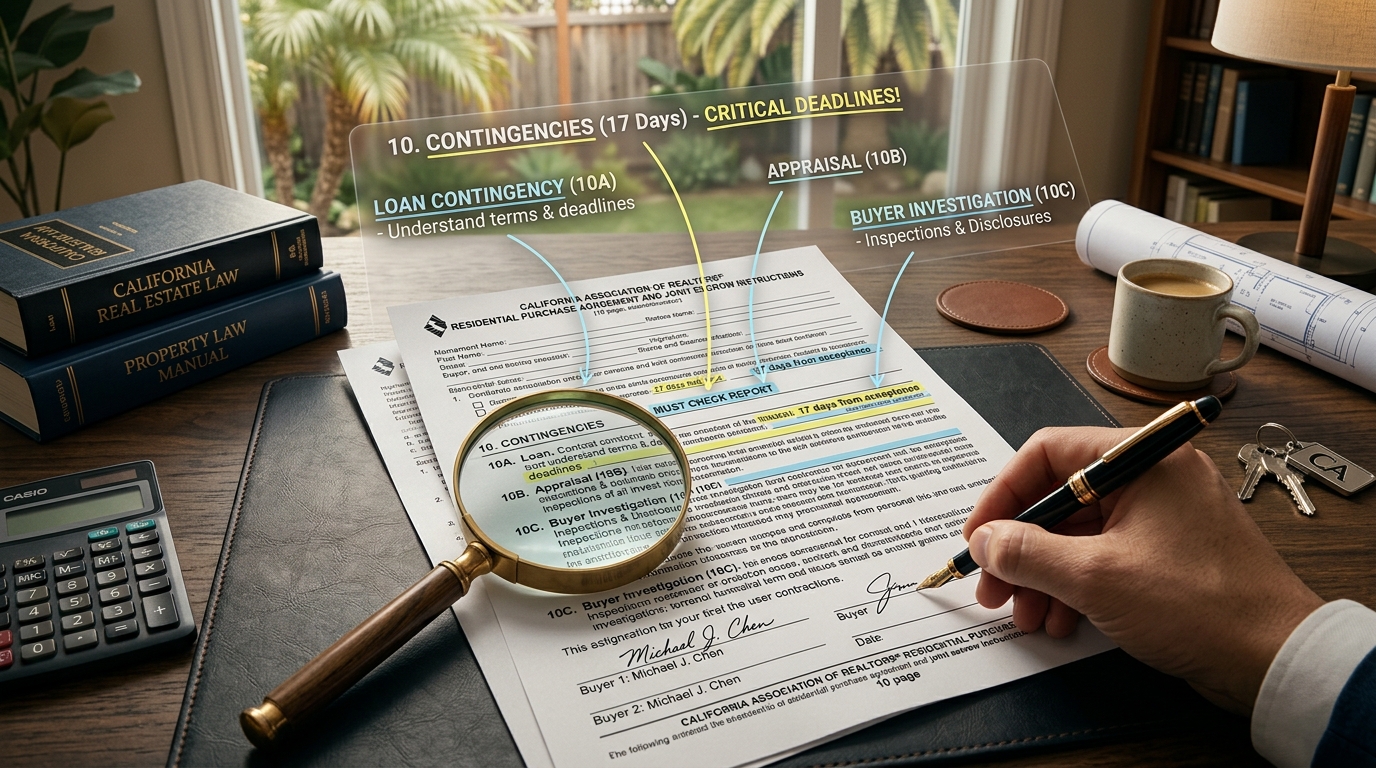
Contingencies are conditions that must be met before the sale can close. They give the buyer legal ways to cancel without losing their deposit. The three most common ones in California are the inspection contingency, the financing contingency, and the appraisal contingency.
The standard inspection contingency gives the buyer 17 days to complete inspections and either approve the property or request repairs. During that window the buyer can cancel for almost any reason. The financing contingency protects the buyer if their loan falls through. The appraisal contingency lets the buyer renegotiate or cancel if the home appraises below the agreed price.
As a seller, pay attention to how many contingencies the buyer has included and how long each one lasts. A buyer who waives contingencies takes on more risk and gives you more certainty. That is one reason cash offers with fewer contingencies are often more attractive to sellers even when the price is slightly lower. Our post on whether cash for houses offers are legally binding explains how contingencies work in cash transactions specifically.
The Clauses That Are Specifically There to Protect You as the Seller
Why the Liquidated Damages Clause Needs Your Initials
The liquidated damages clause is one of the most important protections in the entire agreement for sellers, and it only works if both parties initial it separately. This clause says that if the buyer backs out of the deal after removing contingencies, you as the seller can keep the earnest money deposit as your remedy. In California this amount is capped at 3 percent of the purchase price for owner-occupied properties with one to four units.
If this clause is not initialed by both parties, it is not enforceable. That means if a buyer walks away without a valid reason and you have not initialed this section, your only option may be to pursue actual damages in court. That process costs more money and takes far longer. Always confirm this section is properly initialed before the agreement is signed.
What California Disclosure Law Requires You to Share
California has some of the strictest disclosure laws in the country. As a seller, you are required to give the buyer a set of disclosures about the property’s condition, history, and any known defects. The purchase agreement sets deadlines for when those disclosures must be delivered.
If you fail to deliver required disclosures on time, the buyer gets additional cancellation rights. According to the California purchase agreement overview on eForms, if a buyer does not receive all required disclosures before the sale closes, they have three days to terminate the agreement after receiving them, or five days if the disclosures were mailed. This can derail a deal even when everything else was going smoothly.
Here is a look at the most common clauses in the California RPA and what each one means for sellers:
| Clause | What It Does | Why It Matters to Sellers |
|---|---|---|
| Purchase Price and Terms | Sets the agreed sale price and payment method | Defines how and when you get paid |
| Inspection Contingency | Gives buyer 17 days to inspect and approve | Buyer can cancel during this window |
| Financing Contingency | Protects buyer if loan is denied | Deal can fall apart if buyer cannot get a loan |
| Appraisal Contingency | Lets buyer renegotiate if home appraises low | May reduce your net proceeds |
| Liquidated Damages | Caps seller remedy to 3 percent of price if buyer defaults | Must be initialed by both parties to apply |
| Mediation Clause | Requires mediation before lawsuits | Mandatory and does not require initials |
| Arbitration Clause | Resolves disputes outside of court | Must be initialed by both parties to be binding |
| As-Is Clause | Buyer accepts property in current condition | Does not remove your disclosure obligation |
| Closing Date | Sets the deadline to transfer title | Deadlines in California are strictly enforced |
The Clauses That Can Hurt Sellers Who Are Not Paying Attention
Why Missing a Deadline in California Can End Your Deal
California purchase agreements include strict deadline language. The phrase time is of the essence means exactly what it sounds like. If a deadline is missed, the other party may have the right to cancel or demand performance. Missing a contingency removal deadline by even one day can give the buyer a legal reason to walk away.
As a seller, track every key date in your agreement from the day you sign. Write them down somewhere visible. Know when inspections are due, when contingencies must be removed, and when the closing date falls. Missing one of those dates because you were not keeping track can cost you the entire deal.
How Mediation and Arbitration Work and Which One Needs Your Initials
The mediation clause is automatic in every California purchase agreement. It requires both parties to attempt mediation with a neutral third party before either side can file a lawsuit. This is mandatory and does not require initials to be active.
The arbitration clause works differently. It says that if mediation fails, disputes go to a private arbitrator instead of a court. This clause only applies if both parties separately initial it. Arbitration can be faster and less expensive than going to court, but it also limits your ability to appeal if the decision does not go your way. Talk to a real estate attorney before deciding whether to initial this one.
What to Go Through Before You Sign Anything
The Things Every Seller Should Confirm in the Agreement
Before you sign any purchase agreement in California, go through each of these points carefully:
- Confirm the purchase price and payment method match exactly what was discussed with the buyer before the offer was written
- Check how long each contingency period lasts and whether any have been waived by the buyer
- Verify the closing date works for your own timeline and your plans after the sale
- Confirm who is paying which closing costs, since this is negotiable and changes from offer to offer
- Make sure the liquidated damages clause is properly initialed so you have protection if the buyer defaults
- Review which items are included and excluded from the sale, such as appliances, light fixtures, or other personal property
- Check whether an as-is clause is included and understand it does not release you from disclosing known defects
- Read any addenda or counter-offer terms that have been added on top of the standard agreement language
- Confirm the earnest money deposit amount and which escrow company is holding it
If anything is unclear, ask your agent to walk you through it before you sign. When the stakes are high, a real estate attorney reviewing the document is worth every penny.
How a Cash Offer Changes What the Agreement Looks Like
If you are selling to a cash buyer, the purchase agreement is simpler. There is no financing contingency because there is no lender. There is often no appraisal contingency either. The document is shorter, the timeline is faster, and there are far fewer ways for the deal to fall apart before the closing date.
If you want to see what a cash sale looks like from start to finish, our sell your property page walks through how the process works and what you can expect at each step. And if you have questions about your specific situation, reach out to our team and we will be glad to help.
Conclusion
The California Residential Purchase Agreement is the document that defines your rights and obligations as a seller from the day you accept an offer until the day the sale closes. Reading it carefully, initialing the right sections, and understanding what each clause does puts you in control of one of the biggest financial decisions you will make. If anything in the agreement gives you pause, ask your agent or a real estate attorney before you sign. That is always the right call.
Frequently Asked Questions
What is the California Residential Purchase Agreement?
It is the standard contract used in California home sales, prepared by the California Association of Realtors. It covers the purchase price, financing terms, contingencies, disclosures, and closing procedures. Once both parties sign it, the document is legally binding and governs the entire transaction from that point forward.
Can sellers negotiate the terms in a California purchase agreement?
Yes. Although the RPA uses a standard form, its terms are negotiable. Sellers can counter on price, closing dates, contingency periods, which party pays which costs, and what is included or excluded from the sale. Nothing in the form is locked in unless both parties agree to it in writing.
What happens if a buyer backs out after removing contingencies?
If the liquidated damages clause was initialed by both parties, you as the seller can keep the buyer’s earnest money deposit as your remedy. In California this amount is capped at 3 percent of the purchase price for owner-occupied properties with one to four units. If the clause was not initialed, your legal options are more limited and more expensive to pursue.
Do I still have to disclose defects if the property is sold as-is?
Yes. An as-is clause means the buyer accepts the property in its current condition and the seller is not required to make repairs. It does not remove your legal obligation to disclose known defects. California law requires sellers to disclose material facts that affect the value or desirability of the property regardless of whether the sale is as-is.
What is the difference between the mediation and arbitration clauses?
The mediation clause is automatic and does not require initials. It means both parties must attempt mediation before either can file a lawsuit. The arbitration clause must be separately initialed by both parties. If initialed, disputes that cannot be resolved through mediation go to a private arbitrator rather than a court. Arbitration decisions are generally final and much harder to appeal than court decisions.