
Most people think of Santa Monica or Silver Lake when they picture a walkable LA neighborhood. But in 2026, Mid-City Los Angeles is the area that actually delivers on the promise of a 15-minute lifestyle. You can walk to a world-class museum, grab groceries, catch a bus to downtown, and still be home for dinner without ever touching your car. That is not a fantasy. That is just a Tuesday in Mid-City.
What Is a 15-Minute City and Why Does It Matter for Real Estate
The Concept in Plain English
A 15-minute city is a neighborhood where you can reach everything you need in daily life, like groceries, work, parks, schools, healthcare, and restaurants, within a 15-minute walk, bike ride, or transit trip. The idea has been gaining traction in urban planning circles for years, and Los Angeles has started moving toward it seriously.
In late 2022, the LA City Council voted unanimously to adopt the Livable Communities Initiative, a framework that pushes for mixed-use buildings along commercial corridors and puts new housing near job centers and transit lines. Mid-City is one of the neighborhoods that fits this model most naturally because of where it sits and what it already has.
Why This Matters When You Are Buying or Renting Property
Walkability directly affects property values. Research from the University of Florida Warrington College of Business found that homes in highly walkable neighborhoods sold for an average of 23.5 percent more than comparable homes in car-dependent areas. In Los Angeles specifically, each additional Walk Score point adds roughly $3,948 to a home’s sale price on average.
That kind of data matters a lot if you are trying to figure out where to put your money in the LA market right now.
What Makes Mid-City the Best Example of a 15-Minute Neighborhood in LA
Location Is Everything Here
Mid-City sits almost exactly in the center of Los Angeles. You are surrounded by Beverly Hills, Century City, Hollywood, Koreatown, and Culver City. Downtown LA is only about 6 miles away. Century City is about 5.5 miles out. That central position means you are close to multiple major job centers without needing to pick just one.
I have had people tell me they moved to Mid-City specifically because they could not make up their mind between working in Hollywood and Century City. Turns out you do not have to choose when you live right in the middle.
The Miracle Mile and LACMA Put Culture at Your Doorstep
One of the things that sets Mid-City apart from other LA neighborhoods is its cultural depth. The Miracle Mile stretch along Wilshire Boulevard gives residents access to the Los Angeles County Museum of Art (LACMA), the Page Museum, the La Brea Tar Pits, and the Petersen Automotive Museum, all within walking distance of each other.
Add in the Original Farmers Market, The Grove shopping center, and a stretch of Fairfax Avenue packed with diverse food options, and you have the kind of neighborhood variety that most LA residents spend an hour driving to find. In Mid-City, it is all right there.
Transit and Walkability Scores That Actually Support the 15-Minute Claim
What the Data Shows
Mid-City scores well on walkability metrics. The area sits in what Walk Score describes as a Very Walkable zone, with many addresses scoring in the 80s and above. That puts it ahead of most other LA neighborhoods when it comes to getting around without a car.
The Metro Crenshaw Line, now operating, runs through the area and connects residents to LAX in one direction and the Expo Line in the other. According to reporting on Urbanize LA, the LA City Council’s push for livable communities is specifically aimed at corridors like the ones running through Mid-City, adding more mixed-use housing and commercial space near transit stops.
Multiple bus lines also run through Mid-City, giving residents ways to reach Koreatown, Hollywood, Santa Monica, and downtown LA without touching a freeway.
New Infrastructure Is Making It Even Better
The Mid-City Neighborhood Greenways project is currently under construction and is expected to be completed by summer 2026. It extends the Ballona Creek bike path by two miles, connecting Culver City directly into Mid-City. That means cyclists will soon have a clean, direct route from one neighborhood to the other without sharing the road with traffic.
This kind of infrastructure investment tends to push property values up in the surrounding area. Buyers and renters who want an active, car-optional lifestyle are paying close attention to this project.
How the 15-Minute City Trend Is Affecting Mid-City Property Values in 2026
Mixed-Use Development Is Coming Fast
New residential and mixed-use projects are popping up all along Washington Boulevard and the surrounding corridors in Mid-City. In early 2026, a 124-unit apartment complex was approved for 5110 Washington Blvd. Other nearby projects are adding hundreds more units, which tells you investors see real demand here.
The shift toward transit-oriented development is not just happening organically. LA planning policy is actively pushing for it. New buildings are being approved near bus stops and rail stations, and parking requirements are being loosened to allow more units per lot. That all means more housing, more walkable businesses, and a stronger case for the 15-minute city concept taking root in Mid-City specifically.
Who Is Moving to Mid-City and Why
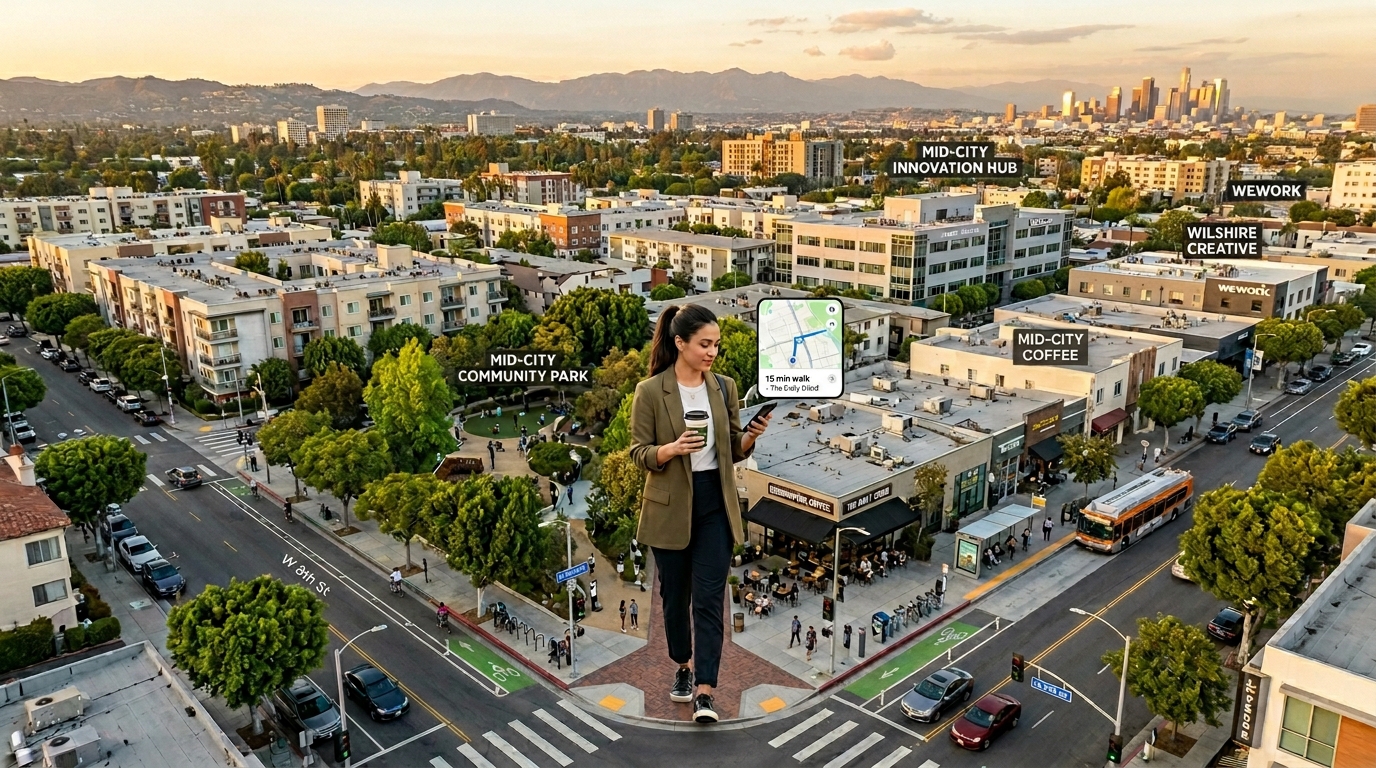
The neighborhood draws a wide range of buyers and renters. Young professionals moving here often work in media or tech and want a central location without paying West Hollywood or Brentwood prices. Families stay for the schools, including the Los Angeles Center for Enriched Studies, a nationally ranked public magnet school for grades 6 through 12. Remote workers like that everything is within reach when they do need to get out of the house.
Here is a quick look at who typically moves to Mid-City and what they value most:
- Young professionals who want central access to multiple job markets without a long commute in any direction.
- Creative workers drawn to the arts and cultural scene around LACMA, the Miracle Mile, and Fairfax Avenue.
- Families who want good schools and a walkable neighborhood with parks and grocery stores nearby.
- Remote workers who value leaving the house on foot and having cafes, co-working spots, and restaurants close by.
- Investors who see steady rental demand from all of the above groups and want properties near transit with low vacancy risk.
Comparing Mid-City to Other LA Neighborhoods on 15-Minute Livability
How Mid-City Stacks Up
To understand why Mid-City stands out, it helps to see how it compares to other neighborhoods people often consider. Most people think you have to pay Culver City or West Hollywood prices to get this kind of lifestyle. Mid-City often delivers it at a more accessible price point.
| Neighborhood | Walkability Level | Transit Access | Cultural Amenities | Price Range (Approx.) |
|---|---|---|---|---|
| Mid-City LA | Very High | Strong (bus, K Line) | LACMA, Farmers Market, The Grove | Moderate |
| Culver City | High | Good (Expo Line) | Sony, Amazon Studios area | High |
| West Hollywood | Very High | Good (buses) | Sunset Strip, restaurants | Very High |
| Koreatown | Very High | Excellent (Metro) | Dense dining, nightlife | Moderate |
| Leimert Park | Moderate | Good (K Line) | Arts, cultural corridor | Lower Moderate |
If you are thinking about buying in a walkable LA neighborhood and want to understand how to evaluate your options, our post on selling and buying property in the LA 15-mile radius walks through how location and transit access factor into value. You can also explore our residential property services page to learn how we work with buyers and sellers across Los Angeles neighborhoods.
Is Mid-City a Smart Place to Buy or Invest Right Now
The Case for Buying in Mid-City in 2026
The fundamentals are strong. Mid-City has walkability, transit access, cultural anchor institutions, and a pipeline of new mixed-use development. It sits at the crossroads of some of the most valuable real estate in the country without carrying the price tags of Beverly Hills or Santa Monica.
Research from Beach Front Property Management’s 2025 analysis on LA transit and rental values confirms that properties near Metro lines are seeing higher rents, lower vacancy rates, and stronger long-term appreciation. Mid-City checks that box clearly.
From what I have seen working with buyers across LA, the neighborhoods that combine transit, walkability, and cultural draw tend to hold their value even when the broader market cools. Mid-City has all three in abundance.
What to Watch Out For
No neighborhood is perfect. Mid-City can have real traffic during peak hours, especially near La Brea Avenue and Fairfax. Parking can be tight if you still rely on a car. And like many central LA neighborhoods, it is experiencing rising rents and prices that can feel challenging for buyers on tighter budgets.
Still, the overall direction of the neighborhood is clearly positive. New housing approvals, bike infrastructure, transit improvements, and the city’s policy push toward walkable communities all point the same way. If you want to get ahead of that trend rather than chase it later, now is a good time to look seriously at Mid-City.
We help buyers find the right fit across all of Los Angeles every day. If you want to talk through your options in Mid-City or any other LA neighborhood, visit our Contact Us page and we will get back to you fast.
Conclusion
Mid-City Los Angeles has earned its place as the standout 15-minute city neighborhood in LA for 2026. It has the central location, the walkability scores, the transit connections, the cultural institutions, and the development momentum to back up that claim. Whether you are buying to live there, investing for rental income, or just trying to figure out where the best value in Los Angeles is right now, Mid-City belongs at the top of your list. The infrastructure is getting better, the demand is steady, and the lifestyle it offers is genuinely hard to match anywhere else in the city at a comparable price.
Frequently Asked Questions
What exactly is the 15-minute city concept and does Mid-City LA qualify?
A 15-minute city is a neighborhood where daily needs like groceries, work, parks, schools, and healthcare are all reachable within 15 minutes on foot, bike, or transit. Mid-City qualifies because of its central location, high walkability scores, access to Metro and bus lines, and dense mix of shops, restaurants, schools, and cultural institutions within a compact area.
Does walkability actually increase property values in Los Angeles?
Yes. Research has consistently shown that walkable neighborhoods command higher home prices in LA. On average, each additional Walk Score point adds around $3,948 to a home’s sale price in Los Angeles, and highly walkable homes sell for about 23.5 percent more than comparable car-dependent properties.
Is Mid-City Los Angeles a good neighborhood for families?
Yes, it is a solid choice for families. The neighborhood has good public schools including the nationally recognized Los Angeles Center for Enriched Studies. Parks, grocery stores, and safe walking routes are accessible, and the central location makes it easy for parents who work in different parts of the city.
How does the Metro Crenshaw Line affect property values in Mid-City?
The Metro K Line, which runs through the Crenshaw corridor near Mid-City, has made the area more accessible and attractive to buyers and renters who prefer transit. Properties near active Metro stations tend to see lower vacancy rates, higher rents, and stronger appreciation over time, making them appealing to both owner-occupants and investors.
What new developments are happening in Mid-City Los Angeles in 2026?
Several projects are underway or recently approved in Mid-City as of 2026. These include a 124-unit apartment complex at 5110 Washington Blvd, a 92-unit building at 8931 W. Helms Place, and a 144-unit project at 8939 Kramerwood Place. The Ballona Creek bike path extension is also under construction and expected to be completed by summer 2026, further improving walkability and cycling access in the neighborhood.