
Echo Park is one of those Los Angeles neighborhoods that tells a real story about how fast a city can change. If you bought a home here 20 years ago, you were probably one of the few people who saw the potential. Today, the same house could be worth close to a million dollars or more. That kind of growth does not happen by accident.
Where Echo Park Started: Property Values in the Early 2000s
A Neighborhood with a Rough Reputation and Real Upside
Back in the early 2000s, Echo Park was a neighborhood most people passed through rather than moved into. Gang activity had been a serious issue through the late 1980s and 1990s, and that reputation stuck around even as the neighborhood started to change. But for buyers who were paying attention, it was exactly the kind of place where smart real estate decisions get made.
Home prices in the area were modest by Los Angeles standards. You could find a bungalow or a small multi-family property in Echo Park for prices that felt almost out of place in a city known for expensive real estate. The location was genuinely good, close to downtown, near Dodger Stadium, with easy freeway access. The bones were there. What was missing was the investment and the demand that eventually followed.
According to historical data from Gatsby Investment, the median sale price across Los Angeles County in 2004 was around $459,461. Echo Park was sitting below that figure for much of this period, which meant buyers were getting a below-market deal in a neighborhood that was only about two miles from downtown LA. That kind of gap between price and location is rare and does not last long.
The First Signs of Change: Artists, Cafes, and Rising Interest
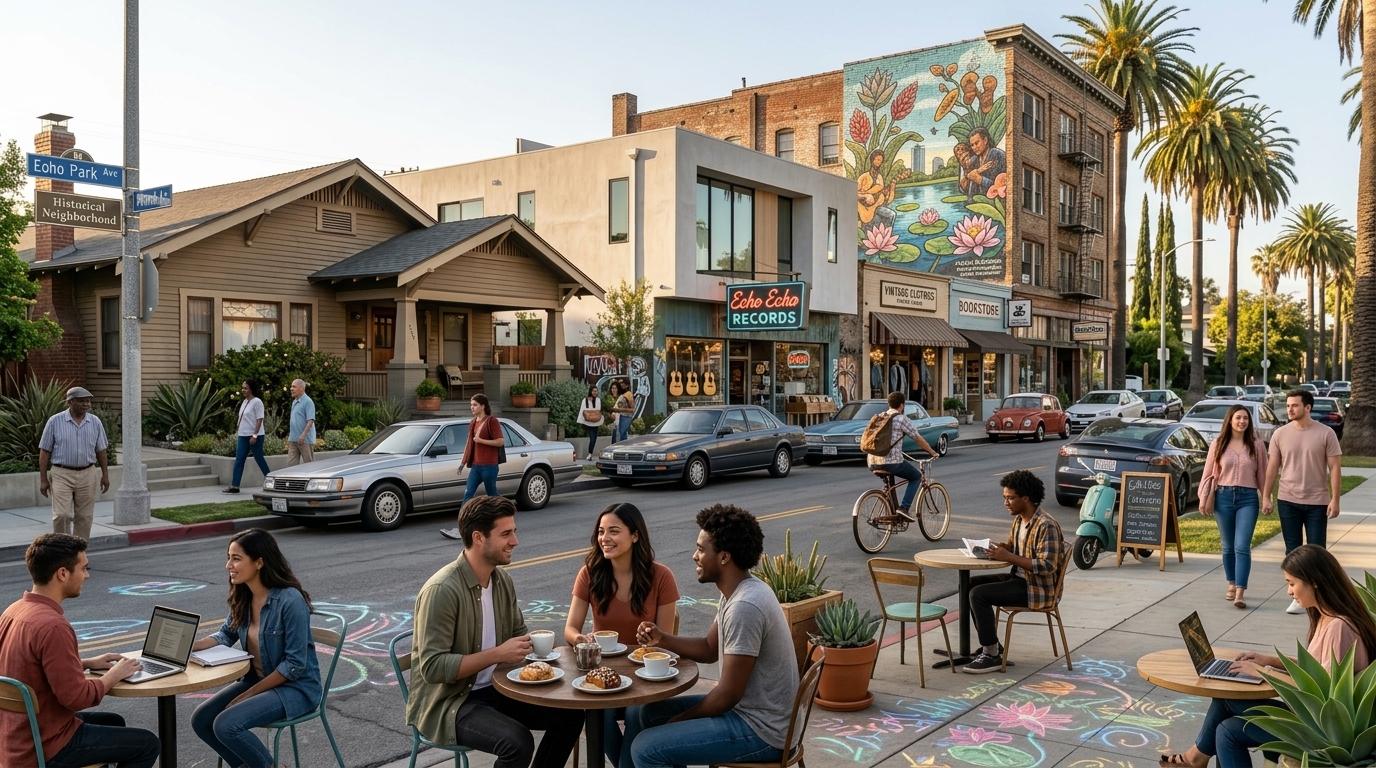
The early 2000s saw something shift in Echo Park. Artists, musicians, and young creative types started moving in because the rent was affordable and the neighborhood had a genuine character that newer, polished areas lacked. The bohemian energy that Echo Park became known for was not manufactured. It grew organically out of a community that was looking for space to work and live without spending everything they had.
Small businesses followed. Coffee shops, independent record stores, and casual restaurants started appearing along Sunset Boulevard. The neighborhood was developing an identity and, with that identity, came a new kind of buyer interest. People who had been watching from the sidelines started making moves. And once that happens in a neighborhood close to downtown Los Angeles, it tends to be hard to stop.
The Middle Decade: How Echo Park Changed Between 2008 and 2015
The Housing Crash Slowed Things Down but Did Not Reverse the Trend
The 2008 financial crisis hit real estate markets across the country, and Los Angeles was no exception. According to Gatsby Investment’s historical price data, the countywide median dropped sharply during this period, falling to around $318,000 in 2008 and dropping further into 2011. Echo Park felt that slowdown too.
But here is the thing about neighborhoods mid-gentrification. The crash slowed the growth, it did not undo the identity shift that had already happened. The coffee shops stayed. The murals stayed. The community that had chosen Echo Park stayed, largely because they had built something there that mattered to them. When the broader market started recovering in 2012 and 2013, Echo Park recovered right along with it, and then some.
Gentrification Picks Up Speed After 2012
By 2012 and 2013, the process of gentrification in Echo Park had clearly shifted into a higher gear. LA Business Journal reported that Echo Park had experienced rapid gentrification over a decade, with lots of new multifamily development projects taking shape across the neighborhood. A 2013 gang injunction covering six rival gangs in the area was also a turning point, creating what authorities described as a safety zone that made the neighborhood more appealing to buyers and developers who had been hesitant before.
Prices started climbing meaningfully. Properties that had sold for $300,000 to $400,000 were now moving well above $600,000. The gap between Echo Park and neighboring Silver Lake, which had already gone through much of its own price run-up, was shrinking fast. Buyers who had missed Silver Lake started looking at Echo Park as the next opportunity, which created more demand and pushed prices higher still.
Echo Park Property Values From 2015 to 2020: The Run-Up Years
Low Inventory and Rising Demand Drove Rapid Appreciation
From 2015 onward, Echo Park entered what most real estate observers would call its appreciation phase. The LA County median price was climbing steadily, and Echo Park was climbing with it. By 2017, countywide medians had pushed past $577,000, and Echo Park had moved well into the high six figures for single-family homes. What had once been an affordable alternative to Silver Lake and Los Feliz was no longer cheap by any measure.
Honestly, this period was bittersweet for longtime residents. The neighborhood that had drawn people in because of its affordability and authenticity was becoming expensive enough to push some of those same people out. Longtime residents who had rented for years found their situations increasingly difficult as ownership prices climbed and rental rates followed. That tension became a defining characteristic of Echo Park during this stretch.
The 2021 Pandemic Spike and What It Did to Echo Park Prices
The pandemic housing surge hit Echo Park hard in the best way for sellers and the worst way for buyers. In 2021, countywide LA prices jumped more than 25 percent in a single year, one of the biggest annual increases on record. Echo Park rode that wave. By that point, the neighborhood was no longer a below-market opportunity. It had become a full-priced LA neighborhood competing directly with Silver Lake for the same pool of buyers.
According to data from Redfin, the average Echo Park house price recently came in around $1.45 million, up about 10.6 percent year over year. That is not the Echo Park of 2004. That is a fully transformed neighborhood with a price tag to match.
Echo Park Property Value Snapshot: A 20-Year Comparison
How the Numbers Have Moved Over Two Decades
Looking at this kind of price growth in a table makes it easier to understand just how much has changed in Echo Park over 20 years. These figures use LA County median data and Echo Park-specific trend reporting from multiple real estate sources.
| Time Period | Approx. Echo Park Price Range | Key Market Driver |
|---|---|---|
| 2004 to 2006 | Below $400,000 for most homes | Pre-gentrification, arts and culture influx beginning |
| 2008 to 2010 | Prices softened due to financial crisis | Countywide crash, but neighborhood identity held |
| 2012 to 2014 | $500,000 to $650,000 range emerging | Recovery, gang injunction, rapid gentrification |
| 2016 to 2018 | $700,000 to $900,000 for single-family homes | Strong demand from buyers priced out of Silver Lake |
| 2020 to 2022 | Approaching and crossing $1 million for most homes | Pandemic surge, low interest rates, remote work demand |
| 2024 to 2026 | Around $1.2 million to $1.45 million average | Market stabilization with continued appreciation |
What Drove the Growth and What Buyers Should Understand Today
The story of Echo Park property values is not just about square footage and sale prices. It is about what happens when a neighborhood with genuine character and a great location gets discovered by a broader market. Once that discovery happens, prices tend to move fast and rarely come back down significantly. Here are the main forces that drove Echo Park’s 20-year appreciation run.
- Proximity to downtown LA made it appealing for buyers and renters who wanted a short commute without paying Westside prices
- Cultural identity, including street art, independent businesses, and a strong community character, drew creative professionals and young buyers
- Gang injunctions in 2013 made the neighborhood feel safer and more accessible to buyers who had hesitated before
- Silver Lake spillover brought buyers who were priced out of the neighboring market and looking for the next best thing
- Low housing inventory across LA combined with high demand kept upward pressure on prices throughout the decade
- The 2021 pandemic surge hit Echo Park hard and fast, compressing years of appreciation into a very short window
- New multifamily development and ADU construction added rental supply but did not significantly dampen home values
- The neighborhood’s ongoing popularity with young professionals kept rental demand strong even as ownership prices climbed
If you are thinking about buying in Echo Park today, it helps to understand this history. The neighborhood is not a hidden gem anymore. It is a well-known, fully-priced Los Angeles market. But that does not mean there are no opportunities. Multi-family properties with rental income potential and fixer-uppers with ADU potential still offer ways to find value in a mature market like this one.
For more context on how location and transit access drive LA property values, check out our post on how living near Metro transit lines affects LA property values. You can also read about the best commutes from downtown LA and how they affect property value for more insight. To learn more about who we are and how we work with local sellers, visit our page on why we love Los Angeles and our local buyers community. And if you want to talk about your options in today’s market, reach out through the Contact Us page.
Conclusion
Echo Park went from an underpriced, overlooked neighborhood on the edge of downtown LA to one of the most talked-about real estate markets in the city. That 20-year arc is a good reminder of how powerful location, community character, and timing can be in real estate. The buyers who moved early, before 2010, saw the biggest gains. But even buyers who came in later have generally done well because the underlying fundamentals, great location, strong rental demand, and limited supply, never really changed. If you are studying the LA market today, Echo Park’s history is one of the most instructive examples the city has to offer. According to Rocket Homes, the Echo Park median is up more than 10 percent year over year as of early 2025, which tells you the story is still moving forward.
Frequently Asked Questions
What were property values like in Echo Park 20 years ago?
In the early 2000s, homes in Echo Park were generally priced below the Los Angeles County median, which sat around $459,000 in 2004. Many Echo Park properties were available for under $400,000, making it one of the more affordable neighborhoods close to downtown LA at that time.
Why did Echo Park property values rise so much over the past two decades?
Several factors drove the appreciation. The neighborhood’s proximity to downtown LA, its cultural identity, the gang injunction in 2013 that made it feel safer, spillover demand from buyers priced out of Silver Lake, and the countywide pandemic surge in 2021 all contributed to the dramatic price growth seen over 20 years.
What is the average home price in Echo Park today?
As of early 2025, the average home price in Echo Park is around $1.45 million according to Redfin data, representing an increase of over 10 percent compared to the previous year. The neighborhood is now one of the higher-priced areas on LA’s Eastside.
Is Echo Park still a good place to invest in real estate?
Echo Park is no longer an emerging market. It is a well-established neighborhood with strong fundamentals. Investors today tend to focus on multi-family properties, fixer-uppers with ADU potential, and rental properties where the income can justify the high purchase price. The market rewards patience and smart property selection more than it did in earlier years.
How did the 2008 housing crisis affect Echo Park property values?
Like most of Los Angeles, Echo Park saw prices fall during the 2008 to 2011 period as the housing market crashed. However, the neighborhood’s developing identity and community character held relatively firm, which meant it recovered faster than some other parts of the city when the broader market turned around in 2012 and 2013.