
If you have ever watched a new Metro station open up in Los Angeles and then noticed the coffee shops, condos, and for-sale signs that pop up around it a year later, you already know something important. Transit access in LA does not just change how you get around. It changes what your home is worth. And with new lines being built right now, some neighborhoods are about to go through a real shift in property values.
Why Living Near the Metro Actually Changes Your Home Value
The Simple Reason Transit Access Raises Property Values
It comes down to one thing. When a neighborhood gets a Metro station, it becomes easier to live there without a car. That opens the area up to a whole new group of buyers and renters. More people competing for the same homes means prices go up. It is basic economics, and it plays out again and again in cities with growing transit systems.
A joint report by the American Public Transportation Association and the National Association of Realtors found that transit connected properties held their value better during economic downturns compared to car dependent areas. In Los Angeles specifically, that effect has been visible across multiple rail lines over the past decade. Neighborhoods within walking distance of a station tend to see stronger appreciation rates and lower vacancy rates in rental properties.
How Far the Effect Actually Reaches
Here is something worth knowing before you start your search. The biggest impact on property values tends to happen within a half mile of a Metro station. That is about a 10 minute walk. Within that zone, you get the most benefit and buyers feel the most pull. Go farther than a mile out and the effect starts to fade, though you can still benefit from improved bus connections and overall neighborhood momentum.
I have seen this firsthand when working with buyers trying to decide between two similar homes. The one closer to the station almost always had a higher price and sold faster. It is one of those things that sounds obvious in theory but really hits home when you see it in the numbers.
LA Metro Lines That Are Already Shaping Neighborhood Values
The Gold Line and What It Did for Northeast LA
The Metro L Line (Gold Line) is one of the clearest examples of how transit shapes real estate in Los Angeles. When it extended service through Highland Park, Pasadena, and nearby communities, it made those neighborhoods more reachable from downtown without a car. Buyers noticed. Highland Park in particular saw a major surge in interest and prices over the years following that improved access.
Today, Highland Park is one of the hotter markets in LA, with homes selling in the $800,000 to over $1 million range regularly. A lot of that has to do with the combination of character architecture, community feel, and the ability to hop a train to downtown in around 20 minutes. That is a powerful combination for buyers who want to skip the 110 freeway every morning.
The K Line and What Is Happening in the Crenshaw Corridor
The Crenshaw/LAX K Line brought rail transit to a part of LA that had been underserved for a long time. Since it opened, there has been growing investor and buyer interest in neighborhoods along the corridor, including Leimert Park and the broader Crenshaw area. These neighborhoods have cultural significance, housing stock with character, and now a direct rail link to LAX and connections to the rest of the Metro network.
According to a Beach Front Property Management analysis of the LA rental property market in 2025, transit corridors like the Crenshaw Line are producing stronger appreciation and lower vacancy rates in rental properties. For anyone watching where the next wave of growth is going in Los Angeles, the K Line corridor is worth paying attention to right now.
New Metro Projects That Could Move the Market Next
The D Line Extension and What It Means for Westside Property
The Metro D Line (Purple Line) extension is one of the most watched transit projects in Southern California right now. It is bringing subway access to Century City, Westwood, and eventually the VA Hospital area. These are parts of LA that have always been expensive, but adding direct rail access to downtown makes them even more attractive to buyers and renters who want a lifestyle with less car dependency.
Westwood and Century City already have strong employment bases anchored by UCLA, major law firms, and entertainment companies. A direct subway link to DTLA adds another layer to that. Experts watching the LA market expect home values near those future stations to continue rising in the lead up to and after the line opens.
If you want to understand how these changes in value affect what you take home when you sell, you might want to look at our guide on avoiding capital gains tax on property sales before you make a move in a market where values are climbing.
North Hollywood and the NoHo Arts District
North Hollywood sits at the intersection of the Metro B Line and the G Line busway, making it one of the better connected neighborhoods in the entire San Fernando Valley. LA Metro recently approved its largest transit oriented development at the North Hollywood station, a massive project set to bring over 1,400 apartments, retail, office space, and open plazas to the area.
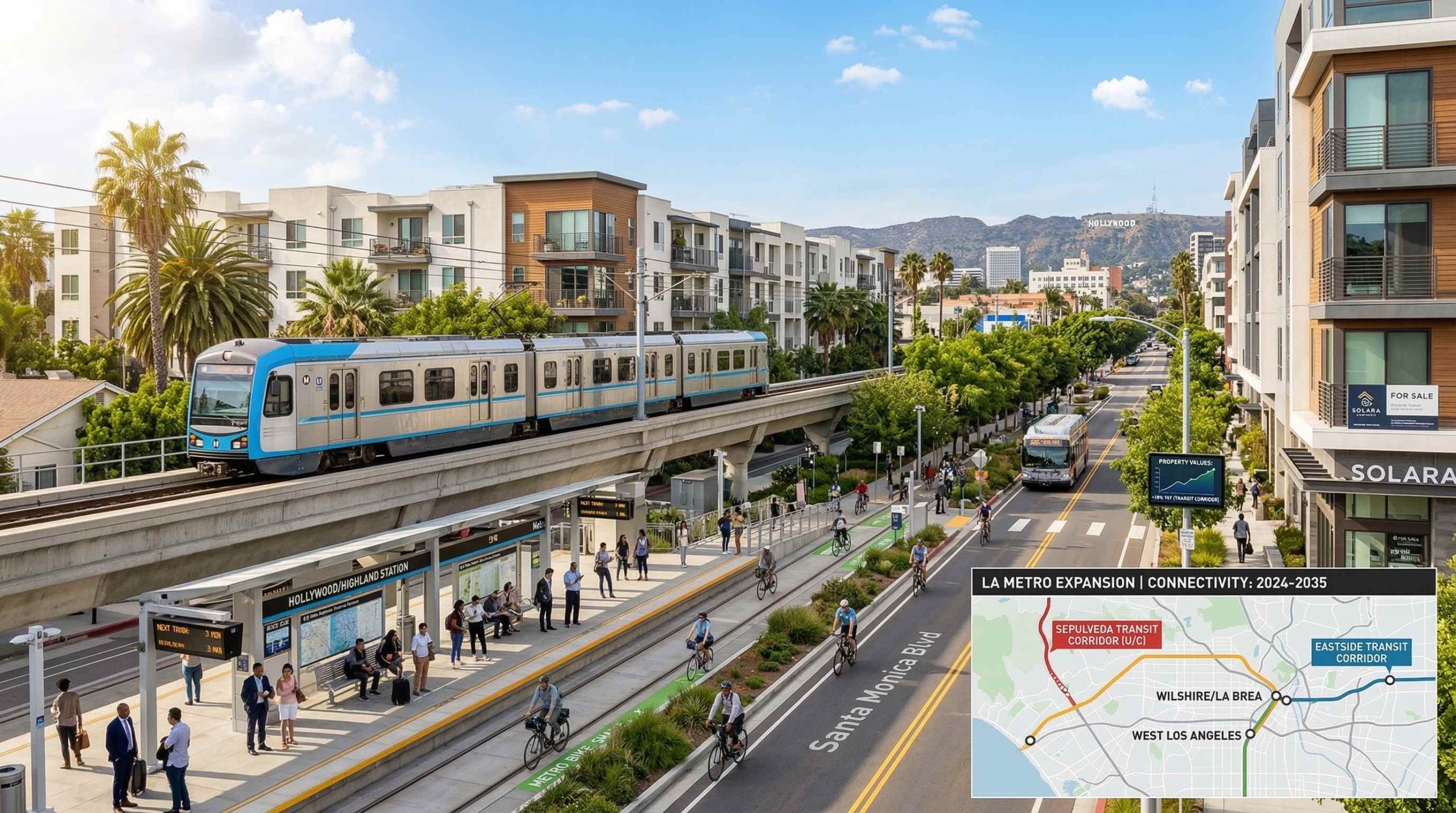
That kind of investment signals something. When a transit agency puts that much development right next to a station, the whole area around it tends to follow. Buyers and investors who get into neighborhoods like NoHo before that development is built are often the ones who benefit most from the jump in values that comes after.
What to Look for When Buying Near a Metro Line
The Checklist That Can Help You Buy Smart
Not every home near a Metro station is a good buy. Here are the things worth thinking through before you make an offer near a transit line in LA.
- How far is the home from the actual station entrance, not just the rail line? Walking distance matters most.
- Is the area getting new businesses and development, or has it been the same for years without change?
- Are there new Metro extensions or station upgrades planned nearby in the next 5 years?
- What direction is crime trending? Improving neighborhoods near transit usually see declining crime rates over time.
- Is the neighborhood zoning changing to allow more density near the station? That usually brings development and higher values.
- What are comparable homes selling for within a half mile versus a full mile? The gap tells you how much the station is worth.
- Is there street level walkability like grocery stores, cafes, and parks within easy reach of the station?
If you are also considering selling a current property to move near a better connected area, working with cash home buyers in Los Angeles can help you move quickly and close on your timeline without waiting for a financed buyer to get their loan sorted.
A Side by Side Look at Transit-Connected vs Non-Transit Neighborhoods
Here is a general comparison to show how transit access tends to affect key real estate factors in LA neighborhoods. Numbers are illustrative based on current market patterns.
| Factor | Near Metro Station (Half Mile) | No Transit Access (Car Dependent) |
|---|---|---|
| Buyer demand | Higher, broader pool of buyers | Limited to car owners |
| Home price stability | Stronger during market dips | More vulnerable to drops |
| Rental vacancy rate | Lower, renters seek transit access | Higher in some markets |
| Appreciation over time | Often above area average | Tracks broader market only |
| Days on market | Typically shorter | Can sit longer |
| Future development nearby | More likely with transit oriented zoning | Less infrastructure investment |
Where the LA Metro Is Going Next and What That Means for Buyers
The 2028 Olympics Effect and LA Transit Investment
With the 2028 Olympics coming to Los Angeles, there is a serious push to improve transit across the city. Billions of dollars are going into rail and infrastructure projects right now. That means neighborhoods along new and expanded lines are going to get more attention from buyers and developers over the next several years.
According to the LA Metro website, projects currently underway or in planning include the C Line extension toward Torrance, the K Line northern extension, and the long-anticipated Sepulveda Transit Corridor linking the San Fernando Valley to the Westside. Each of these carries real estate implications for the neighborhoods they will serve. Buyers who understand transit planning can get ahead of the curve.
Inglewood Shows What Transit Investment Can Do for a Market
Inglewood might be the clearest current example in LA of how transit investment combines with other factors to transform a market. Between SoFi Stadium, the Intuit Dome, and the K Line connection to LAX, Inglewood has become one of the most watched markets in Southern California. Property values near the Century Boulevard and Prairie Avenue corridors have already risen, and most analysts believe there is more growth ahead as additional development follows the transit investment.
If you are thinking about buying in an area like Inglewood or anywhere else in LA where transit is changing the equation, our team works with buyers and sellers across the region. You can also explore our investment opportunities page to see what we are watching right now in the LA market.
For buyers who want to learn more about how the sales process works from start to finish, our step by step escrow guide walks through what to expect when you are ready to close on a home in California.
According to the National Association of Realtors quarterly housing report, home prices rose in 73 percent of metro markets in the fourth quarter of 2025, with transit access remaining one of the strongest predictors of sustained value in competitive urban markets.
Conclusion
New Metro lines are not just a transportation story. They are a real estate story. In Los Angeles, where driving is a constant battle, access to reliable rail transit adds real and lasting value to the homes near it. Whether you are buying your first home or looking for your next investment property, paying attention to where the Metro is going is one of the smartest moves you can make in this market.
If you have questions about buying or selling near a transit corridor in LA, our team is here to help. Get in touch with us today and let us talk through what makes sense for your situation.
Frequently Asked Questions
Does living near a Metro station increase home value in Los Angeles?
Yes, in most cases it does. Homes within a half mile of a Metro station tend to attract more buyers, command higher rents, and hold their value better during market downturns compared to homes in car dependent areas farther from transit.
Which LA Metro line has had the biggest impact on property values?
The Metro L Line (Gold Line) through Northeast LA, including Highland Park and Pasadena, is often cited as one of the most impactful transit lines for real estate in LA. Those neighborhoods have seen major price growth since the line improved connectivity to DTLA. The K Line through Inglewood and the Crenshaw Corridor is the one to watch now.
What neighborhoods in LA will benefit most from new Metro lines?
Areas along the D Line (Purple Line) extension, including Westwood and Century City, and neighborhoods near the planned K Line northern extension and Sepulveda Transit Corridor are expected to see the most impact. Inglewood is also still in the early stages of a larger shift driven by transit and stadium development.
How close to a Metro station should I buy to get the best property value benefit?
The strongest impact on property values is felt within a half mile, roughly 10 minutes walking, of a Metro station. Beyond that, the effect gradually decreases, though neighborhoods within a mile still tend to benefit from improved transit access and overall neighborhood momentum.
Is now a good time to buy near a Metro corridor in Los Angeles?
For buyers who are thinking long term, getting into a transit corridor before major development arrives tends to offer the best value. With new lines being built ahead of the 2028 Olympics, several LA neighborhoods are still in the early stages of their transit driven appreciation. Talking with a local real estate professional who understands the market can help you time your move well.