
A few years back, having multiple generations living under one roof was seen as a last resort. Maybe grandma needed help. Maybe a grown kid could not afford their own place. But something shifted. In Los Angeles, multi-generational living has gone from a backup plan to one of the smartest real estate moves a family can make right now.
What a Multi-Generational Home Actually Is
A multi-generational home is a property where two or more generations of a family live together. That could mean grandparents, parents, and kids sharing a main house. It could mean an adult child living in a secondary suite or ADU on the same lot. It could also mean a family buying a property with two separate units so everyone has space but stays close.
These homes are not just a bigger version of a regular house. They are designed to give each generation some privacy while keeping the family connected. Think separate entrances, second kitchens, private bathrooms, and flex rooms that can shift purpose over time.
In Los Angeles, with its sky-high property values and tight housing supply, this setup is making more and more sense for a lot of families.
How Common Multi-Generational Living Has Become
According to the National Association of Realtors, multi-generational home purchases hit an all-time high in 2024. That year, 17% of all homebuyers chose homes that could accommodate multiple generations, up from 14% the year before. The top reason given was cost savings.
That number is only going to keep climbing in LA. The cost of buying a separate home for every family member is simply not realistic for most people. The average home value in the Los Angeles area is near $972,837 according to market data from 2025. That figure makes the idea of pooling resources and buying one well-designed property together a genuinely smart financial decision.
Why LA Families Are Choosing This Setup More Than Ever
Honestly, the financial pressure alone would be enough to explain the shift. But it goes deeper than that. A lot of LA families, especially those with cultural traditions of extended family living, have always valued keeping relatives close. The financial reality just finally caught up with what many already wanted.
There is also the caregiving side. When aging parents are nearby, coordinating their care is so much easier. When grandparents live on the property, built-in childcare becomes possible. These are real daily benefits that a lot of families deeply value, and they do not show up in any cost calculation but matter just as much.
The Financial Case for Multi-Generational Homes in LA
Let me be direct about the money side because this is where things really get interesting for LA buyers and sellers alike.
When two or more family units are sharing a mortgage, the qualifying income goes up significantly. That means families can reach price points they simply could not access individually. A single-income household that could qualify for a $600,000 property might, with a combined family income, qualify for a $950,000 home that includes an ADU or secondary suite.
Beyond the purchase side, the ongoing costs get shared too. Mortgage, utilities, insurance, and maintenance costs split between two family units is a very different monthly commitment than each unit bearing everything on their own.
ADUs and Secondary Suites Add Real Resale Value
In Los Angeles, accessory dwelling units have gone from a bonus feature to a major value driver. California state law has made it easier than ever to build ADUs, and buyers know it. A property with a legally permitted ADU or secondary suite commands a meaningfully higher price than a comparable single-unit property.
According to data from the California Department of Housing and Community Development, ADU production in California has grown dramatically since the state relaxed ADU laws in 2017 and updated them again in 2020. Los Angeles County has led the state in ADU permits. That production has made properties with ADUs more recognizable and desirable to buyers who understand their flexibility.
If you are planning to sell a property that already has a secondary suite or ADU, you have a real edge. Buyers looking for multi-generational setups are actively searching for these properties and will often pay more for them because they are harder to find in move-in-ready condition.
How a Multi-Generational Property Compares to a Standard Home Sale
Here is a practical comparison to show why these properties carry different weight in the market.
| Feature | Standard Single-Family Home | Multi-Generational Property with ADU |
|---|---|---|
| Buyer pool | General homebuyers | Families, investors, and multi-gen buyers |
| Income potential | None beyond personal use | ADU can generate $1,500 to $3,000+ monthly rent |
| Resale appeal | Standard | Higher, especially post-2020 ADU law changes |
| Qualifying income for buyers | Single-unit buyer income | Combined family income or ADU rental income counted |
| Mortgage flexibility | Standard | Some lenders allow ADU income in qualification |
What to Look For When Buying a Multi-Generational Home in LA
Not every big house with an extra bedroom qualifies as a good multi-generational setup. The difference between a property that works well for multi-gen living and one that causes constant friction is in the details.
The most important thing is privacy for each generation. That means separate entrances, ideally. A family that has to walk through grandma’s living room to get to the kitchen is going to have a harder time making it work long-term than one where each unit has its own front door.
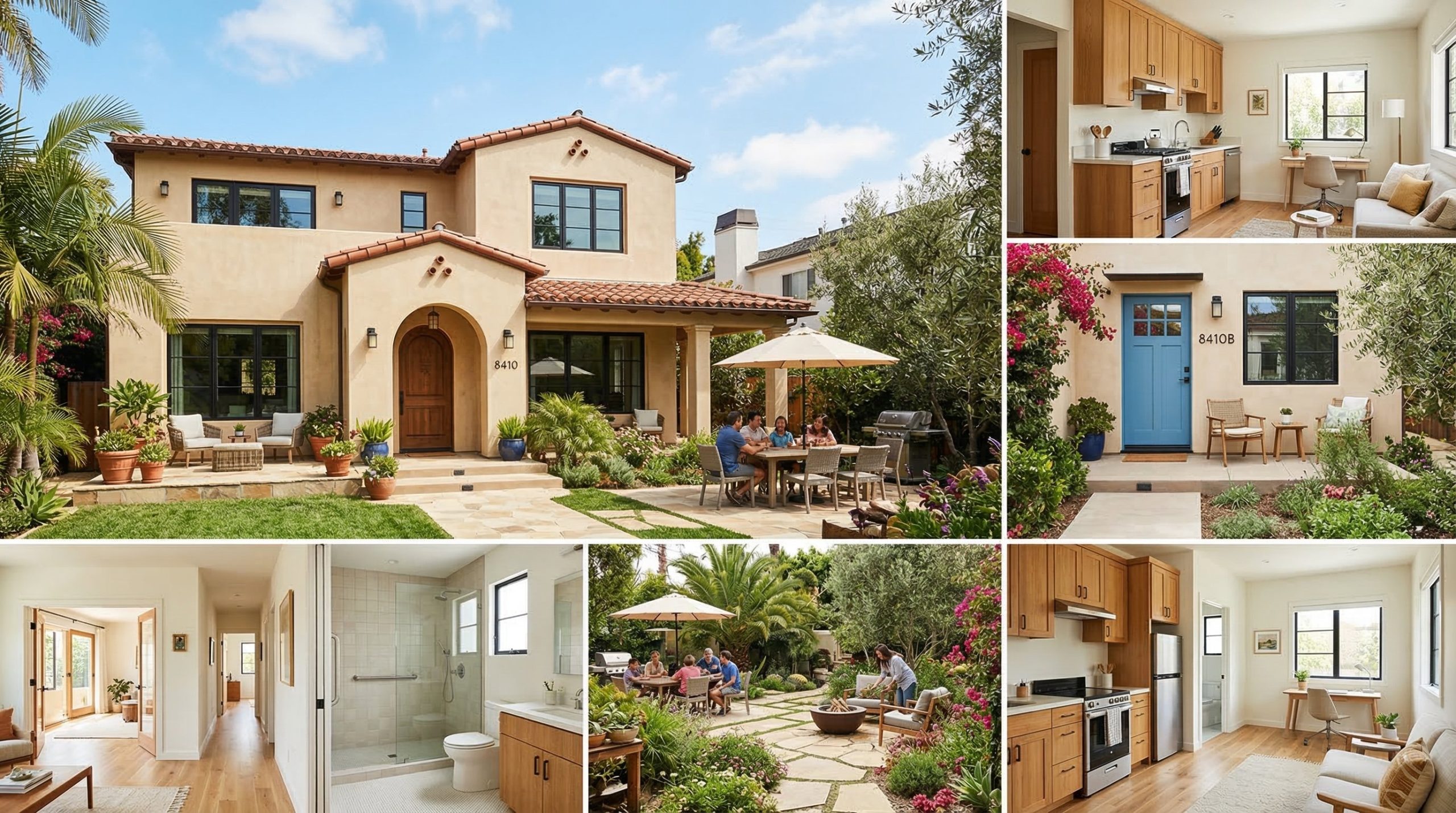
Here are the features that matter most when evaluating a property for multi-generational use.
- Separate entrances for each living unit, ideally with exterior access so no one has to pass through another family’s private space.
- At least one full bathroom per generation, with a second bathroom strongly preferred for each unit.
- A kitchenette or full second kitchen in the secondary suite so meal preparation stays independent.
- A flexible floor plan that allows rooms to shift between office, guest room, and living space as the family’s needs change over time.
- Accessibility features like single-level living, wide doorways, and walk-in showers if elderly family members will be part of the household.
- Outdoor space that can be divided or shared, with a patio or garden area that allows both togetherness and separate use.
Zoning and Permit Considerations in Los Angeles
Before you buy or build with multi-generational use in mind, you need to understand the zoning on the property. Not all LA lots allow ADUs, and the rules vary by city within the county. Los Angeles City, Pasadena, Santa Monica, and other incorporated cities each have their own ADU ordinances that govern what is allowed in terms of size, setbacks, and number of units.
The Los Angeles Department of Building and Safety is the starting point for checking permit requirements and zoning on any specific property. If you are buying with the intent to add a secondary suite or convert an existing garage or room, verify the zoning allows it before you commit to the purchase.
Unpermitted units create real problems at sale time. A buyer with a lender will often find that unpermitted spaces cannot be counted in the appraised value, and some lenders will not fund the loan at all if there are open permits or code violations. Getting the structure permitted properly protects both the family using it and the value of the asset when it comes time to sell.
If you own a multi-generational property in LA and are thinking about what it could sell for, our team works with properties of all configurations. Read our page on selling your house fast in Los Angeles for more on how we approach properties like this.
If you want to understand how a multi-gen property compares to a standard sale in terms of speed and net proceeds, our post on traditional versus cash home sales breaks that down clearly.
For questions about what your specific multi-generational property could be worth and how we can help you sell it quickly, reach out through our contact page.
Conclusion
Multi-generational homes have become one of the most practical and financially sound ways for LA families to handle the city’s housing costs without giving up quality of life. Whether you are buying one, already living in one, or thinking about selling a property that would make a great multi-gen setup, the market is on your side right now.
The demand is real, the financial advantages are clear, and the ADU-friendly laws in California have made these properties more valuable and more accessible than at any point in recent history. If you have one of these properties and are ready to sell, you are in a strong position.
Frequently Asked Questions
What counts as a multi-generational home in Los Angeles?
A multi-generational home is any property where two or more generations of a family can live with some level of privacy and separation. In LA, this usually means a main house with a separate ADU, an in-law suite with its own entrance and bathroom, a duplex where family members occupy separate units, or a large single-family home with a clearly divided layout. The key features are separate living spaces, ideally separate entrances, and enough privacy that each generation has genuine independence.
How much more is a multi-generational home worth compared to a regular home?
It depends heavily on the neighborhood and the quality of the secondary unit. A legally permitted ADU in Los Angeles can add $150,000 to $400,000 or more to a property’s value depending on size, condition, and location. Properties with ADUs also attract a larger pool of buyers, which can drive competitive offers. The rental income potential is also factored in by many buyers, especially investors and families who plan to use the ADU income to offset their mortgage.
Can an ADU rental income help qualify for a mortgage in California?
Yes, in many cases. Fannie Mae and some California-based lenders allow borrowers to count anticipated or existing ADU rental income as part of their qualifying income when applying for a mortgage. This can meaningfully increase how much a buyer can borrow and has made multi-generational properties more accessible for families who plan to rent one unit while living in the other. Rules vary by lender, so it is worth asking your loan officer specifically about ADU income treatment.
What are the best neighborhoods in LA for multi-generational homes?
Neighborhoods with larger lot sizes and more flexible zoning tend to work best for multi-generational setups. Areas like the San Fernando Valley, Eagle Rock, El Sereno, Glassell Park, and parts of the South Bay have historically offered larger lots where ADUs are practical. Some hillside neighborhoods have more zoning restrictions, so checking the specific property’s zoning before buying is important. Neighborhoods with good school access, walkability, and proximity to hospitals also tend to be popular with multi-gen buyers who need to serve multiple age groups in the family.
Is it better to build an ADU or buy a property that already has one?
Both have advantages. Buying a property with an existing permitted ADU saves you time, the cost of construction, and the uncertainty of the permitting process. However, existing ADUs may be dated or may not match exactly what your family needs. Building a new ADU gives you full control over the design and amenities but involves permits, construction timelines of 6 to 18 months, and costs ranging from $100,000 to $300,000 depending on size and finishes. For most families who want to move in and start using the setup right away, an existing ADU is the more practical choice.