
Buying a home as a single mom feels impossible sometimes. You’re managing everything on your own — the bills, the kids, the future. But here’s what most people don’t tell you: there is real money out there designed specifically to help you buy a home. You just need to know where to look.
What Are Home Grants for Single Mothers?
How Housing Grants Actually Work
A home grant is money given to you that you don’t have to pay back. It’s not a loan. There’s no interest and no monthly payment attached to it. The government, nonprofits, and housing agencies set this money aside specifically for people who need help buying a home.
For single mothers, these grants are often tied to your income. If you earn below a certain amount — usually 80% of the area median income (AMI) in your county — you likely qualify. That’s a bigger group than most people realize.
I’ve spoken with single moms who thought they made “too much” to qualify. Once they actually checked the income limits in their area, they found they were well under the threshold. Don’t assume you don’t qualify before you check.
Are These Programs Just for First-Time Buyers?
A lot of first-time homebuyer programs define “first-time” more loosely than you’d think. If you haven’t owned a home in the last three years, you count as a first-time buyer under most federal and state programs — even if you owned a home with a former partner years ago.
That means millions of single mothers who owned a home during a marriage or relationship can still qualify today. This is one of the most overlooked facts in the entire homeownership assistance world.
Top Federal Grant and Assistance Programs for Single Moms
HUD Programs That Can Help You Right Now
The U.S. Department of Housing and Urban Development (HUD) runs several programs that single mothers can directly benefit from. One of the most useful is the Section 8 Homeownership Voucher Program. If you already receive a Section 8 housing voucher, you may be able to convert it toward buying a home instead of renting.
This doesn’t work in every county, but in places where it does, it can cover part of your monthly mortgage payment. According to the U.S. Department of Housing and Urban Development, the homeownership voucher program is specifically designed to help low-income families — including single parents — transition from renting to owning.
HUD also funds HUD-approved housing counselors who work for free. These are real people who sit down with you, look at your full financial picture, and connect you with every grant and program you qualify for in your area. I honestly think this is the most underused resource out there for single moms.
USDA and FHA Loans: Low and No Down Payment Options
If you live outside a major city or in a smaller town, the USDA Rural Development loan is worth serious attention. It requires zero down payment. Zero. And a big portion of the United States qualifies as a USDA-eligible rural area — including many suburbs that don’t feel rural at all.
The FHA loan is the most popular option for single mothers in cities and suburbs. You only need a 3.5% down payment with a credit score of 580 or higher. On a $200,000 home, that’s just $7,000 down. Pair it with down payment assistance and your out-of-pocket cost can drop even further.
Here’s a quick look at how the main loan options compare for single mothers:
| Loan Type | Min. Down Payment | Min. Credit Score | Best For |
|---|---|---|---|
| FHA Loan | 3.5% | 580 | Single moms in urban/suburban areas |
| USDA Loan | 0% | 640 | Buyers in eligible rural areas |
| VA Loan | 0% | 580–620 | Veterans and military single moms |
| Conventional 97 | 3% | 620 | Buyers with decent credit |
State and Local Home Grants Available to Single Mothers
How State Housing Finance Agencies Help
Every state has its own Housing Finance Agency (HFA). These agencies manage programs specifically designed for buyers who need extra help — and single mothers are often at the top of the priority list.
Most state programs offer down payment assistance (DPA) as either a grant or a forgivable loan. A forgivable loan means if you stay in the home for a set number of years — usually 5 to 10 — the loan disappears. You never pay it back.
Some examples from real state programs:
- California: CalHFA offers up to 3% in down payment assistance through the MyHome Assistance Program
- Texas: TDHCA’s My First Texas Home gives up to 5% in help paired with a 30-year fixed mortgage
- Florida: The Florida Homeownership Loan Program (FL HLP) offers a $10,000 second mortgage at 3% interest
- Ohio: OHFA’s Your Choice! Down Payment Assistance gives 2.5% or 5% with forgiveness after 7 years
- North Carolina: NCHFA’s NC 1st Home Advantage gives $15,000 in forgivable assistance to qualifying first-time buyers
These programs change as funding comes and goes, so always check directly with your state HFA or a HUD-approved counselor for the most current information.
Nonprofit and Community Grant Programs for Single Moms
Beyond the government, nonprofit organizations are a huge source of housing help for single mothers. Habitat for Humanity is the most well-known. They work with qualifying families — including single moms — to build or renovate homes. You contribute sweat equity (your own labor), and in return, you get an affordable mortgage with no profit built in.
I once read about a single mom in Ohio who moved into her Habitat home after working 400 hours alongside volunteers to build it. She said it wasn’t just the home that changed her life — it was the sense of ownership she felt because she helped build it herself.
According to Habitat for Humanity, they’ve helped more than 39 million people access affordable housing worldwide — many of them single-parent households.
Other nonprofits to look into include NeighborWorks America, local Community Development Corporations (CDCs), and church-affiliated housing programs in your area.
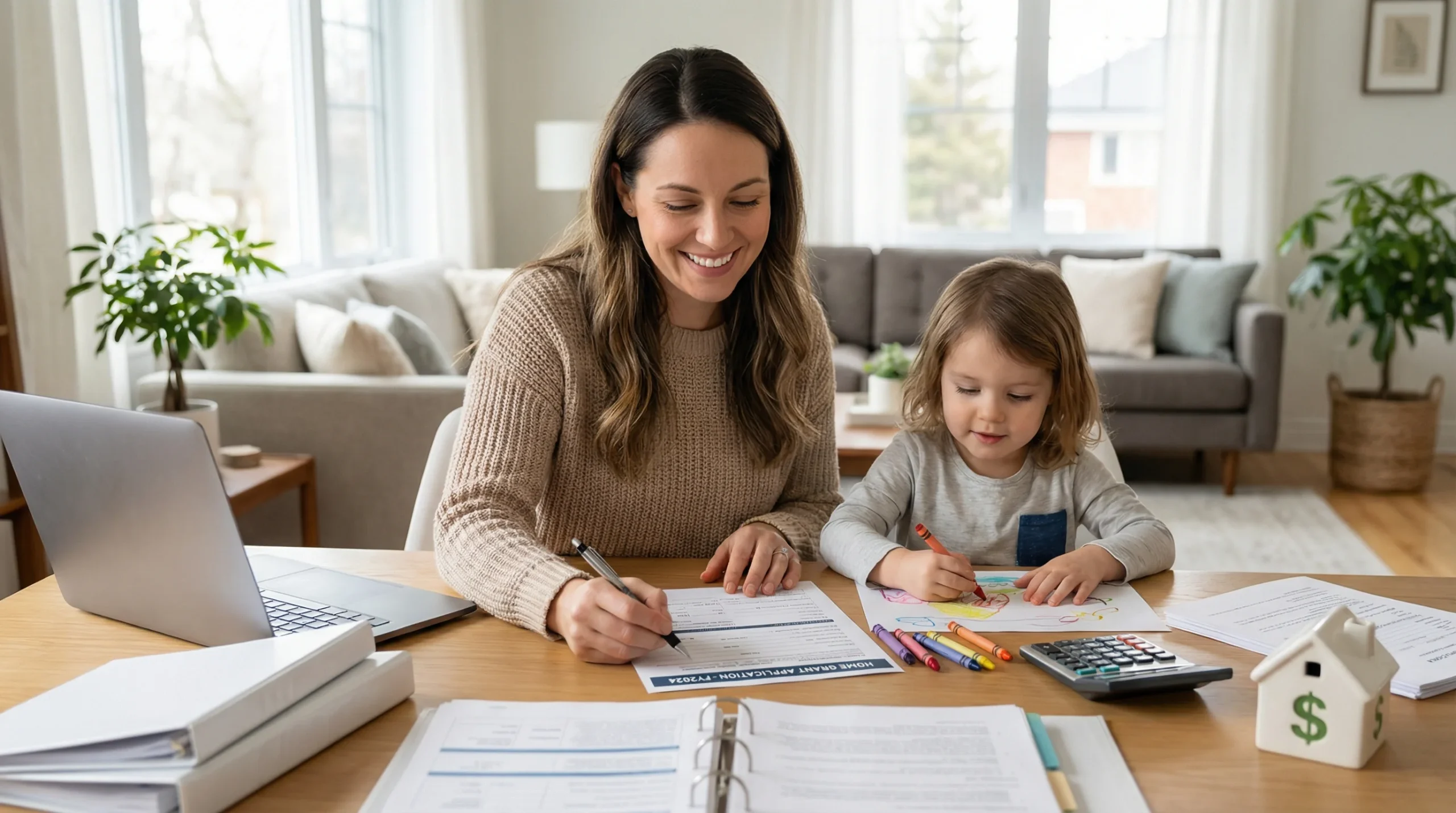
How to Qualify and Apply for Home Grants as a Single Mother
What Most Programs Look For
The requirements vary by program, but most home grant and assistance programs look for the same core things. Here’s what you’ll generally need to have ready:
- Income verification: Pay stubs, tax returns, and proof of any child support or alimony received
- Credit score: Most programs require at least 580–640, but some have no minimum
- Debt-to-income ratio: Usually below 43–50% of your gross monthly income
- Primary residence requirement: You must plan to live in the home you buy
- Homebuyer education: Most programs require a HUD-approved course — usually available online
- Citizenship or legal residency status
The homebuyer education course sounds boring, but honestly, it’s worth doing even if you don’t end up using a specific program. It walks you through the full buying process — what to expect, what questions to ask, what costs are coming.
Step-by-Step: How to Get Started Today
Getting started is simpler than most people expect. You don’t need to figure it all out at once. Here’s a practical path forward:
First, check your credit score for free using AnnualCreditReport.com. Look for any errors and dispute them — even one wrong item can drag your score down. Second, contact a HUD-approved housing counselor. They’re free and they do exactly this for a living. You can find one at HUD’s website by searching for counselors in your zip code.
Third, find out your state’s Housing Finance Agency and browse their current programs. Fourth, get pre-approved with a lender who participates in the program you want to use. The pre-approval shows you exactly how much you can borrow and tells sellers you’re serious.
If you’re exploring your options and want personalized guidance on next steps, contact us today — we work with buyers in all kinds of situations and can help you figure out the best path forward.
Extra Programs Single Mothers Should Know About
The Good Neighbor Next Door Program
If you work as a teacher, nurse, police officer, firefighter, or EMT, the Good Neighbor Next Door program from HUD gives you a 50% discount on homes in designated revitalization areas. That’s half price on a government-owned home — and you only need to commit to living there for three years.
For a single mom in one of these professions, this can be life-changing. A home listed at $150,000 becomes $75,000. That gap alone could mean the difference between renting forever and owning a home for your family.
According to HUD’s Good Neighbor Next Door program page, available homes are listed each week on HUDHomeStore.hud.gov, and eligible buyers get exclusive access during the first 7 days of the listing period.
Mortgage Credit Certificate (MCC): Save on Taxes Every Year
The Mortgage Credit Certificate (MCC) is one of the most overlooked benefits for first-time buyers. It’s not a grant — it’s a federal tax credit. Every year you own the home, you get a credit of up to $2,000 applied directly to your federal tax bill. Over a 15-year period, that’s up to $30,000 in savings.
Many state HFAs offer MCCs alongside their down payment programs. Ask your lender or housing counselor specifically about whether an MCC is available in your state. It has to be applied for at the time of purchase — you can’t add it later.
If you want to understand how other loan programs like FHA loans work alongside these grants, our guide on FHA loan requirements and benefits walks through all the details in plain English. And if you’re also researching state-specific programs, our article on Ohio first-time buyer tax credits is a helpful example of how powerful these state programs can be.
For buyers thinking through the bigger picture of homeownership, you might also find it helpful to explore how selling a property works — especially if you’re transitioning from a previous home situation.
Conclusion
As a single mother, you deserve a home that’s yours. The money and programs are real — HUD housing grants, state down payment assistance, FHA and USDA loans, nonprofits like Habitat for Humanity, and special discounts like the Good Neighbor Next Door program. The key is knowing these tools exist and taking the first step to explore them. Talk to a free HUD-approved counselor, check your state housing agency, and get your credit score ready. Homeownership as a single mom is not a dream — it’s a plan waiting to happen.
Frequently Asked Questions
Can a single mother get a grant to buy a house?
Yes. There are federal, state, and nonprofit grant programs designed to help low- to moderate-income buyers — including single mothers — cover down payment and closing costs. Many of these grants are forgivable, meaning you never have to pay them back if you stay in the home for the required period.
What credit score does a single mom need to buy a house?
Most programs require a minimum credit score of 580 to 640. FHA loans accept scores as low as 580 with a 3.5% down payment. Some programs have no minimum credit score if you meet other requirements. Even a score in the low 600s opens up a lot of options.
What is the easiest home loan for a single mother to get?
The FHA loan is generally the most accessible for single mothers because it has the lowest credit score and down payment requirements. If you’re a veteran or active military, the VA loan is even better — zero down payment and no mortgage insurance.
Does Habitat for Humanity give free houses to single moms?
Habitat for Humanity doesn’t give free houses — they sell them at an affordable price with a zero-profit mortgage. You contribute sweat equity (your own labor during building), and in return you get a home you can afford. It’s not free, but it’s built around what you can actually pay.
How do I find home grants for single mothers in my state?
Start by contacting a HUD-approved housing counselor — they’re free and know every program available in your area. You can also search your state’s Housing Finance Agency (HFA) website directly. Most states list all current programs, income limits, and participating lenders in one place.