
If you’re searching how cash home buyers work, you’re probably trying to sell with fewer headaches: no repairs, fewer delays, and a cleaner closing.
A cash home buyer is simply a buyer who can purchase your property without relying on a traditional mortgage. That usually means fewer financing steps and fewer lender-driven delays. Cash buyers can close faster and avoid appraisal or financing contingencies, which can matter when sellers want speed and certainty.
This guide breaks down the real process, what documents you should ask for (especially proof of funds), and how to spot red flags so you do not get trapped by a bad deal.
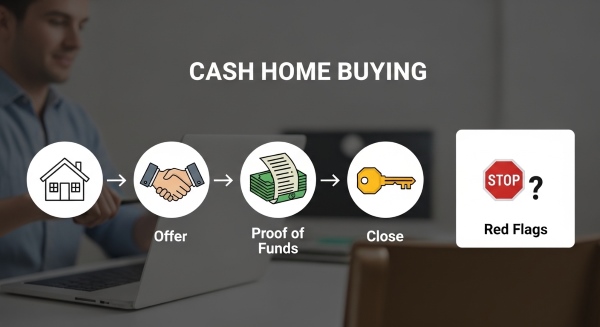
What does “cash offer” actually mean?
A cash offer means the buyer has access to enough funds to buy your home without needing a bank loan to approve the purchase.
That does not automatically mean:
- the buyer is “better” than all financed buyers
- the deal has zero paperwork
- the buyer will not negotiate
It usually means the process can be simpler because it removes lender underwriting, mortgage conditions, and many financing delays.
How cash home buyers work (the step-by-step process)
Most cash sales follow a straightforward path:
Step 1: You share basic property details
You typically provide:
- address
- property type, beds/baths
- condition (repairs needed, updates, damage)
- occupancy (vacant, owner-occupied, tenant-occupied)
- your timeline (how fast you want to close)
Step 2: The buyer reviews the home (sometimes a quick walk-through)
Many buyers will do a short visit or request photos to confirm condition.
Step 3: You receive a cash offer
A cash buyer usually makes an offer based on:
- local comparable sales
- visible condition and repair costs
- holding costs and resale risk (for investors)
- your timeline and any title issues
Step 4: You sign a purchase agreement
This is where you should slow down and check the terms:
- closing date
- earnest money
- contingencies (inspection, title, etc.)
- who pays which closing costs
- whether the buyer can assign the contract (important)
Step 5: Title and escrow start (this is where safety matters)
Once both sides agree, the transaction typically goes into escrow with a title/escrow company (or attorney closing, depending on the state).
“Close of escrow” is the point where the sale is legally complete: funds are disbursed and the deed is recorded.
Step 6: Title search, payoff, and final numbers
The title company checks for:
- liens
- unpaid taxes
- ownership issues
- HOA issues (if any)
Then they prepare a settlement statement showing the money flow.
Step 7: Closing day and getting paid
You sign closing documents, the deed is recorded, and funds are disbursed.
Timeline note: Many sources report cash deals can close much faster than financed deals, sometimes in about 1–2 weeks, depending on title work and scheduling.
Why cash sales are often faster than financed sales
A traditional financed sale can slow down because of:
- lender underwriting
- appraisal requirements
- loan conditions and re-checks
Cash buyers often avoid appraisal and financing contingencies, which is one reason sellers may prefer them when speed and certainty matter.
Proof of Funds (POF): what it is and why you must ask for it
A proof of funds document shows the buyer actually has the money available to buy the home.
BYP defines proof of funds as documentation showing how much money a person or entity has available, and notes it is used to prove a buyer can cover purchase costs.
What a real proof of funds should include
A good POF typically shows:
- bank name
- available balance (enough to cover purchase)
- account holder name or entity name (sometimes partially masked)
- date (recent)
What you should NOT accept as “proof”
Be cautious if a buyer sends:
- a blurry screenshot with no bank name
- a statement that is very old
- “proof” that does not match the buyer name or entity
- a document that looks edited
Simple rule: If the buyer is real, POF is easy.
The most common cash buyer terms you should understand
Earnest money
A deposit held in escrow to show the buyer is serious. If a buyer refuses earnest money without a clear reason, ask why.
Contingencies
Conditions that let the buyer renegotiate or walk away:
- inspection contingency
- title contingency
- “partner approval” or vague contingencies (be careful)
Assignment clause
Some buyers assign contracts. This is not always bad, but you should understand it before signing. If you want certainty, negotiate assignment limits.
Escrow and close of escrow
Escrow is the process that holds paperwork and funds until conditions are met. Close of escrow is when the deal is legally complete, funds are disbursed, and the deed is recorded.
Cash offer scams and red flags to watch for
Most cash buyers are legitimate, but scams exist. Here are the biggest red flags:
1) Upfront fees or pressure to wire money
In a normal sale, most costs are settled at closing, not before. If someone asks you to pay a “processing fee,” “inspection fee,” or demands a wire transfer before signing proper paperwork, treat it as a major warning sign.
The FTC warns homeowners about scams that demand upfront fees in the mortgage relief context, and advises not to pay upfront for promised results.
Even if your situation is not mortgage relief, the pattern is similar: urgent promises + upfront payment is a classic scam structure.
2) “Sale-leaseback” offers that promise you can sell and stay safely
The FTC has specifically warned that sale-leasebacks are “far from risk-free,” even if ads make them sound safe.
If you are considering anything like this, get legal advice first.
3) They will not use a real title/escrow company
A legitimate closing typically runs through a title/escrow company or attorney (depending on state). If the buyer wants to avoid standard closing channels, stop and verify everything.
4) The offer changes at the last minute (“bait and switch”)
A common complaint in shady deals is: strong offer first, then huge price drop later. Protect yourself by:
- requiring clear reasons for any price changes
- limiting inspection windows
- using a reputable closing company
- getting everything in writing
5) Identity and title fraud
A Realtor association scam overview highlights title fraud and other real estate scams that can target clients.
If anything feels off about ownership, insist on proper identity verification through the closing company.
Seller safety checklist (copy this before you accept a cash offer)
Before you sign:
- Ask for proof of funds (recent and verifiable).
- Make sure the contract clearly states the closing date, who pays what, and all contingencies.
- Confirm the closing will be handled by a reputable title/escrow company.
- Avoid anyone asking for upfront fees or unusual wires.
- Read the assignment clause and make sure you understand it.
- Keep communication in writing (email or text) so terms are documented.
How BYP can help (fast, as-is option)
If you want a simpler route instead of listing, BYP describes a process focused on speed and convenience, including:
- no open houses
- no repairs, maintenance, or cleaning
- no commissions
- a cash offer and closing within a flexible timeline (Buy Your Properties)
FAQs: How cash home buyers work
How long does a cash home sale take?
It depends on title work and scheduling, but many cash deals can close in about 1–2 weeks in some cases, while financed deals often take longer due to lender steps.
Do cash buyers still do inspections?
Often yes. Even cash offers can include inspection periods. Your contract determines whether the buyer can renegotiate after inspection.
What is proof of funds and why do I need it?
Proof of funds is documentation showing a buyer has enough available money to complete the purchase. It helps you avoid fake buyers and reduces closing risk.
Can I sell my house as-is to a cash buyer?
Yes. Many cash buyers purchase properties in current condition. If you want the full as-is guide, internally link your as-is post:
What is close of escrow?
Close of escrow is when the transaction is legally completed: funds are disbursed and the deed is recorded.